
November 8, 2006 is a day that will live in culinary history. It’s the day The New York Times introduced millions of readers to no-knead bread.
No-knead breads (a.k.a. casserole breads) have actually been around for decades, since long before the Times’ Mark Bittman came out with his version (based on one from Sullivan Street Bakery’s Jim Lahey).
Remember cottage cheese dill bread, that ’60s standby? No-knead bread. English Muffin Toasting Bread, from the ’70s? No-knead. Sometimes it really is all in a name.
But the Times, with their vast reach—plus a recipe that produces chewy, artisan-style bread—re-popularized this yeast bread methodology. And since then, the no-knead craze has done nothing but gain steam (pun intended).
Prompted by the Times, we started fooling around with no-knead breads in the King Arthur test kitchen. And we’ve come up with a comprehensive array of recipes.
But there’s always room for more; we’ll be examining yet another no-knead method here in early June, and this one goes beyond crusty loaves to sticky buns and challah. So stay tuned; no-knead is still hot as a 450°F oven.
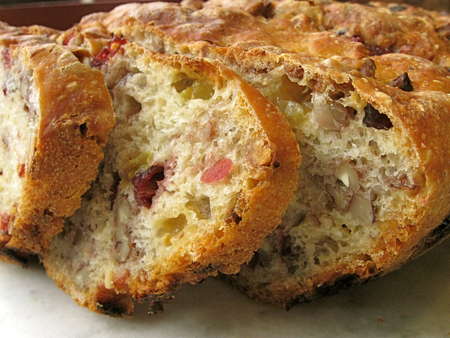
In the meantime, enjoy our No-Knead Harvest Bread. It’s packed with fruit and nuts, and especially dense and chewy—perfect for a schmear of cream cheese or (my favorite) softened Brie.
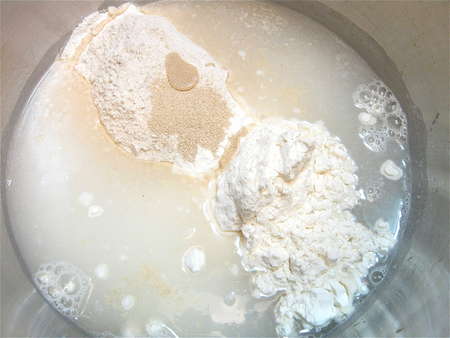
Quick, everybody, into the bowl! Lancelot (high-gluten) flour, white whole wheat flour, salt, instant yeast, and cool water. Can you use King Arthur all-purpose or bread flour here? Absolutely. Will your bread rise as high? Not quite… for the highest rise, try Lancelot. But don’t let its absence in your cupboard prevent you from baking this tasty bread.
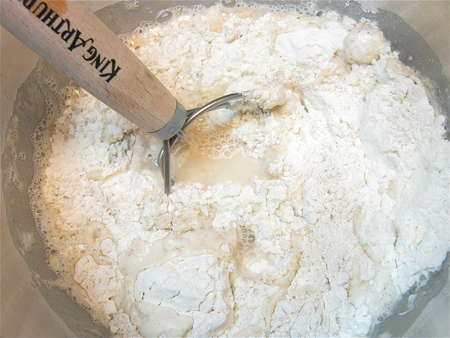
Mix it all up. Our dough whisk is the perfect tool for this wet, no-knead dough.
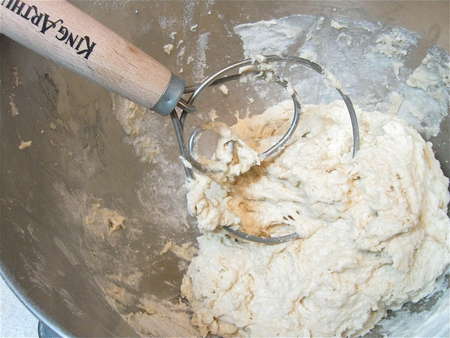
See the big loops? The dough doesn’t get caught on the whisk, yet it mixes beautifully.
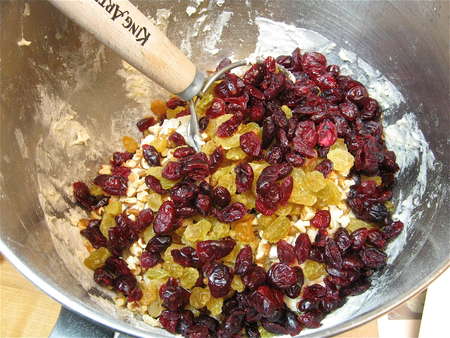
Once the flour and liquid are combined, mix in the fruit and nuts. I’m using golden raisins, cranberries, and pecans here.
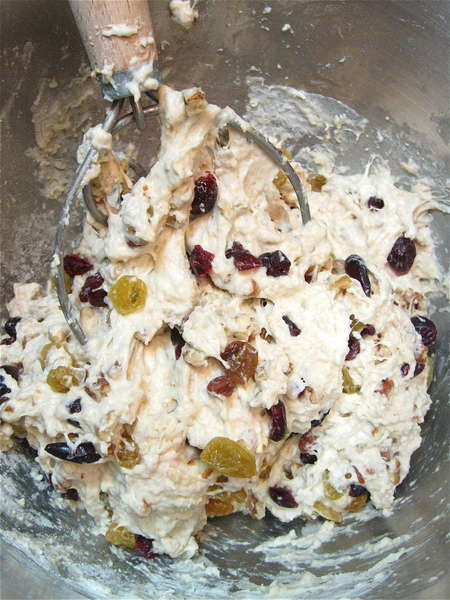
Again, the dough whisk does a super job. As would your hands… just wet them thoroughly to prevent too much stickiness.
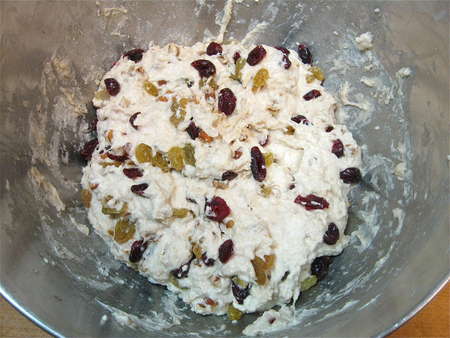
Scrape the dough into the center of the bowl, cover it, and let it rise for at least 8 hours, or overnight. This dough started its rise at 2:45 p.m. on a Thursday…
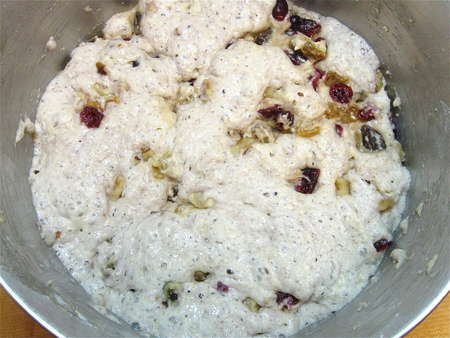
…and here it is at 7 a.m. Friday morning. Puffy, spongy, risen.
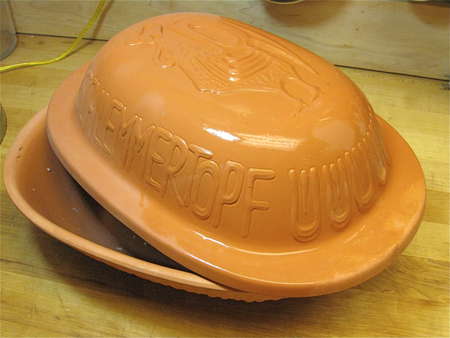
Next, select your pan. It needs to be something with a cover, like a Dutch oven or this German clay baker. You can see the cover looks wet; I’d soaked it, as that’s what the manufacturer’s directions call for. I made several subsequent loaves without soaking, and soaking does seem to add a bit of sheen to the crust, which makes sense: sheen comes from steam, steam comes from water, and there you have it—Bob’s your uncle. A soaked lid adds a satiny crust.
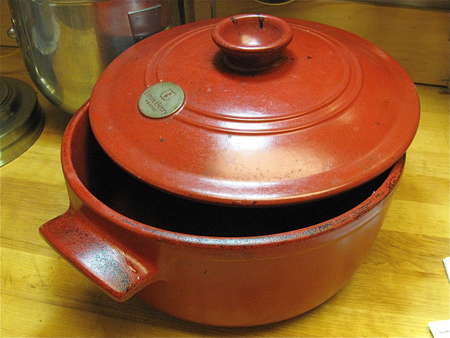
Or try a Dutch-oven shaped stoneware crock.
You can also fashion a cover out of foil for your favorite deep casserole dish.
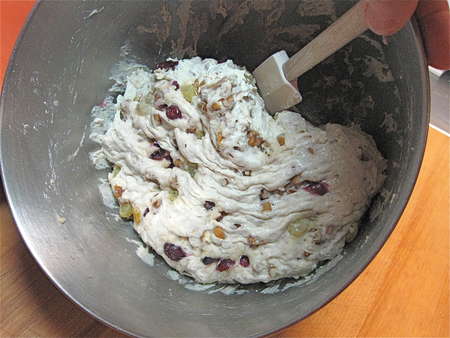
Gently stir down the dough…
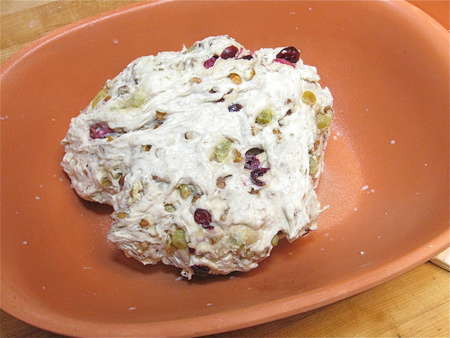
…and spoon it into the vessel of your choice.
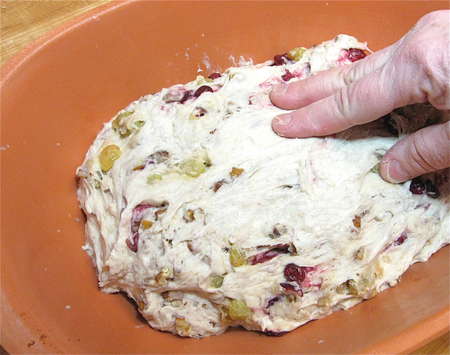
Wet your fingers, and gently press it to cover the bottom of the crock.
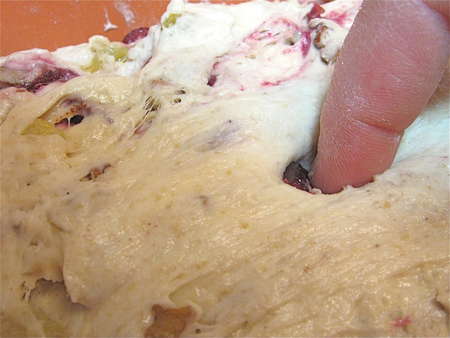
Take the time to poke any fruit down into the dough.
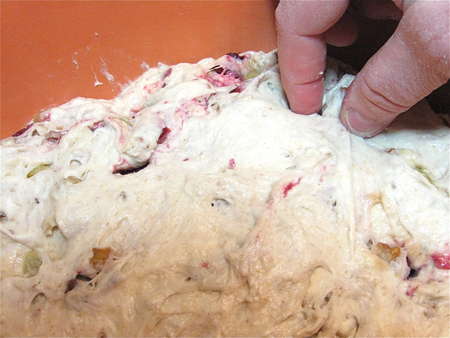
Any fruit sticking out on top will burn, so try to cover it all up, one way or another. Here I’m pinching dough over the top of a recalcitrant raisin.
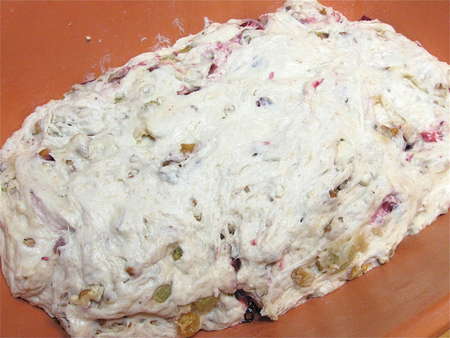
Don’t go crazy; just do the best you can.
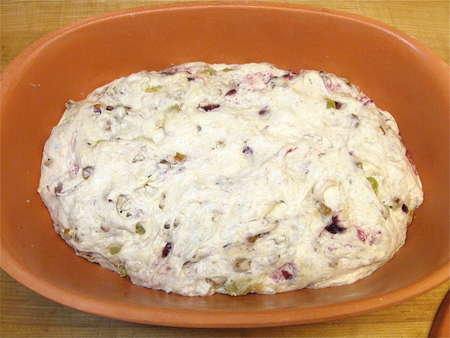
Ready to rise. Put the cover on the pan, and let the bread rest for 2 hours at room temperature. It’ll expand, but don’t expect a grand rise here. As I noted earlier, using high-gluten flour will produce the most robust rise; all-purpose flour, the smallest rise. All are fine; the AP flour loaf will simply be heavier/denser than the bread flour loaf, which will be heavier/denser than the high-gluten loaf.
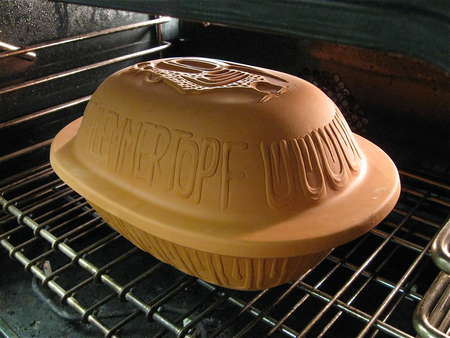
Cover the pan, and put the bread in a cold oven. Turn on the oven, with the temperature set to 450°F.
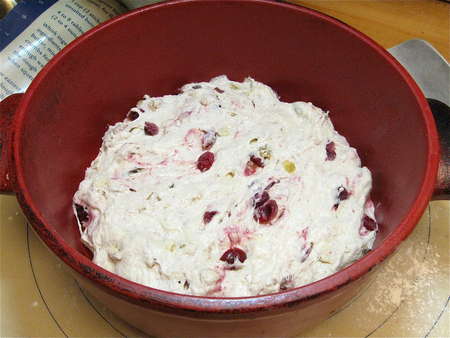
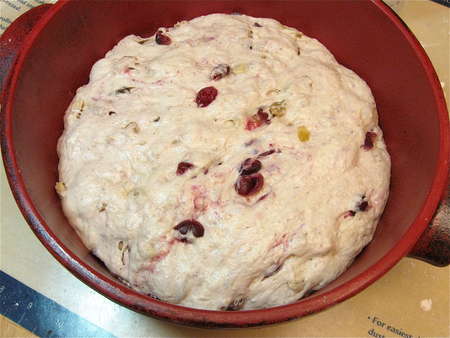
Here’s the dough, made with all-purpose flour, before it’s “risen.”
And here it is after 2 hours. Not a huge difference; more a matter of increased puffiness.
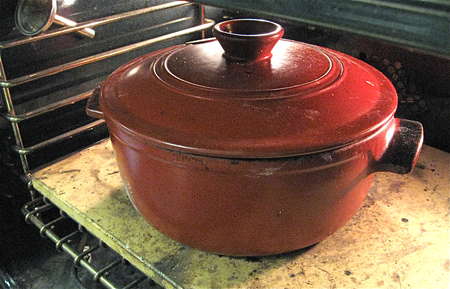
Into the cold over it goes.
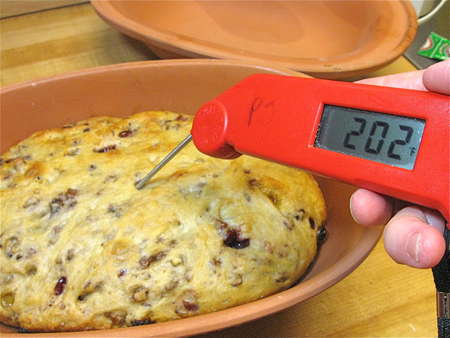
Forty-five minutes later, take the bread out, and remove the cover. take its interior temperature with an instant-read thermometer. A finished loaf will register 205°F at its center. As you can see, this one has a few degrees to go.
You might remember reading that a perfectly baked loaf of bread should be 190°F at the center. So what’s up with this 205°F? Dense breads—this bread, a heavy rye, a 100% whole wheat country loaf—need to be baked to a higher temperature at the center, to avoid any gumminess.
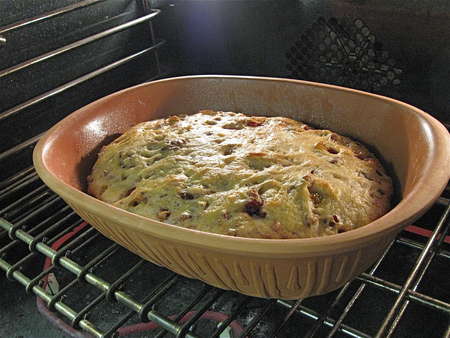
Back into the oven it goes—without its cover. If it could use some browning, leave it uncovered. If it’s brown enough, tent the pan with a sheet of foil. Why not simply replace the cover? Because you no longer want to trap any steam; at this point, it’s better for the bread to dry out a bit.
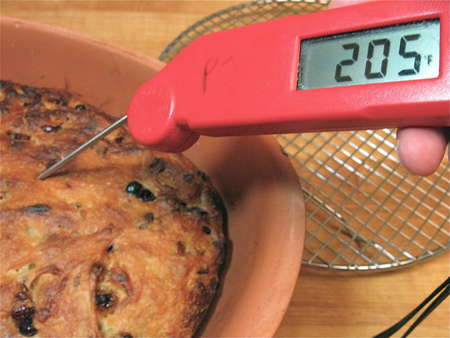
There we are: 205°F.
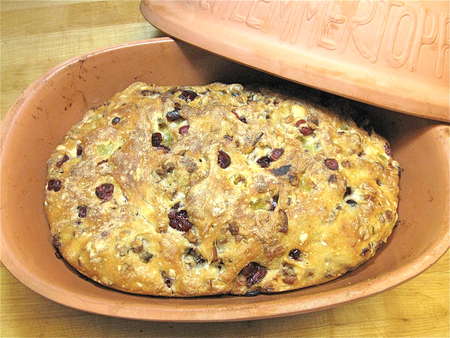
Here’s another version. After 45 minutes in the oven, I liked how brown it was, and didn’t really want it to brown further. So I tented this one with foil before baking for an additional 10 to 15 minutes, till its internal temperature was 205°F. It baked through without over-browning.
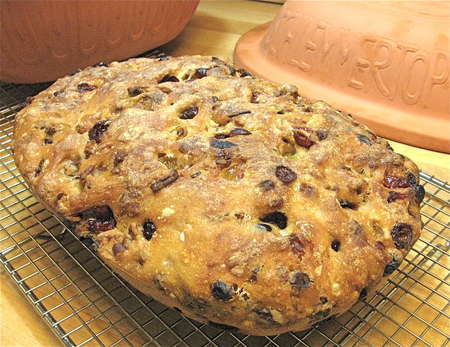
Take the bread out of the pan, and place it on a rack to cool.
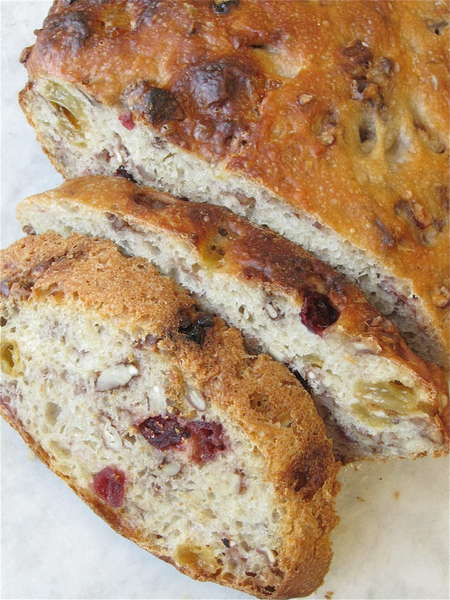
Slice when completely cool, and enjoy…
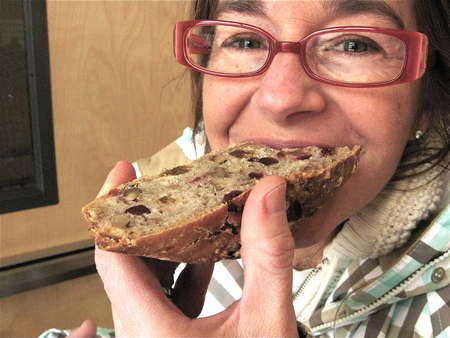
Just like Deb!
Read, rate, and review (please!) our recipe for No-Knead Harvest Bread.

Buy vs. Bake
Buy: When Pigs Fly Bread Co., York, Maine: Harvest Bread with apples, raisins, and walnuts, $3.67/lb.
Bake at home: No-Knead Harvest Bread with cranberries, golden raisins, and walnuts $1.60/lb.
March 17th, 2009 at 9:13 am
This looks so yummy and easy! My favorite bread at the store is cranberry walnut bread, and now I can make it at home! Will be trying this week! Thanks for all the inspiration with these terrific blogs! Could I use my corningware with glass covers for this, or do I need more of a domed cover?
Lish, if your Corningware is deep enough, no problem. It needs to be one of their deeper casseroles – like, not one of the 2″ deep ones. Id’ say it should be a minimum of 3″ deep, preferably a bit more. Enjoy! PJH
March 17th, 2009 at 9:25 am
I have been dying to try this bread since it first appeared on the cover of your catalog! You mention making in a Dutch oven…have you tried it in a Le Creuset pot or another heavy pan (not stoneware?) Would you change anything – baking time, etc?
Yes, Audrey, Le Creuset would be fine – and no need to change baking times. If your pot is smaller than 9″ diameter, then you should increase the baking time slightly; but hopefully you have a round crock at least 9″ to 10″ in diameter. Have fun – PJH
March 17th, 2009 at 10:23 am
Can you add vital wheat gluten to all purpose flour to achieve the same result as the Lancelot flour?
Give it a try, Jenny – it won’t be exactly the same, since it’s not integral to the flour, but it’ll probably help with the rise, anyway- PJH
March 17th, 2009 at 10:44 am
Lovely presentation, and yum. However, I missed the temperature for the oven. You state to place the cooking vessel in a cold oven, but then no temperature at which to set the oven is indicated, that I can see. Am I missing something?
Thanks….the oven temp should be 450′ Irene at KAF
The information is in the recipe, Bruce – I’ll add it to the blog post as well. Thanks. PJH
March 17th, 2009 at 11:31 am
I’ve always preheated the cooker, dumped in the bread, spritz with water, slash, cover, bake. Does the cold oven and soaked cooker lid trick work better, or do you still spritz? I’ve been making sourdough from the whole wheat cookbook and will try the final rise in my cold stoneware baker lined with lightly-greased parchment paper. Mmm… now I want to go finish off the last loaf – pain au levain with dark chocolate chips!
Hi Laura – We changed our method due to people having trouble trying to use pans that would crack/break when preheated empty. It’s OK for cast iron, but some stoneware can’t take the heat. As for “better,” give the soaked lid a try (if you have a cooker with an unglazed clay lid) – see what you think. Pain au levain with dark chocolate chips, eh? Sounds yummy… PJH
March 17th, 2009 at 11:37 am
I’m tempted to add a little malt to get a loaf similar to the malted fruit loafs found in England. I’ll report back
Also, I think the Cook’s Illustrated No-Knead recipe was by far the best for a rustic loaf. The added lager and vinegar really gives the bread a great flavor.
March 17th, 2009 at 12:50 pm
I made this bread from your catalog before Christmas. I cut the loaf in half and froze part of it. A few weeks ago, I wanted to make French Toast and this was the only bread I had, so I gave it a shot. It makes the best French Toast! Give it a try!
March 17th, 2009 at 2:07 pm
I have a 2 1/2 quart glass casserole dish, a 4 quart corning ware dish or a 4 quart stainless non stick dutch oven or 8 quart stainless non stick dutch oven both of these pots can go into oven up to 500 degrees F. So my question is can I use any of these and if so which one would be best. And any ideas since it wouldn’t help to soak any of these lids that go with any of these pans how about wet parchment paper laying on top of the dough?
Hi Kimberly,
The larger of the two Dutch ovens would be excellent for no-knead and artisan breads. Try baking without any soak or any parchment and see how you like the bread. It may be a little less “shiny” but the crust will still be excellent. ~MaryJane
March 17th, 2009 at 2:30 pm
Keep ‘em coming King Arthur! I can’t get enough of no-knead bread!
March 17th, 2009 at 4:26 pm
Can you add citrus zest to yeast doughs? Seems like this would be tasty with a hint or orange or lemon.
Absolutely, Liz – great idea… PJH
March 17th, 2009 at 8:31 pm
Yummy, yummy! I think you have another winner. This looks absolutely delicious and since my left arm is paralized I won’t have to get out my Zo.
Your step by step pictures and instructions are extremely helpful. Now to decide if I want to make no knead whole wheat or no knead harvest bread? maybe I’ll make both and gift someone. I hope you are doing better and are slowly recovering from your surgery.
Kathleen
Thanks, Kathleen – I like the gift idea. Bake2Give, right? I admire you being a one-armed baker — I’m finding it quite challenging and educational… PJH
March 17th, 2009 at 9:31 pm
Ok, it’s 10:00 p.m. and I have this yummy-looking dough resting on the counter, covered with plastic wrap, and plan to bake it tomorrow morning. That will give me time to decide on a baking vessel. If I choose a cast iron Dutch oven (camp-style), how do I add the moisture for the steam? One other question: I used the Lancelot flour and KA Artisan Bread flour (subbed for the whole wheat amount) but my dough was much dried than that in your photos. Maybe I mis-measured the flour (didn’t level off accurately?), but I added a couple Tbs. of additional water to compensate (and match your photos). The blog descriptions and photos really help with the success of my baking. And it certainly inspires me to try each new recipe you feature here. Thanks so much, PJH!
Lise, did you measure the flour with the “sprinkle and sweep” method? That makes a difference. Also, the whole wheat flour absorbs liquid differently than the artisan bread flour (ww actually absorbs more slowly, which initially gives a wetter dough), so that’s a difference, too. You can spritz the dough with warm water before baking if you like, but I really think just covering the pan will creat sufficient steam. I think you’re going to love this bread… Enjoy. PJH
March 17th, 2009 at 11:07 pm
Oh, how I love this bread! I made it when it first was featured on your catalog this last (later part of) summer. I didn’t have the fancy baker, so I used my corningware – turned out FABULOUS! We were actually in the process of moving into our (first!) new home, so I wanted something special to toast up for breakfast because, really, I didn’t know where the rest of my food was at that point! My one year old son even liked this bread – I just left the nuts out. I suppose it would work well with apricots too, for a tangy summer bread?
My only complaint is that after making it, I wasn’t paying attention while packing and got too close to the cooling 450 degree Corningware – I now sport a 3 inch long, 1.5 inch wide scar on my inner wrist/forearm from brushing up against the rim of the darned pot – talk about an instant 2nd degree burn! But, it was so worth it to have that lovely loaf of bread to break in our new home with family and friends! Just mind the cooling ceramic pot!!
And anyway…what baker is worth their salt (or sugar, or cocoa…) without a few battle scars? I just figure I’ve gotten my fair share already at 27 with this one…
WOW, Andrea. OUCH. So sorry! But you’re right all of us in the test kitchen have at least one horizontal scar across the underside of our forearms, courtesy of hitting a hot oven rack where the potholder ends… Glad the bread “toasted” your new home! PJH
March 18th, 2009 at 6:32 am
I have a dough hook on my mixer which I’d love to use. Any advice on this vs. actual kneading? Thanks
Wendy, there’s “no need to knead” here. Use your mixer’s flat beater paddle, not the dough hook. Beat just till everything is thoroughly combined. That should do it – PJH
March 18th, 2009 at 10:05 am
I’m loving the resurgence of no knead breads, particularly now that I’m chasing a 4 year old around. The extra hands off time is much appreciated! I would love to try a version with apples. Would you recommend using dried or fresh apple? I generally like to cook with Golden Delicious and Granny Smith, because I think they hold their shape better and it’s a good mix of sweet and tart. But I’m concerned that the fresh apple might add too much moisture to the dough and make it gummy in those spots. What would you recommend?
You’re right, Erin, I’d use dried apples. Or at least apples that are sautéed thoroughly enough to have released their juices. Sounds good – PJH
March 18th, 2009 at 8:17 pm
This looks amazing. I’m not good at making bread, and have long given up trying. This might get me back in the game. Thanks!
Mary, indeed – come play with us! PJH
March 19th, 2009 at 4:24 am
You mention high gluten or AP flour for the recipe. Would bread flour be a better choice than AP if I am out of Sir Lancelot (as I currently am)?
Yes, Tom, bread flour would be your choice for a higher rise. Enjoy – PJH P.S. Love your screen name…
March 19th, 2009 at 7:38 am
This bread looks so yummy!
Love fruit bread that is crusty outside, and soft inside. Never would have thought of using a clay baker for bread, but now I’ve gotta try it!
Thanks PJH!
March 19th, 2009 at 9:44 am
This is a weird question — but is there any way to make harvest rolls with this recipe? I have young kids who would help themselves to rolls all day long but slicing bread is beyond them and they end up dragging crumbs all over the house. With rolls, they just reach, grab and go! (I make your potato flour rolls all the time for this purpose)
I would make this all the time if there was a way to make rolls out of them.
–Lisa
Lisa, I’d try dolloping the sticky dough into a wider, shallower (but still covered) casserole dish – maybe cover a dish with some foil? A muffin scoop might work well. Let rise and bake as directed for bread, probably baking a shorter amount of time. Sounds like it could work – good idea! PJH
March 19th, 2009 at 9:51 am
Just a note to the person who asked about using Le Creuset- they work great, except that the standard knobs on the pots can break if exposed to very high heat. Le Creuset sells stainless knobs that you can swap out if you want or need to replace them.
March 19th, 2009 at 12:13 pm
I notice that in the blog pictures that the casserole is sitting on an oven stone. I would need to use a Corningware casserole ( 5 quart) for this bread. Is it safe to sit this casserole on an oven stone? Would the cold oven start protect against cracking?
Can’t guarantee your bakeware, Marsha, but starting in a cold oven should protect your casserole on a stone, I’d think. The oven stone is totally unnecessary, though – I just didn’t feel like taking it out of the oven when I baked the bread… PJH
March 20th, 2009 at 5:59 pm
Is the 1/2 tsp. of yeast correct? I’ve not seen an amount that small before. Thanks – looking forward to making
Yes, Chris, correct, because it rises for so long in the fridge… you’d be amazed at what that 1/2 teaspoon can do. Actually, you saw in the pictures what it can do… PJH
March 20th, 2009 at 10:49 pm
I’ve done this with the preheated dutch oven, but I have a clay baker that gets very little use, I’m glad to see your instructions for using it!
March 21st, 2009 at 5:15 am
I see you have a stone in your oven. But I have the three-sided stone wherein the instructions are to pre-heat over to set temperature, then let it heat up for one hour.
That means that if I put my bread in a cold oven, it will be two hours before it is at the proper baking temperature. Should I adjust times to compensate for this?
We suggest that you remove your oven insert. Frank from KAF.
March 21st, 2009 at 8:44 am
Thank you, Frank. However, I moved boldly ahead before your reply posted.
Here’s what I did: I preheated my oven with the three-sided stone to 450, then I put my covered pan with the risen dough into the oven (essentially one hour before the oven was fully preheated.) Then I baked the loaf for 1 1/2 hours checking it at one hour and 1 1/4 and moistening the lid each time I checked. At 1 1/2 hours, the internal temperature was exactly 202.
Also, I used parchment paper inside the pan. That’s easier and neater than greasing plus you can just lift the bread out.
March 21st, 2009 at 2:12 pm
HI KAF BAKER
Does the GERMAN CLAY BAKER come in more than one size, if so, which size do you use?
Do you soak only the top or both top and bottom? We have one size of clay baker, and soak both the top and the bottom to give your bread a satiny crust. Molly@KAF
March 21st, 2009 at 2:29 pm
Hi KAF baker
One more question: Do I need the Pizza stone, for better results.
Do you put the pizza stone on the oven shelf, or in place of a shelf?
Sorry I am new to bread, pizza baking. I am an experienced cake, cookies, pie, and tart baker, so I hope I can catch up quickly.
Hi – A pizza stone yields great results for pizza crust and crunchy/chewy, artisan breads. You don’t need it for any bread that’s in a pan. I leave my stone in the oven all the time, so I’ll sometimes set a pan on the stone, but again, it’s not necessary for breads in a pan. Pizza, though – YUMMMMMM… PJH
March 21st, 2009 at 11:25 pm
Great way to use my old Rommertopf! So many techniques and ideas my head is spinning, but I’m having a really good time! By the way, the Vermont Maple Oatmeal bread was a success… didn’t rise quite as much as yours, even with the smaller pan, but the texture and flavor were great. Will definitely make again.
Question on the No-Knead English Muffin Toasting Bread. The link lead to a blank page and it’s not on your list of No-knead recipes. A search brings up 2 recipes: the one with the blank page and one for a bread machine.. which I’d be inclined to try in my stand mixer…but now you’ve got me hooked on the No-Knead idea! Any idea where it’s hiding???
Glad you liked the maple bread, Tory.
We’ve been having lots of troubles with links lately – the one to the English Muffin Toasting Bread should be fixed now. Sorry about that! PJH
March 22nd, 2009 at 12:14 pm
We had this for breakfast this morning and it was delicious!I made the dough last night, let it rise overnight and baked it this morning. It was so easy!
Excellent, Caryl! Glad you liked it. PJH
March 22nd, 2009 at 1:29 pm
I live in Florida and it is hot and high humidity, I was wondering if I should do anything different, especially because of the yeast? I have never baked a yeast bread. Thanks!
If you have an air conditioned house, Leah, you should be fine. If your house is like 85°F – 90°F, try to find the coolest place; and understand that the whole process will go much more quickly. I think you’ll find this quite easy to do, and won’t have a problem with the humidity/heat. Good luck – PJH
March 24th, 2009 at 2:56 pm
Re: We’ve been having lots of troubles with links lately – the one to the English Muffin Toasting Bread should be fixed now. Sorry about that! PJH
Thanks, PJ! It’s still AWOL, but I’m sure it’ll be worth the wait… I have no choice but to persevere because I went and told my guys about it!
All of these links are working, far as I can see. Did you refresh your page, Tory? PJH
March 24th, 2009 at 4:19 pm
Well, PJ, I finally figured it out! There’s a whole page of ‘dead space’ at the top of the entry… and in my ‘let’s do this at 11:30 at night approach’ (half asleep!), I never bothered to scroll down to find this amazing 5-star recipe!!!
I’m heading off right now to bake a loaf! Thanks for your patience with me…..You guys are great!
Well, I don’t like to hear about the dead space, either…. Hmmm, we’ll have to look into that. Amazing how different browsers display things. Thanks for staying in touch, Tory – PJH
March 24th, 2009 at 7:23 pm
You said that we could use a Le Creuset pot, as that is the only pot I have…but one of the comments here by Kae says that the standard knobs might split and preferably should be changed to a stainless one. Do you think that if I cover it with a foil, it would be alright? I really want to try this no-knead bread… bread making is my weakness. Thanks.
Mari, I’d say contact Le Creuset customer service and ask what the upper temperature range is for that handle… and then ask what you can do to insulate it, if necessary. You could also simply cover the pot with foil instead of the lid… PJH
March 25th, 2009 at 9:15 pm
I’m looking forward to trying this in my romertopf. Did you have to grease yours at all before you put the bread in? It doesn’t look like it.
I did, Alice, though as you say, I don’t think I really had to… PJH
March 29th, 2009 at 6:33 pm
WOW! I just made this delicious loaf (subbing chopped dried apricots for cranberries and reg. Raisins) – amazing! Keep up the wonderful work!
GREAT, Erin – glad you enjoyed it. PJH
March 29th, 2009 at 10:10 pm
This is my first visit to your blog, but it will not be my last. I have joined the no-knead craze and will following your posts with great interest. Tonight I successfully made ciabatta from the book Kneadlessly Simple. I used King Arthur all-purpose flour and the results were delicious. I’m off to see what other no-knead ideas you have!
Welcome, Susan – we continue to experiment with this fun method, so check what we have online now, and expect more going forward! Have fun – PJH
April 18th, 2009 at 1:06 pm
I made this and its quite tasty but rather dry and cries out for cream cheese or brie. I only had butter but managed to suffer onward. It was interesting watching the dough become cohesive without any effort on my part. I left the fruit and nuts out while the dough fermented overnight. I kneaded them in by hand the next morning and watch the dough become looser and moister and no longer as coherent. I baked this in a 4 quart dutch oven after letting it rise for four hours.
I think I prefer breads with oil and milk and potato flakes to the Artisan style. Have you tried a potato focaccio with dried fruit? Its much the same taste but softer.
Actually, I love fruit focaccias. Try our Sweet Breakfast Focaccia. I’ve also made one with grapes and rosemary – darn, now you’ve got me wanting one, I’ll have to go make it—oh, too bad! PJH
April 19th, 2009 at 10:38 am
Have you ever thought of just a touch of powdered sugar on top of a fruit focaccia for extra decadence? Or a little bit of icing piped on top? I do whole wheat focaccia for the sake of my waist line so only dream about such additions. I guess I could sprinkle a date/cranberry focaccia with cinnamon sugar before baking and not add too many more calories. I need to get hold of myself since I haven’t recovered from eating Easter treats yet.
Don’t the grapes in a grape focaccia add too much moisture? I guess I should bake one and see, just for scientific curiousity of course so it shouldn’t count as breaking my diet.
Haven’t experimented a lot with sweet focaccia, but it does sound like a yummy project. Take a look at the recipe for rosemary and grape focaccia – you actually bake the grapes first, so they lose a lot of their liquid. Try it – PJH
April 23rd, 2009 at 9:38 am
I have made this bread twice now and absolutely love it. I just made it last week to have for a playdate. We all love cranberries and this is such a great and easy recipe. I have not had a problem with it being dry, but I put the fruit in before I let it sit all night. The last time I made it though, I let my husband grease the pan. BIG mistake, since the bottom stuck and the rest of the bread separated from it. I keep telling him he broke my bread! It was still delicious and moist, and even the kids asked for seconds! I also made the everything no knead bread and it was fabulous. Even a busy mom of two little ones has time to make this bread.
April 27th, 2009 at 10:06 am
This weekend I made bread pudding with the leftovers, adding some fiora di sicilia flavoring to the eggs milk and sugar mixture, and it was FABULOUS!! My son said YUMO!
May 15th, 2009 at 10:47 am
PJ,
sorry I didn’t write sooner. I did e-mail Le Creuset about the knobs that usually comes with their pots, and they do not recommend using it for a high temperature range…so, the solution was to buy a stainless steel knob which you can find online anywhere… Just to let you know, I finally got the knob and will try it today. I am so excited to make it. Thanks again for sharing this with us. have fun with it! Mary @ KAF
Thanks for sharing this information, Mari – PJH
October 5th, 2009 at 2:16 pm
I’m curious if this bread would cook up well in a crock pot? My crock pot has a stoneware insert with a glass lid.
We have not experimented using a crock pot to bake no knead bread-you may certainly try and see what you think-let us know how you make out. Joan@bakershotline
October 18th, 2009 at 5:20 pm
Hi, I only have a cast iron dutch oven is that OK, also need to know sure I preheat the oven and grease the dutch oven?
I will use calamatta olives, wath do you think?
Thank you, Robert
HI Robert,
Yes, a cast iron dutch oven will work fine. Don’t grease, but do preheat the pan. Use semolina or farina in the bottom of the pan to prevent sticking. Have fun with the olives! ~ MaryJane
October 27th, 2009 at 11:26 pm
Just wondering why it goes into a cold oven? I read that many times while reading the recipe, and what do you know, my dough went into the hot oven! Ugh – brain fluff! I went back to the recipe after setting the timer, knowing 45 min. was just too long at 450. So, here I sit wondering how this is going to turn out…
Connie, a cold oven gives the bread a slow, steady rise rather than a quick, short one. I’m betting your loaf was just fine, right? Surprisingly, with all of people’s fear of it, yeast baking is VERY forgiving… PJH
October 30th, 2009 at 5:07 pm
The first time that I made this bread I used a 5-quart Corning Ware casserole with glass cover. It came out good but the loaf was rather flat in shape. Do you think that this would work in a 3-quart casserole to give a higher loaf? This bread is delicious in the morning for breakfast with coffee or hot tea.
I say give it a try, Marsha – you wouldn’t want it to come more than halfway up the sides of the casserole, so eyeball it and don’t try to overfill it, OK? Let us know how it come sout – PJH
November 3rd, 2009 at 7:38 pm
Should the thermometer read 205 BEFORE I remove the lid? If not, what should the temp be?
After reading all the blogs, I assume I can use an enameled cast iron dutch oven with the dimpled lid or would foil be a better cover?
Thanks for all the wonderful help you provide.
June, take it out, take off the lid, take the temp., and it should be somewhere close to (but not yet) 205°F. A few more minutes in the oven to brown the top will bring it up to 205°F. OK? And an enameled cast-iron Dutch oven would be excellent, with the lid. PJH
July 17th, 2010 at 3:43 pm
Do you soak the whole clay baker or just the top?
Just the cover, Harriet – PJH
September 22nd, 2010 at 3:45 pm
I saw this and thought an added 2 eggs would make it less dry, and boy is it good that way, however, in a clay pot, it was very stuck, I put it in cold oven as directed and soaked in water. So I retried w/ a cast iron dutchoven, let it heat, and dumped in the dough, and it also is stuck to the bottom, though not as bad.
Havent tried it w/o egg, because it is so good w/ the egg, but a really nice recipe, we had it for dinner!
October 22nd, 2011 at 12:00 pm
Just got out all the ingredients for this bread and realized that my Lancelot flour expired LAST year! Can I use it or will the resulting bread be less than stellar?
Also, I am out of SAF yeast, can I use active dry yeast? If so, what adjustments do I need to make?
Thanks in advance for your swift response!
Go ahead and use the Lancelot – it’s not whole grain, so should be fine. Use active dry just as you would instant – no need to dissolve first. It’ll take longer to get going than instant, but will eventually catch up. Good luck – PJH
November 6th, 2011 at 2:07 pm
What process suggestions do you have for retarding this dough by placing it in the refrigerator, so that it can conform better to a flexible schedule? Thanks.
Ina, where it says to let it rise for 8 hours at room temperature – simply refrigerate it instead. It can stay in the fridge for at least several days. One caveat – when you want to bake it, you’ll need to give it plenty of time to both warm up, and rise. Good luck – PJH
September 11th, 2012 at 7:51 am
I purchased Emile Henry crock from you at the beginning of ths year and have made this loaf quite often. This is the most wonderful and versatile bread ever! If I want to, can I make it with all Sir Lancelot flour? I don’t have to put wheat flour, right?
Monica
Best results happen baking the recipes as written – if you are used to the dough consistency, you can make your own variation knowing it will vary from the original recipe. Best wishes on your baking journey – Happy Baking! Irene @ KAF
March 12th, 2013 at 11:51 am
I bought a version of this bread at Wegman’s. It is so expensive, but I’m hooked, so I decided to try to make my own, not realizing you had this great website and recipe to help. Thank you. My question is, can I bake many loaves at a time using just a baking stone on the grill of the oven? I usually buy many loaves at a time from the store and freeze them so I’ll always have them on hand. They are just as perfect when defrosted. But thought if I’m going to all this trouble to bake, why not bake four or five loaves at a time? I eat these up so quickly. If this is possible what do I need to know?
You can indeed do a big bake – and freeze the loaves. Consider refreshing the loaves to bring them warm and crispy to the table. Our bakery suggests reheating at 350′ for 5 to 10 minutes. Happy Baking – Irene@KAF