
Oh the woes of gluten free bread.
It’s boring. Tasteless. The dough is unmanageable and not versatile.
I beg to differ.
When my family began making the gluten-free transition years ago, it was so hard to part with the comfort of good bread. It actually seemed easier to just avoid it altogether rather than risking failure in making it, or spending $6-$7 for a loaf at the grocery store.
We have since then, despite a small amount of whining in the process, successfully landed in a happy homemade loaf-loving life.

My three bread-mongers: they love the stuff and don’t care how it comes to them. Whole wheat, seeded, nutty, white and airy, crackling crusty, soft and smushy. It matters not.
And can you imagine the looks of pure disdain when I broke the news that we were no longer going to be in artisan bread bliss? The first bite of gluten-free bread can be like jumping into cold water without dipping your feet in first and they certainly weren’t jumping in line to be taste-testers for me.
Uncertainty, shock, regret? Not anymore.
How could I look at these faces and NOT try my best to make their favorites the way they knew them? I had to find a solution for cinnamon-raisin bread (a breakfast staple in our home for years past), or I was very quickly going to become the most unpopular member of the household.
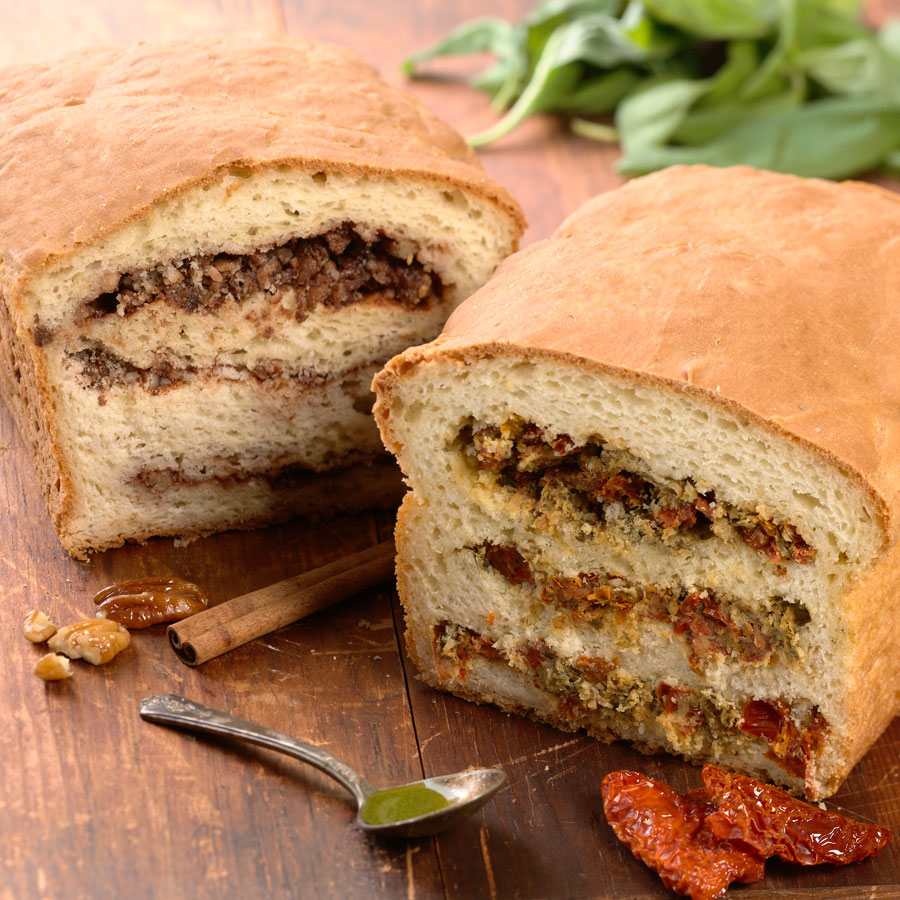
My remedy for the bread-batter-battle, my Suessian friends? I discovered that layered fillings can add pizzazz to your gluten-free dough concoctions just as well as the rolled and swirled!
Though I’ve accepted the many limitations of gluten-free loaves, I’m not willing to give up on the possibilities. I’m about to share with you a way to fill your gluten-free bread with any flavors of your choice.

Follow the directions on the King Arthur Gluten-Free Bread Mix box, starting with 3 eggs, 1 1/2 cups lukewarm water, and 4 tablespoons of either melted butter or oil.
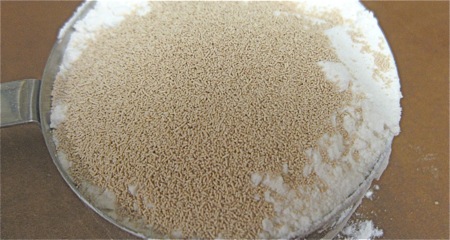
Just in case you haven’t stopped to look yeast in the eye, here it is up close and personal.

Add 1 cup of the mix and yeast to the egg mixture, and beat on high speed. Add the rest of the mix by the cupful, beating well and scraping the sides of the bowl after each addition. You know the rules.
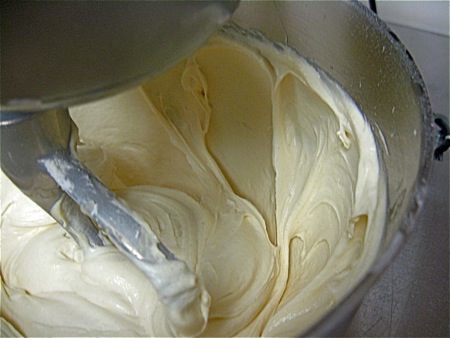
Continue to beat the mixture on medium-high speed for 30 seconds in between adding cups of dry mix. Give it a final 2 minute whirl in the mixer on medium-high speed during which the batter should develop into a thick, cake batter-like consistency.
Allow this to rest, covered, for about 30 minutes and use this time, wisely, to make the fillings.
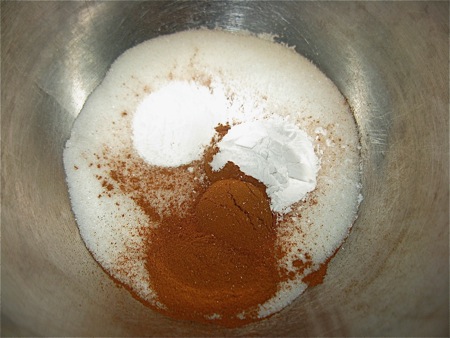
For the cinnamon filling, mix 1/2 cup granulated sugar, 1 tablespoon cinnamon and 2 teaspoons tapioca starch. Stir in 1/2 cup chopped pecans.
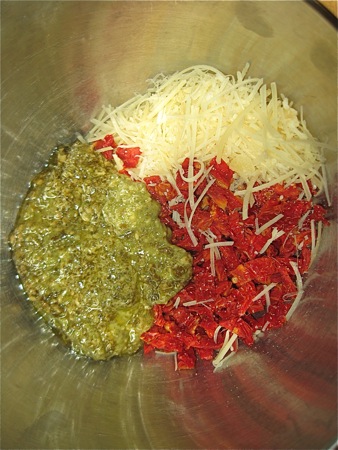
For the pesto filling, combine 3/4 cup sun-dried tomatoes, 1/2 cup pesto, and 1/2 cup Parmesan cheese.
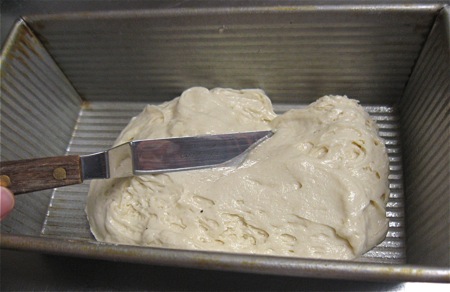
Begin the layering process by spreading about 1 1/4 cups batter in the bottom of a 9″ x 5″ loaf pan.
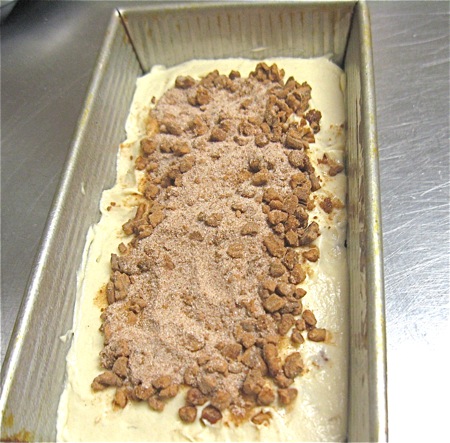
Add about 1/3 of the cinnamon mixture.
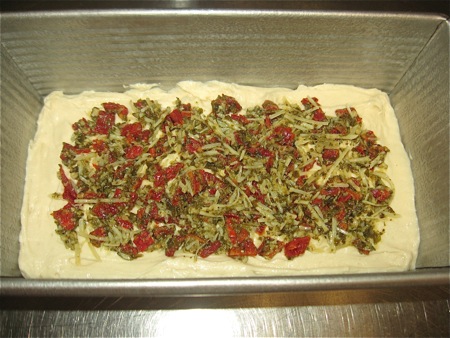
Or 1/3 of the pesto filling, and distribute evenly.
Leaving a 1/2″ border around the edge is crucial for the loaf to be sealed and cohesive. If neglected, the bread layers won’t glue together, and the pieces will fall apart as you slice them.
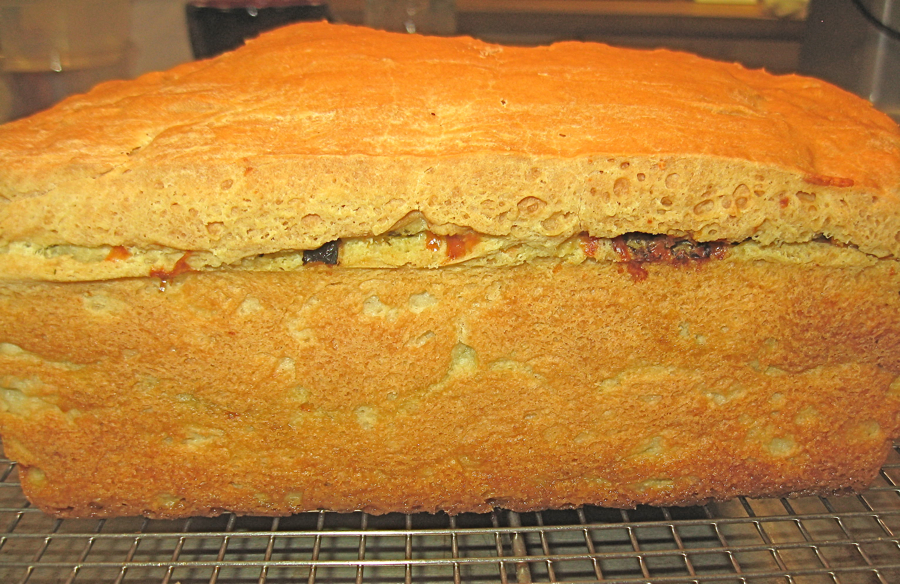
I learned the hard way, when the filling bubbled over the edge of the pan, causing a thin trail of smoke to float through the air. Each slice became instant bread sticks as soon as I cut through them, so I had to make it again- oh brother!
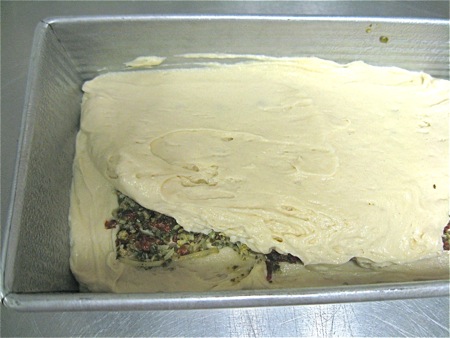
Cover the filling with another dose of batter and repeat the process…
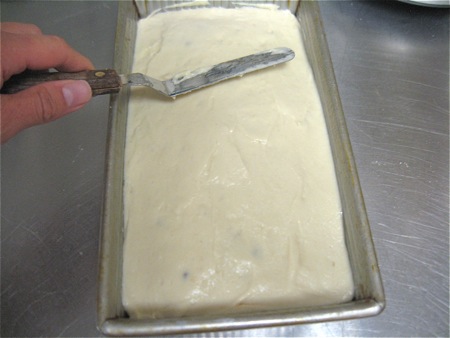
…until you have three glorious layers. Cover with a final layer of bread batter, leaving the center in a domed shape and smoothing gently with wet fingers or a small offset spatula.
The bread will need to rise, covered, for 20 to 40 minutes, depending on the temperature of the room. The dough should crown about 1″ over the rim of the pan.
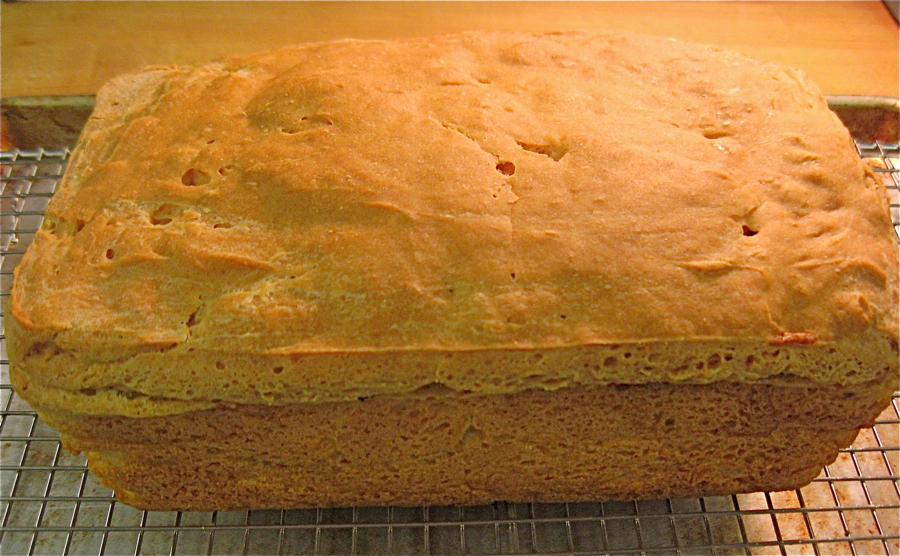
Bake for 50 to 60 minutes, or until the internal temperature of the loaf reaches 200- 210°F. Turn the bread out of the pan, and allow to cool completely on a rack before slicing.
And, yes, the rule you all despise – the wait-until-completely-cool-before-cutting one- is true and still applies even to gluten-free loaves. I realize the comfort of warm bread is a treasure and I hate to be the bearer of bad news, but patience is much more than a virtue here. It’s the difference between gluten-free bread and chewing gum. Trust me.
I hope you’ll enjoy jazzing up your breads with anything you choose, and have fun using this idea as an unlimited creative outlet.
Please read, bake and review our recipe for Gluten-free Filled Breads.
Print just the recipe.


October 22nd, 2012 at 7:55 am
Love the photo of the kids Amy! Hugz to all. Perhaps one day we’ll meet them. LOVE the idea of any bread stuffed with wondrous things….I hope all the GF folks go nutty good over this one. Particular favorite would be the Cinnamon-stuffed-swirled one!
I just saw her youngest in her arms pass through the office about an hour ago. I am sure our fellow GF fans will like this one too! Regards Paul! Elisabeth
October 22nd, 2012 at 10:06 am
I don’t understand the whole gluten-free craze. If you don’t have celiac disease, why would anyone do it? Isn’t this just another fad?
This is a very good question and worth asking. Some folks are gluten intolerant or could have Celiac’s Disease that has gone undiagnosed. Only a biopsy can really diagnose Celiac’s, therefore it cannot be called a fad. The biopsy shows damaged villi in the small intestine. Damaged to the point that NO nutrition is accepted by the body. No vitamins, no minerals, no calories. People with undiagnosed Celiac Disease, or those with Celiac Disease that choose not to follow a gluten free diet, will eventually die of malnutrition or intestinal cancer. They will also suffer from diarrhea, nausea, skin ulcerations, bone disease, depression, itching, foot and leg cramps, exhaustion and so much more. Those with a Gluten Intolerance will not do damage to their villi. They will react to the gluten with bloating and/or diarrhea but will not damage their bodies internally as Celiac’s do. However, it could take up to two years for a Celiac’s villi to heal after ingesting just a single crumb of wheat, rye or barley. Needless to say, it is pretty serious for some and is here to stay! Elisabeth
October 22nd, 2012 at 5:21 pm
We eat GF because my other half is intolerant. After several trips to the doctor I ask him if he wanted to try GF just to see what happens. He was so sick that I could have suggested we eat tree bark and he would have agreed if it would have helped. After about a week of GF he started to feel amazing and his bloating went away. I don’t eat wheat now just because it isn’t in the house. If one in the house is GF most families will just go total GF. There are so many other starches/flours, etc. out there to replace it with.
October 22nd, 2012 at 7:29 pm
What an innovative way to get the “swirl” into the GF loaf! Thanks for sharing such a great idea along with the ways to make it work best.
October 23rd, 2012 at 2:55 pm
we would be interested in more GF recipes that do not use mixes. we like your GF flours and ingredients and would like more GF recipes using them! Please!
We are always working on new recipes, especially for our gluten free customers. For now we have a plethora of GF recipes on our website, along with a wonderful gluten free cook book that may interest you!-JDB
October 23rd, 2012 at 8:14 pm
Love the look of the savory stuffed bread………but is it possible to make it using a standard bread recipe???
In order to achieve a layered look, you would need to divide your dough into several pieces and roll it into rectangles to fit the pan- might be a bit tricky, but certainly worth a try. ~Amy
October 23rd, 2012 at 8:31 pm
Thanks for this recipe! We are wheat and sugar free( not by choice) so it would be cool to see a way where you can do substitutions (ie oat, rice, or GF flour) as well as other recipe swap outs. I’d love to know more about the substitute flours and when not to use them or / how they act differently than regular flours.
And where do you sell the GF mixes?
Thanks! Love King Arthur!
I would be happy to talk more with you about the different types of GF flours and their uses, please give me a call. 800-827-6836. You can find our Gf products at these stores. ~Amy
October 23rd, 2012 at 9:29 pm
To MamaG – There are many levels of gluten sensitivity – Celiac Disease is the most severe. There is also Gluten Intolerance and Gluten Sensitivity. Current medical research estimates 1 in 133 American suffer some form of sensitivity and most remain undiagnosed.
Gluten sensitive people have a vast number of symptoms. I discovered I have an intolerance/sensitivity to gluten the Summer of 2011. I was on a clear diet due to diverticulitis when myriad issues disappeared only to reappear once I started consuming gluten containing foods. The issues included several years of severe pitting edema in my lower legs, hair loss, joint pain, general aches I attributed as age related. I went GF and the issues once again disappeared so I have stayed GF. I also have not had to take the allergy medication I had been on since being diagnosed with severe environmental allergies 20+ years ago.
Accidental exposure to gluten results in the return of swelling and a general ‘hit by a bus’ feeling. To be tested for Celiac I would once again have to eat foods containing gluten for at least 4 weeks! As eating gluten makes me miserable I have not not had the biopsy to see if I have damaged villi. The only “treatment” for celiac is to be GF and as I am already doing that, I see no reason to make myself ill just to be told I will feel better if I go GF. :\
All that to say – no, for me it is not a fad, it has been a very necessary lift style change.
Thank you for reading this.
KAF – thank you for some awesome GF Products!!
Thank you so much for posting this information! ~Amy
October 24th, 2012 at 10:23 am
Gluten-free is definitely not a fad, although some may have jumped on the so-called bandwagon as what they perceive to be a healthier lifestyle. The biggest thing that has happened is that companies are now acknowledging that there need to be more products out there for people who have to live gluten-free. My mom has had to be GF for 30 years now and only recently has she been able to enjoy baked goods that others take for granted. We have experimented for years trying to come up with recipes that even come remotely close to anything edible. There are more and more people out there realizing that there is an answer to what has been making them sick. I commend King Arthur Flour for coming up with what I consider to be the best flours and mixes for GF EVER. The gluten free flour they produce is far superior and closer to regular wheat flour than any we have tried, and we have tried them all. I recently made zucchini bread with the GF flour and it was the best bread I ever tasted. A fad? Good heavens no. Thank you King Arthur!
December 29th, 2012 at 9:31 pm
To MamaG:
Some people also have an allergy to wheat or other gluten containing foods. We’ve recently discovered, through blood tests, that my son has a “high” allergy to milk, a “medium” allergy to wheat and a “low” allergy to egg white. Not intolerance, but allergy, resulting in hives, skin lesions, abdominal pain, etc. It took many months of visits to bewildered doctors to figure this out. Rather than a fad, this may indeed be helping the undiagnosed. It is, however, a change not to be taken lightly, as it will be difficult to maintain a healthy diet with apropriate amounts of protein, fiber and other key nutrients.