Home | About | Contact
800.827.6836 | Norwich, Vermont

shopping cart  
0 items in cart | checkout

Classic Puff Pastry (Pate Feuilletee)

Croissants de Patissier and Puff Pastry Turnovers

The French call it "pate feuilletee," which means "pastry made leaf-like." In fact, it has so many "leaves" that it is also called "millefeuille," meaning a thousand leaves. Each of these "leaves" consists of a layer of flour separated by a layer of butter. The expansion (puff) occurs because the butter layers create steam when exposed to the heat of an oven. This expands the space between the flour layers. Ultimately, in classic puff pastry, you want to create 729 layers of folded dough, not quite one thousand, but like the millipede which really doesn't have a thousand legs, the effect is there.

Before you embark on this adventure, here is something to keep in mind. You want everything (including yourself) to stay cool. Your goal is to create distinct layers of butter and flour, so you don't want the butter to melt. If you have any suspicion that the butter is too soft (oozing or breaking through the layers), refrigerate the dough for 30 minutes to firm it up. Just stay relaxed, cool, and enjoy the process.

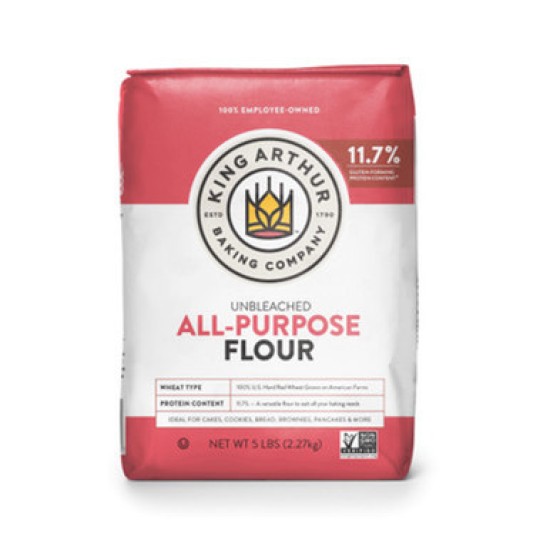
1 pound (4 cups) King Arthur Unbleached All-Purpose Flour OR 3 cups King Arthur Unbleached All-Purpose Flour and 1 cup unbleached pastry flour OR 3 1/2 cups King Arthur Unbleached All-Purpose Flour and 1/2 cup cornstarch*
1 pound (4 sticks) unsalted butter, 1/2 stick chilled, the rest at room temperature
1 to 2 teaspoons salt (1 for sweet pastry, 2 for savory)
1 1/4 cups cold water (use more if necessary, a tablespoon at a time); you can also substitute 1 tablespoon of lemon juice for 1 of water if you wish to further temper the gluten in the flour

*Cornstarch is the finely ground endosperm of a kernel of corn. It corresponds to the endosperm of a wheat berry which is what is ground into white flour. Unlike wheat flour, cornstarch (or corn flour) has no gluten in it. It can be used in combination with a strong (high gluten) wheat flour like King Arthur Flour to reduce the percentage of gluten in the whole. When this is made into a dough or pastry, you'll have the integrity and strength of the original flour as well as the tenderness made possible by the cornstarch.

Making the Dough: Measure the flour into a mixing bowl. Remove 1/2 cup and set it aside in another bowl.

Take the half stick of chilled butter, cut it into small pieces and drop it into the flour. With two knives, a pastry blender or your fingertips, cut or rub the butter into the flour until it resembles cornmeal.

Add the salt (and optional lemon juice) to the water and add this to the flour. Mix gently with a fork until you have a rough dough that pulls away from the sides of the bowl. If you need to add more water, do it a tablespoon at a time, until the dough holds together.

Turn the dough out onto a lightly floured surface and knead until it is smooth and the gluten has been somewhat developed, about 2 or 3 minutes. Wrap it in plastic and refrigerate for at least 30 minutes.

Preparing the Butter: Take the remainder of the butter and the reserved flour and mix the two together until they're well blended and smooth. You can do this with a mixer, a food processor or with a spoon, by hand.

Pat this butter/flour mixture into an 8-inch square on a lightly floured piece of waxed paper. Cover it with second sheet of waxed paper and refrigerate it for at least 30 minutes. By mixing the butter with flour, you stabilize it somewhat so it won't decide to "flow."

Rolling & Folding: Remove the dough from the refrigerator and put it on a lightly floured surface. Gently roll it into a square about 12 inches on a side. You don't have to be obsessive about the dimensions but be pretty close.

Put the butter square in the center of the dough square but turn it so that the corners of the butter square point toward the sides of the dough square. Fold the corners of the dough over the butter until they meet in the middle. Pinch and seal the edges of the dough together.

Turn the square over and tap it gently with your rolling pin or by hand into a rectangular shape. (Make sure everything is still completely, but lightly, floured.) Begin rolling the dough from the center, away from and towards you, into a larger rectangle 20 inches long and 10 inches wide.

As you work, keep the dough, the table and the rolling pin well dusted with flour. Although the dough will absorb some of the flour, it is relatively soft to begin with so the dusting flour isn't enough to worry about.

Turn the dough over from time to time. As you roll you tend to expand the top layers more than the bottom. By turning it, you'll even it out.

When the dough is the right size, fold the bottom third of the dough up to the center and the top third over (like a business letter) and turn the dough package 1/4 turn to the right so it looks like a book ready to be opened. If the dough is still nice and cold and still relaxed, do another rolling and turning the same way. (If it begins to feel too soft or wants to resist being rolled, cover it, put it on a small baking sheet and refrigerate it for 15 minutes to chill and relax.)

If you've successfully rolled it out and folded it twice, you've completed two turns. Classic puff pastry gets six. Continue refrigerating it after each two turns (or more often if necessary) until all six turns are completed.

Make a checklist somewhere so you know how many turns or layers you've made. Bakers commonly put fingerprints in a corner of the pastry to indicate the numbers of turns. If you try this, be careful you don't break through with your fingernails, since the layers are very thin.

An alternate way of rolling and folding, which is both more and less demanding, is to make a turn every 15 minutes. This means that you will have to be more attentive to the dough, but the dough, because it has a chance to rest after each turn, will be nice and relaxed for the next rolling.

The Big Chill: When all six turns are done, put the dough in the refrigerator for at least an hour (and preferably overnight) before shaping. Like other pastry doughs, you can freeze puff pastry in a non-self-defrosting freezer for up to a year if it's well wrapped. It can also be frozen at any time during the rolling, folding, turning process. Defrost it thoroughly before you use it, but just make sure it doesn't get too soft.

Croissants de Pātissier

Puff pastry croissants are called "croissants de pātissier" because they are made by a pastry chef rather than a baker who makes "croissants de boulanger." We gave you a recipe for Croissants de Boulanger back in the January issue of "The Baking Sheet." Both varieties are incredibly light; Croissants de Boulanger, made with yeast, are flaky and earthy; Croissants de Pātissier, made without yeast, are flaky and ethereal. As we suggested with our other croissants, you can fill these with jam or any savory filling. This recipe will make a dozen.

    1/2 recipe Classic Puff Pastry
    1 egg beaten with 1 tablespoon water for wash
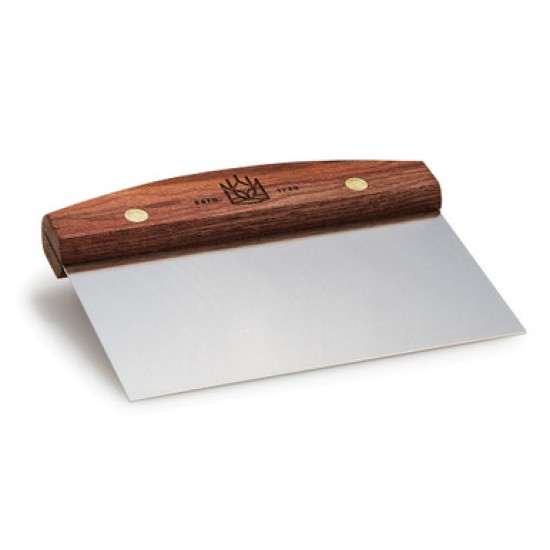
Shaping: On a lightly floured surface, roll out the dough until it's a rectangle about 12 x 18 inches. Trim the dough all the way around by pressing straight down with a very sharp knife or your King Arthur bowl scraper. This cuts off the folded edges which would inhibit the "puff."

Cut the dough in half lengthwise and in thirds widthwise. This should give you six, 6 x 6-inch squares. Cut these squares in half diagonally.

If you wish, put a dollop of filling in the center. Then roll each triangle up starting with the long edge, working toward the tip. Form the crescent by bending the two ends in the direction opposite from that in which you rolled the dough.

Chilling: Place the croissants on a lightly greased baking sheet. Cover and chill for at least 30 minutes.

Baking: Fifteen minutes before you want to bake the croissants, preheat your oven to a hot 425°F. Just before they go in the oven, brush the tops with the egg wash. Bake for 15 minutes. Turn the heat down to 350°F and bake for another 10 to 15 minutes. Remove from oven and cool completely on a wire rack.

Puff Pastry Turnovers

This recipe will make six turnovers, which can be filled with any of the suggestions in the preceding introduction, or some inspiration of your own.
    1/2 recipe Classic Puff Pastry
    1 egg beaten with 1 tablespoon water for wash
Shaping: On a lightly floured surface, roll out the dough until it's about 12 x 18 inches. Trim the dough all the way around by pressing straight down with a very sharp knife or a bowl scraper. Cut the dough in half lengthwise and in thirds widthwise. This should give you six, 6 x 6-inch squares.

Filling & Chilling: Put a dollop of whatever filling you choose in the center of the dough. Moisten the edges with a bit of water and fold the dough in half diagonally. Place turnovers on a lightly greased baking sheet, cover and chill for at least 30 minutes.

Baking: Fifteen minutes before you want to bake your turnovers, preheat your oven to a hot 425°F. Just before they go in the oven, brush them with the egg wash. Bake for 15 minutes. Turn the heat down to 350°F and bake for another 15 to 20 minutes. Remove from oven and cool completely on a wire rack.

This recipe reprinted from The Baking Sheet Newsletter, Vol. III, No. 1, November 1991 issue.

Reviews

Page:   1  
*****

01/30/2009

Regina B from Australia

The amateur virtual baking club that I joined used this recipe as the challange to learn how to make pastry. Making puff pastry apparently was not as difficult as I thought and the result was not bad as the first timer. The critical thing that I experienced was to ensure that the butter is plastic enough for rolling (not too hard or too soft/nearly melted). Be aware when making it in summer as the butter will be melting easily. At the end, I made some croissant and sausage rolls with the pastry. Definitely, I will try again next time.

*****

04/15/2009

Mimi from san jose, ca

Thank you sooooo much. I have always had a fear of baking and KA flour made it so possible and easy. I tell eveyone now about KA flour, I just started to learn about baking and didn't know much about flour. KA quality flour is extremely important for all the laboring of rolling folding. It came out a Great success and wonderful. I have only made it twice, once without the cornstarch, which in the Cordon Bleu cookbook didn't have and this recipe with cornstarch. It made a whole world of a difference with the handling of of the dough with the addition of the cornstarch. Thank you for the tips. My friends were raving about the pastries. Now am thrill to try pizza and other baking goods. Thank you again. All the stores I have search do not carry the the pastry flour though.
Congratulations! You certainly started your baking quest at the top of the mountain with puff pastry! Sadly, our pastry flour is not always available at the stores that carry all-purpose. We wish you well in your upcoming baking adventures. Irene at KAF

Page:   1