Home | About | Contact
800.827.6836 | Norwich, Vermont

shopping cart  
0 items in cart | checkout

The Easiest Rye Bread Ever


This no-knead rye dough bakes up in a crock to make a wonderful, moist sandwich rye bread.

Ingredients

Directions

1) Place the water in a 6-quart dough-rising bucket or other large container.

2) Weigh or measure the remaining ingredients, and mix together.

3) Add about half the dry ingredients to the water and stir to combine.

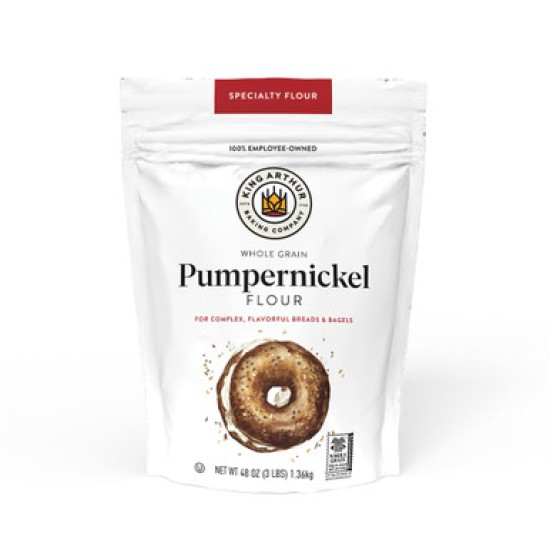
4) Add the remaining dry ingredients and mix until there are no dry spots; your hands are the best tool here. The texture of the dough should be fairly soft and sticky due to the pumpernickel flour.

5) Cover the container and let the dough rise at room temperature for 2 hours. Then refrigerate overnight, or for up to 4 days.

6) To bake bread: Grease your hands, and scoop out a scant 2 pounds of dough (about half the batch).

7) Shape the dough into a ball, and place it in a greased, lidded baking pot or casserole.

8) Let rise, covered, for 2 to 3 hours.

9) Just before placing the crock into the oven, make several slashes in the dough. Place on a middle rack in the oven. Set the temperature for 450°F, and turn the oven on.

10) Bake the bread for 40 minutes. Remove the lid and check to see if it's done; it should be lightly browned, and the interior should register at least 195°F on an instant-read thermometer. Bake for an additional 5 to 10 minutes, if necessary.

11) Remove the bread from the oven and turn it out of the crock onto a rack. Cool for several hours before slicing.


Yield: 1 loaf. Total batch of dough yields 2 loaves.

Recipe summary

Hands-on time:
15 mins. to 30 mins.
Baking time:
40 mins. to 50 mins.
Total time:
2 hrs 45 mins. to 7 days 1 hrs 20 mins.
Yield:
1 loaf; total batch of dough yields 2 loaves.
Rate recipe
****+
Recipe comments (12) »

Bookmark/share
this recipe

Del.icio.us Yahoo Digg reddit Google Squidoo StumbleUpon Yahoo

Reviews

*****

10/25/2009

Cynthia Moulthrop from Spring Hill, TN

My husband,who is a very difficult critic when it comes to rye bread, raved about this recipe's flavor and texture. I was concerned at first when I had a little lump of dough in my crock,but when I read the review on line saying it should be 2 not 4 loaves, I combined the two loaves I had started into one.It never grew overly large but was tender and moist with a nice crust. Very rustic, something you would pay dearly for in a bakery!

*****

10/24/2009

Dandfla from South Florida

I had good results with this recipe! The dough proofed nicely in the casserole and I even got some oven spring. The final loaf was DELICIOUS with a very moist crumb and crunchy crust. Still, it is a heavy, dense bread which is what I wanted. After reading the reviews, I did make a few changes in the recipe. First, I added one teaspoon of Diastatic Malt Powder. Second, I kneaded the dough for about two minutes before putting it in the casserole dish. (It was easy to knead with oiled hands. I have heard the experts say this redistributes the yeast and makes for a better rise.) Third, I used a straight sided casserole that is 7 inches in diameter. After 45 minutes of baking the internal temperature was 195 degrees but the loaf was soft and needed to be baked longer. I removed the bread from the casserole and placed it directly on the oven rack and baked it for eight more minutes. The crust became extra crispy and the crumb dried out. This made a very nice rustic bread with a full robust flavor! I will make it again.

*****

10/23/2009

Doreen Gerrish from Stonington, CT

I made this bread just how the recipe said to. when I rolled it into a ball and put in 4qt cast iron kettle it didn't rise at all it went flat. I left it in there for 3 hours and nothing happen. so I decided not to bake it. it was flat. put rest of dough in the refri over night and that rose, but once i put into pan nothing. was not happy with the recipe and that I wasted all my rye, white flour that I just finished grinding in my grain mill.
I am sorry you had problems with this recipe. We did have an error (which has been corrected on line) as this makes two loaves. I wonder what type of yeast you use. A rapid rise yeast will not work in this recipe. Please call our hot line to go over the recipe with you. Joan@bakershotline .

*****

09/21/2009

Gail from Maryland

I clipped this recipe out of the catalog; luckily I read the reviews before I tried it, so I knew the yield was two loaves and not four as the original recipe stated. I baked the first loaf in a five quart casserole - I think the recipe calls for a four or five quart. The cold dough was easy to handle, and I didn't have any trouble shaping it into a ball, but it flattened out during the three hour sitting time, didn't seem to rise much at all, and didn't have any oven spring. I tried the second loaf in a three quart container with just a two hour sitting time. Of course the loaf was a little higher because of the smaller casserole, but again it didn't seem to expand much at all, and I ended up with another pretty flat loaf. I bake rye bread a lot, so I know it's more dense than some other bread but not usually this dense. Would more rising time in the first phase, before the dough goes into the refrigerator, help? Or a little more yeast, maybe a tablespoon and a half total? I'd like to make this again, because it's easy and tasty, but would really like a higher rising loaf.
You could try letting it rise longer before refrigerating but it may not help. It's just not a high rising loaf. Molly @ KAF

*****

09/14/2009

Robin from Middle Georgia

I made this dough before reading about the changes (to make two loaves not four), but used some of the remaining dough to make another loaf today (today is day two if you count Saturday for mixing and Sunday for the first loaf). Same result as the first day: a flat, dense loaf, nothing like your photo. "Lively" is not a word I'd use to describe the dough at all. I did proof some of my yeast afterwards and it is good. As others said, the taste is good but man is it a hockey puck otherwise.

*****

09/09/2009

Sue from Indianapolis

I loved the taste of this bread but was confused as to when to add the butter or oil. Is it added to the water or just used to grease the loaf at the end? I also achieved a flat blob, but was relieved to see that it was the recipe, not me. I had a problem with the loaf sticking to the bottom of the pan and think that using a round of parchment paper in the bottom might help. I intend to try this again very soon.
The butter or oil is part of the recipe. Add them to either mixture, whichever one is easiest for you to incorporate. Consider spraying the cold pan with oil before adding the dough. This recipe yields 2 loaves. Thank you for your willingness to try this recipe again! Irene @ KAF

*****

09/02/2009

Stephanie from Minneapolis

I had the same problems as the above reviewers - the first rise went fine, but the second rise never took off, and it came out of the oven as an ugly blob. Surprisingly, the taste was phenomenal though!

*****

09/02/2009

Frank from KAF baker's hotline


I'd like to thank all of that took the time to call and email us with questions about this recipe. I'm sorry that so many of you had difficulty achieving a nice loaf of rye bread. With the help of the other bakers on our hot line, along with our test kitchen team, I took this recipe for a test drive. I started by making the recipe as written. Here is what I discovered. The original published yield was incorrect. This recipe is actually for only 2 loaves, we'll update the website. Once we realized this everything started to fall into place. The ingredient amounts are correct. They worked up into a nice lively dough that turned into a hearty, robust loaf of tender rye bread. With a 2 loaf yield, my bread looked just like the accompanying photo. The time line is critical. Keep the final rise in the 2-3 hour range. I've only taken this dough out to a 3 day fermentation, so I'd appreciate hearing from anyone that has gone for 4-7 days. Lastly, I ask all of you that did have difficulty the first time around, please give this one a second chance. It's a delicious loaf and the no-knead method makes for a very flexible time line. Happy Baking! Frank @ KAF.

*****

08/30/2009

Deb from Denver

I followed the exact recipe, and got a loaf with great texture and great taste, but it's only around 1 1/2 inches high when baked in a 4.5 qt cast iron dutch oven.

08/27/2009

Bev from El Paso, TX

I am not sure if I would recommend this recipe or not. I have baked it twice and it has not turned out like neither the photo looks, nor like the instructions say it should. In short, it is an ugly, tough looking blob of bread. But, it is the BEST TASTING rye bread I have made. Thus, the dilemma; should I scrap it because it is just ugly, or keep baking it because my family (and I) love the taste?