
Sandwich Central: Rustic Olive Rolls
As the cost of food continues to rise, I continue to try to bake everything possible at home. We don’t eat a lot of sweets, but bread is a must-have staple: toast for breakfast, sandwiches for lunch, rolls or focaccia for dinner. Thus I’ve made it my goal each weekend to bake a week’s worth of bread.
White sandwich bread is a piece of cake (HA). I’ll make one loaf for our lunchtime sandwiches, and another, swirled with cinnamon, for breakfast toast (stay tuned for a blog on that at the end of this month).
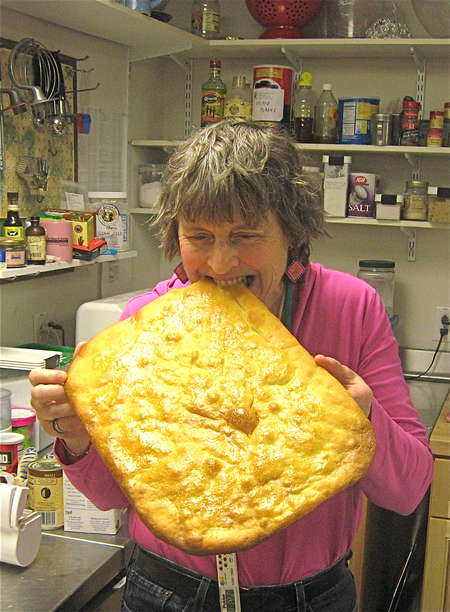
For dinner, I’ll often make a couple of big slabs of focaccia; they keep well, and cut-off squares reheat easily in the toaster. And boy, don’t I love focaccia… I couldn’t resist taking a bite of one, hot out of the oven, and our roving kitchen photographer (a.k.a. Andrea) caught me!
Other times I make something whole-grainy. My favorite is Raisin Rye Pecan Bread. Even though it’s more breakfast- than dinner-like, I just plain enjoy it. And the sweetness of the raisins, plus nuttiness of the pecans, often marries quite well with the beef stew, curried chicken and veggies, or whatever leftovers we happen to be having.
One recent weekend I was paging through one of the professional baking magazines I receive, and an article caught my eye:
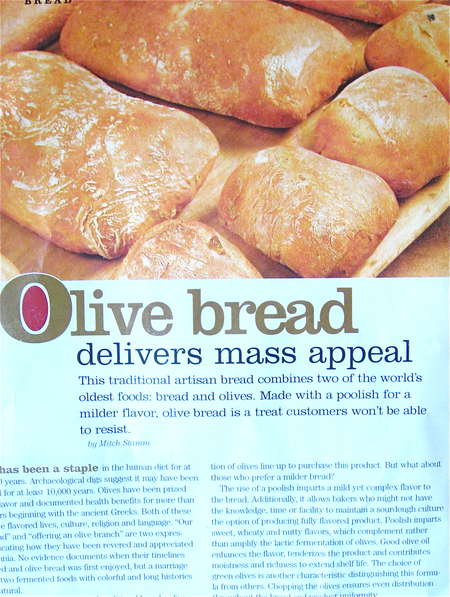
Ahhh, olives… one of my favorite food groups. Groups? Well, there’s olive oil, of course, my favorite all-purpose fat: extra-virgin first-pressed for salad; mild “light” (inexpensive) oil for bread-baking; a peppery version enhanced with garlic for bread-dipping…
Then there are the olives themselves: black out of the can, green out of the jar, or any of the wonderfully tasty versions (big, meaty Cerignolas are a current favorite) from the fresh foods section at the supermarket. And let’s not forget tapenade, and green olives stuffed not with the plebeian pimiento, but with garlic cloves, or even anchovies… Well, you get the picture. Olives are always in my fridge.
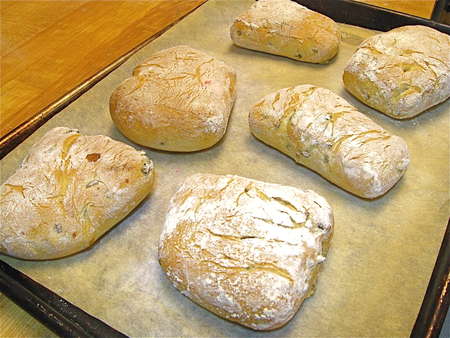
Thus olive bread spoke to me. I read the recipe, which made 16 dozen rolls; cut it down to home size; and quickly threw them together here at work. WOW. Nice. Chewy, tasty, little bits of green olive scattered throughout. And they looked really “professional,” with their shaggy, floury surface. (Everyone was asking, “Hey, who made the ciabatta rolls? they look gorgeous!”)
Then, the true test: I brought them home. Would they translate to a dinner bread? Absolutely. With spaghetti, as the buns for hamburgers, with grilled spareribs… Plain enough to go with anything, tasty enough to stand alone (with a drizzle of olive oil, naturally), these rolls have made it into my permanent repertoire.
Like baguettes, these rise in a floured cloth. That’s what gives them their pretty crust. Please don’t skip this step; it’s easy, and really does give the rolls a professional look. As befits their professional magazine (“Modern Baking”, fyi) origin.
Hope you enjoy these Olive Rolls.
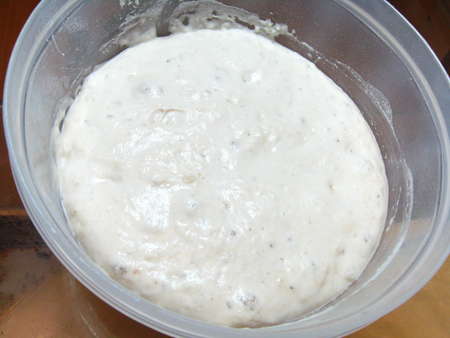
First, make a starter. Flour, water, and yeast will bubble and expand overnight, giving the rolls a jump-start on both texture (a better rise) and flavor.
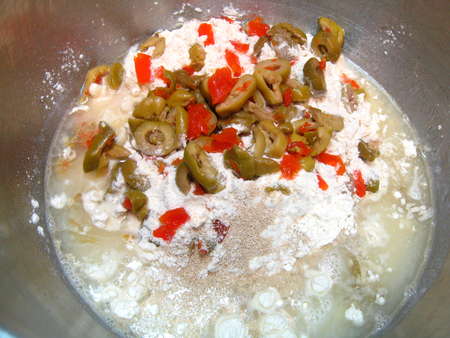
Combine the starter with the remaining dough ingredients; I’ve used plain-jane bottled green olives here, but use the ones of your choice. If they’re bottled in liquid, sqeeze them dry before adding to your dough.
Just about 5 minutes later, in a stand mixer, you’ve made a soft, fairly sticky dough.
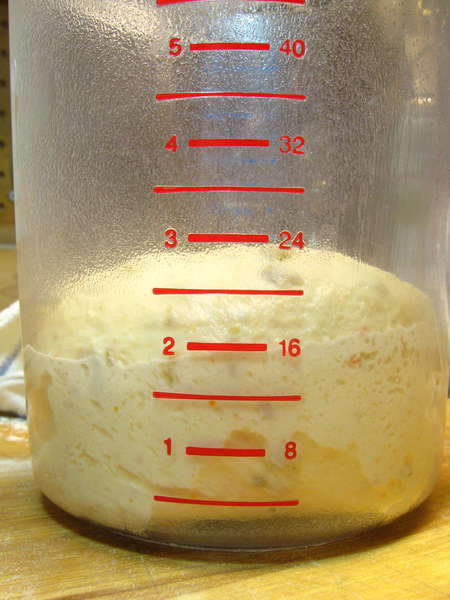
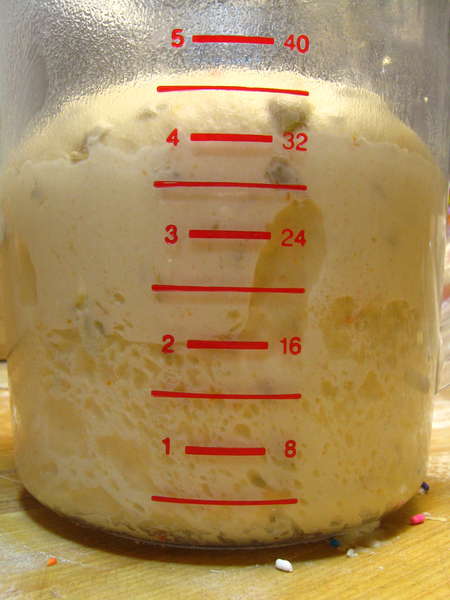
Put it in a lightly greased, covered container…
…and let it rise for about an hour. It’ll get nice and puffy.
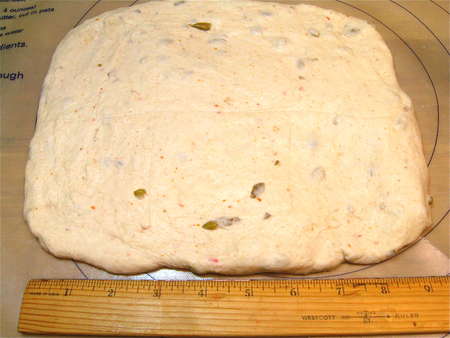
Gently deflate the dough, and pat it into a 9” x 8” rectangle. Make the corners as square as you can; this will result in a prettier roll.
Cut the dough into six 3” x 4” rectangles.
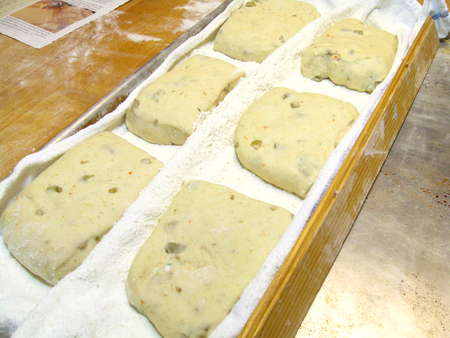
Place the rolls in the folds of a floured couche or cotton towel. There’s no secret technique here; simply sprinkle a smooth cotton towel with flour, rubbing it in gently and shaking off much of the excess.
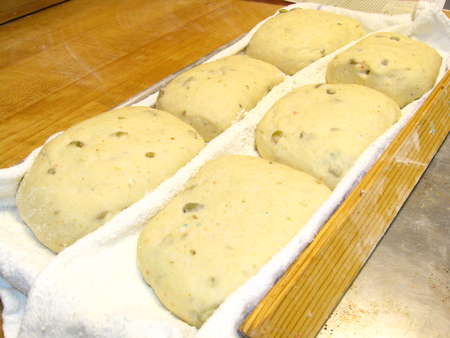
Let the rolls rise, covered, for 60 to 90 minutes. They’ll become nicely puffy.
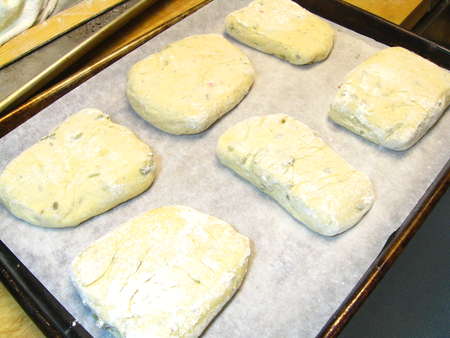
Gently pick up the rolls and place them, floured side up, on a parchment-lined or lightly greased baking sheet. Put them in the oven…
…and 25 minutes later, voilà! Olive rolls.
A wonderful addition to the bread basket.
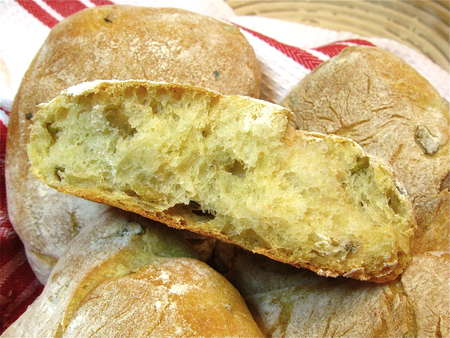
And look at that nice, open texture. Break out the olive oil!
Check out our recipe for Rustic Olive Rolls.

Buy vs. Bake
BUY: Artisan bakery 20-ounce olive bread: $4.50, 23¢/ounce
BAKE: Homemade olive rolls (ingredients cost): $2.24, 11¢/ounce
May 5th, 2008 at 8:48 am
These look wonderful, but unfortunately I’m not crazy about olives. Do you think I could substitute golden raisins, or dried cranberries, and get the same result? Should I plump them first? Would the recipe work as written if I just left them out? Thanks!
May 5th, 2008 at 9:19 am
Sure, Audrey, either leave them out or substitute (no pluming required). In which case you should increase the salt to 1 1/4 teaspoons, to make up for the saltiness you’re losing by eliminating the olives.
May 5th, 2008 at 10:13 am
Sounds so good! Would baking the dough in one big, free-formed loaf work for this recipe? Just bake longer?
Thanks!
May 5th, 2008 at 10:29 am
If I were to substitute garlic for the olives should I roast the cloves first - or should I chop them and saute them in olive oil- or can they be added “as is”?
May 5th, 2008 at 10:44 am
Can this dough be made with a bread machine instead of mixer?
May 5th, 2008 at 11:01 am
Would love to have combination for the filling you used shown on KA’s website, not sure, feta, sun dried tomatoes, kalamata olives??
Can’t wait to make this. Reminds me of my favorite pizza with cheese and green olives!!
May 5th, 2008 at 11:02 am
Allison, yes, bake it in a big freeform loaf, it’ll be fine. I’d imagine, depending on the shape of the loaf, it would bake for 35-40 minutes or so? Give it a try.
Gwenn, yeast doesn’t like fresh garlic. So I’d let the rolls rise first, then knead the garlic in after that first rise. Roasted cloves will fall all to pieces, they’re so mushy. Sautéed cloves (maybe cut in half before frying) would probably be better.
Carol, yes, make the dough with a bread machine. That’s usually what I do. The bread machine kneads dough better than any other tool: hands, food processor, or stand mixer.
May 5th, 2008 at 11:25 am
PJ, what is the container you use for the dough to rise? Does the Baker’s Catalogue carry it? thanks.
May 5th, 2008 at 12:29 pm
Hi Beth - it’s a big ol’ Rubbermaid food service 8-cup measuring cup. We don’t sell that one, but we’re hopefully going to offer one this fall from Cambro-
May 5th, 2008 at 1:00 pm
Anita, yes, it’s feta cheese, pitted olives (Kalamata, oil-cured black, take your pick), sun-dried tomatoes (snipped into pieces); plus olive oil to moisten if you like. Coarsely chopped garlic cloves and dried oregano optional.
May 5th, 2008 at 1:05 pm
Hi Beth, Do the crusts really come out crispy, not so soft but chewy like the artisan breads, and does the inside come out porous? I’m not sure if I am explaining it correctly. Do I need to have a tile or something like that in the oven to make the top chewy like the real Italian bread? I tried it once and the bread came out soft on top. I don’t know what I did wrong. Help!
May 5th, 2008 at 2:39 pm
Can I substitute whole wheat flour in this recipe?
May 5th, 2008 at 3:15 pm
Great questions options and ideas! The quick responses
from P.J. are just an example of why this website “ROCKS”!!!! Please don’t stop what you’re doing, it really is terrific!
May 5th, 2008 at 3:54 pm
Mary, the crust on these rolls is chewy (not crisp), and the inside is porous. You don’t need a tile or stone; raising them in the floured towel does help with the chewy crust, though. Also be sure to bake at the specified (hot) temperature.
Bill, you can substitute whole wheat but the rolls will be entirely different: denser, heavier, drier, without the nice interior holes. That’s pretty much the nature of whole wheat. Try substituting 1 cup whole wheat first, then go to 2 cups if you find 1 cup acceptable, then 3. That way you can see what spot along the way you really prefer.
May 5th, 2008 at 4:18 pm
Oooh, I see po’ boys and paninis coming up! I may have to stay home from work one day this week just to make these.
May 5th, 2008 at 4:30 pm
My mouth is watering just looking at the pictures and reading the instructions! I love the idea of olives in the bread. I usually use a large overn size stone for my breads..got it from you guys and hand carried it on a plane clear across the country to the West Coast. Wil this change the outside texture much?
May 5th, 2008 at 5:23 pm
When I cover the rolls for the second rise, what is the best for covering? Plastic wrap, dish towel (damp or dry?) or something else.
May 5th, 2008 at 5:23 pm
Holly, a stone sounds good - they’ll just be crisper on the bottom, that’s all. I can see you and your stone must be attached at the hip - those things weigh a ton! You must have had a fun time legging it through terminals that day…
May 5th, 2008 at 8:27 pm
Ellen, I usually use a big clear plastic cover that came on a deli takeout platter from the supermarket. It’s nice because it doesn’t sit on top of the rolls, but keeps them moist and safe from drafts. I wouldn’t suggest a wet cloth. Try greased plastic wrap, which you drape over them VERY LIGHTLY.
May 5th, 2008 at 11:23 pm
For rising I have found a half-sheet pan fits perfectly in my microwave oven. I mist the inside of the microwave with water and run it for about 20 seconds just to warm it a litttle. Then I put the pan of rising bread (whatever I am making) inside the microwave and it is free from drafts. If it needs to be in a long time I just open and mist once an hour or so.
May 6th, 2008 at 7:16 am
These look delish! I always have a starter going in my fridge (her name is Zelda…!) Can I use that instead of waiting for the just made starter? How much would I use?
May 6th, 2008 at 8:27 am
Candace, it would depend on the consistency of your starter, how much to use; you want starter that equals 1 cup flour + 1/2 cup water, so hopefully you can figure out how much of your starter to use going by that guideline-
May 6th, 2008 at 12:17 pm
WOW!!! Thank you this is the best bread I have ever made.
I burned my fingers on the pan taking them out of the oven I got so excited! I used the hints above for another type of bread and didnt include the garlic until after the first rise, thank you it rose so much better
I changed that recipe using the guide lines from the rolls and it is fab.
I also made the scall bread. wow another hit. There is a party at my house tonight and the bread is done thanks to you.
I am comming back for more.
May 6th, 2008 at 6:44 pm
Hey,
I think a great modification for the would be halepeno peppers in the dough along with a garlic clove. I tried this as it is posted here and it has great.. thanks once again.
May 7th, 2008 at 9:04 am
These look great, I can’t wait to try them. Question - I have some garlic stuffed green olives marinated in Chardonay. The particular jar I have right now is very salty - should I rinse the olives before using them in the recipe? Also, is the recipe for that beautiful foccacia on the site?
May 7th, 2008 at 9:12 am
Hi Erik - yes, rinse the olives if they’re very salty; too much salt slows down the bread’s rise. And the focaccia recipe is indeed in the recipe section at kingarthurflour.com; it’s called Golden Focaccia. I’d make a link for you here but I haven’t QUITE figured out how to do that yet… : )
May 8th, 2008 at 9:26 am
In your recipe you mention “freestanding covers.” Does this mean you will be offering this item for sale again?
May 8th, 2008 at 11:35 am
No, Ruth, I wish! Manufacturer quit making them. I often use the clear plastic cover from a big supermarket “party platter;” if you ever get a big store-bought sheet cake, they often come with a nice big plastic cover, too. Save and reuse for your rising dough.
May 8th, 2008 at 12:07 pm
Thanks for the great recipes. I can’t wait to try the Scali bread and the Olive rolls. PJ, thanks for the idea to use the clear plastic covers from store bought cakes. I never would have thought of doing that but I will now.
May 8th, 2008 at 3:48 pm
I just made these rolls in the Zojirushi breadmaker purchased from King Arthur a mere two weeks ago. What a joy these rolls were to make. I had no idea the zoji could make such gorgeous dough and indeed it did it beautifully for these savory rolls. Please keep recipes like these coming often!! Your blog is an excellent resource. Thank you from Melissa in Seattle.
May 9th, 2008 at 8:54 am
Wow! The next time I make hamburger buns, I will try these. Currently, I have been making my hamburger buns from a recipe I copied from the King Arthur Catalog; Moomies Beautiful Burger Buns. They are wonderful, and people always comment on the “wonderful buns; Did you make them?” We always have olives in our fridge, too, and olive oil is my favorite cooking oil, and baking, and salad dressing. We have “deluxe” hamburgers when our garden tomatoes are ripe; grilled burgers topped with garden fresh tomatoes and a mixture of chopped green olives and miracle whip. These olive buns would put deluxe hamburgers over the top! Thanks for the recipe
May 9th, 2008 at 1:02 pm
I love olives and I love olive bread, though I have never tried to make it. I have never heard of using green olives in olive bread, much less pimento stuffed green olives! Rather untraditional. I plan to try the recipe using oil cured or Kalamata black olives.
May 9th, 2008 at 3:02 pm
Just a hint I picked up on a YouTube video of someone making similar ’square’ rolls. Instead of letting the dough rise in a big measuring cup or bowl, etc., this restaurant cook put the dough in a square plastic container (I think he used old square ice-cream tubs). When the dough had risen, he turned it out and it was already square. It deflated instantly when he turned it out, and he gave it a few rolls with a rolling pin (working from the middle outward) and in seconds he had a perfect square of dough the size he wanted for his rolls.
They didn’t turn out looking machine-made, but they were of more or less uniform size and shape. Seemed like a cool trick to me, because I never seem to be able to get a square dough (like for cinnamon rolls) square when I try to roll it square starting from a circle.
May 9th, 2008 at 11:14 pm
Annette - what can I say, I’m a cheapskate - Kalamata or oil-cured olives would be delicious, of course.
Nel, now that you mention it, I’ve seen that done, too. I’m going to see if I can rustle up a square or rectangular tub that’s the right size for next time. Thanks!
May 10th, 2008 at 7:42 pm
I tried the recipe for the Rustic Olive rolls. Everything went fine until I went to move them from the floured cloth to the baking sheet. They were so soft they just deflated. The dough was quite sticky. It didn’t appear to be as firm as your rolls in the picture. Do you think I should have added more flour, or can you offer any suggestions?
I’ve had the same problems trying to make baguettes. All is fine until I try to move to the baking sheet then everything deflates. Help!
May 10th, 2008 at 10:50 pm
Sue, I think you’re letting your baguettes and rolls rise too long. Let them expand only till they’re about 3/4 of the way to doubled; if they expand too much, 1) they’re hard to handle (as you’ve noticed), and 2) they don’t show much oven-spring, which is that lovely big rise once they hit the heat of the oven. Also, as you say, the dough may be a bit too soft; maybe you live somewhere humid, or for some reason your flour/liquid ratios are a bit different than the ones we encounter here in Vermont. Whatever, it’s a good idea to adjust the amounts of flour and water till you’ve got a good ratio for YOUR environment, which may be different than what the recipe says. Good luck -
May 12th, 2008 at 9:38 am
Hi PJ,
I made my starter on Friday but found it to be very dry. Saturday it had risen a little but did not look anything like your picture which looked soft and spongy. Mine was just very dry. I continued with the recipe anyway. The rolls were rather flat. They tasted delicious and with a small knife we managed to cut them and make sandwiches. I just wonder what could have gone wrong with the starter. The yeast was fresh. Could it have been the flour? I used King Arthur Bread Flour that I have had in the fridge for awhile. Does flour get old? I will definitely try this again even though I had less than perfect results. It just makes me more determined to get it right. Thanks for any help you can give me.
Joyce
May 12th, 2008 at 3:27 pm
Joyce, flour stored in the fridge does tend to dry out.Since there’s no need to keep bread flour refrigerated (unless you have a chronic bug problem), I’d leave it at room temperature in the future. Whole grains in the freezer, yes; AP or bread flour on the counter are fine. When you originally mix the starter, it should be gooey/pasty, not at all dry. You shouldn’t have any trouble getting all of the flour into the mixture. If your starter is very dry, simply add more liquid; it’ll be fine. And I think that’ll help the bread all along the way.
Also, if you used RapidRise yeast, that’s not a good choice - be sure to use instant or active dry. Good luck when you try them again!
May 12th, 2008 at 4:26 pm
As a follow up to Sue’s question and PJ’s answer, would it be possible to do an article about the various adjustments needed for different climates?
Also I’d love to have some kind of ‘Baking 101′, like ‘what to do if the starter is to dry or is it to dry at all?’ etc. There is an incredible amount of information in the posts and comments, but it’s very hard to find when you are in a pinch.
This is such a great blog, I’m coming often just to check if there is something new up. Thanks!
May 13th, 2008 at 7:41 am
Thanks PJ. I used active dry yeast. Maybe it was the flour. Since I have had the flour for awhile, I think I will just buy another bag of flour and try again. Thank you for the input.
Joyce