
Home | About | Contact
800.827.6836 | Norwich, Vermont

shopping cart  
0 items in cart | checkout »

“How do you make that bread with the big holes?” Secrets of ciabatta revealed.

September 22nd, 2008 by PJ Hamel

img_7844.JPG

It’s the ne plus ultra of artisan bread.

The gold medalist (whoops, make that King Arthurist) of chewy loaves.

The Holey Grail.

I’m speaking, of course, of ciabatta, that light-as-air, hole-riddled loaf beloved of rustic-loaf bakers everywhere. (“Rustic” describing the loaves, of course; although perhaps some of the bakers as well.)

Here at King Arthur Flour, “How do I get those big, irregular holes in my bread?” is one of the most common questions we get on our baker’s hotline (open days/evenings, 802-649-3717; call us.) And, while there are numerous paths to that destination, the most reliable I’ve found is a very slack (wet) dough, one that’s challenging to work with because it’s so sticky and oozy and elastic. But one that, ultimately, yields a rich harvest of holes. And flavor.

I’ve made ciabatta a lot—about as many times as you’re heard the word “change” coming from the mouths of our Presidential candidates in the past month or so. And it’s definitely a “practice makes perfect” scenario.

Eventually, you learn just how slack the dough can be without being SO slack that it spreads, rather than rises. At last, you figure out just how long you can let the shaped loaves rise before they collapse. In other words, this bread is not without its challenges.

But by following the directions and the pictures below, you’ve got a really good shot at success. And even if you don’t get a loaf with HUGE holes, it’ll still be delightfully chewy and richly flavored.

So here we go: let’s take the Ciabatta Challenge.
img_7735.JPG

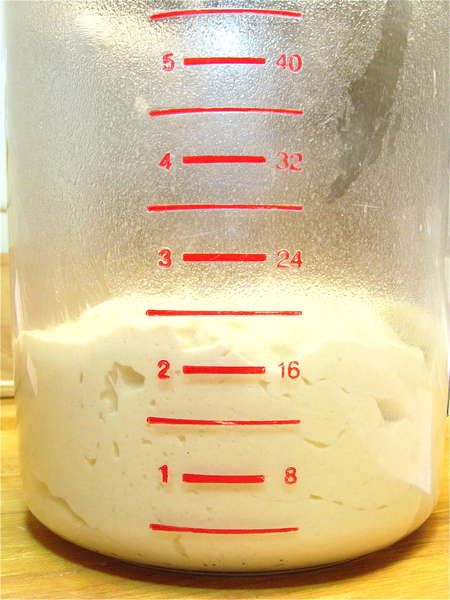
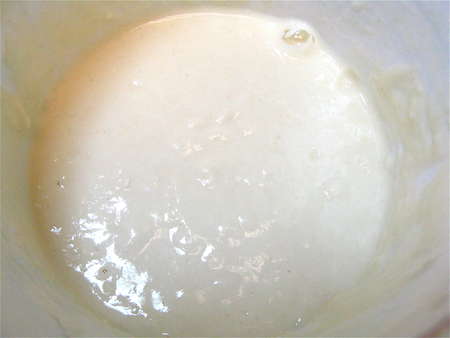
First, make the overnight starter. For simple breads, breads made with flour, water, yeast, and salt, an overnight starter gives the yeast a nice, long window in which to perform its magic—which is not only raising the bread, but giving it marvelous flavor. As yeast grows, it gives off alcohol and organic acids, both of which are flavor enhancers. Thus, the longer yeast grows, the more flavorful your bread will be.
img_7737.JPG

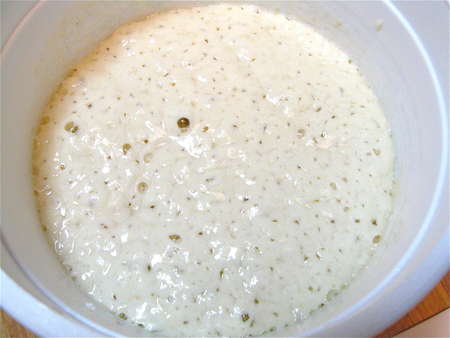
Here it is the next day, nice and bubbly. This starter has had about a 15-hour rise at room temperature.
img_7738.JPG

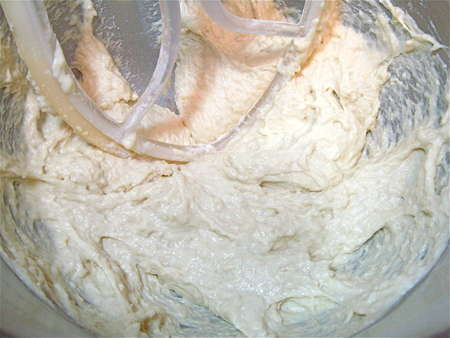
Mix the starter with the remaining dough ingredients.
img_7747.JPG

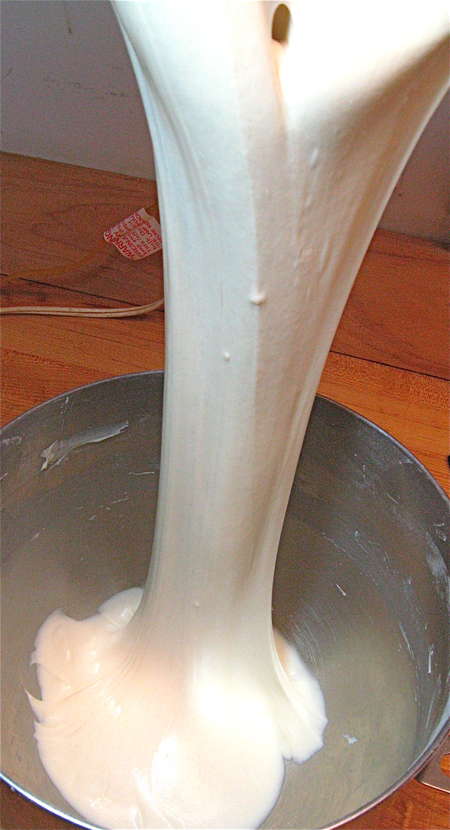
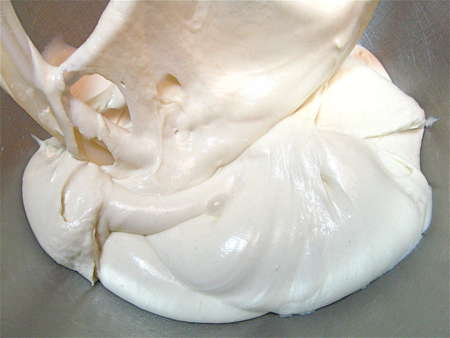
Knead till smooth; it’ll be silky-smooth. This dough is so soft, it really can’t be kneaded by hand; it needs a mixer or bread machine. Or food processor, I imagine, though I haven’t tried that method with this dough.

img_7744.JPG

Talk about elastic… You go, gluten!

img_5386.JPG

Now you’re going to let the dough rise for about an hour, deflate it, and let it rise again. This midstream deflation redistributes the yeast a bit, and offloads much of the CO2, making it easier for the yeast to grow.
img_5423.JPG

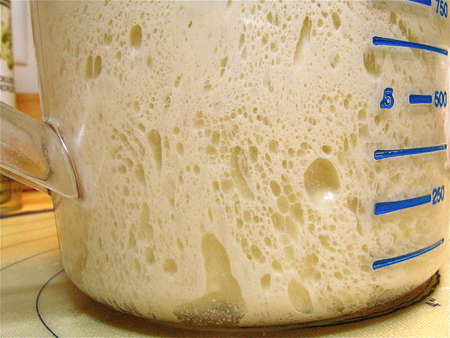
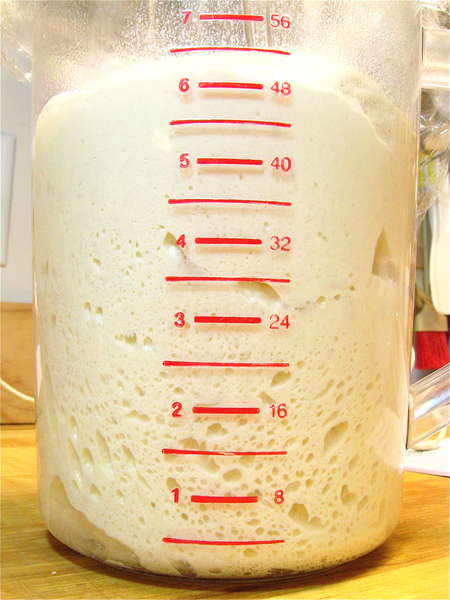
So here we are after 2 hours; despite deflating it after an hour, it’s risen to great heights.

img_5504.JPG

Look at those nice bubbles! I love to use this 8-cup clear measuring cup for dough rising. You get such a nice view of everything that’s happening.

img_7751.JPG

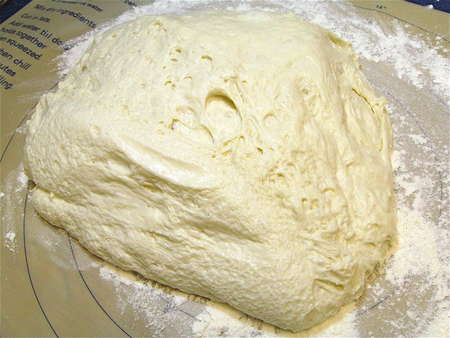
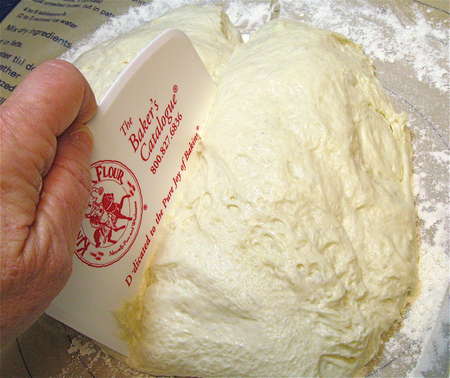
Next, turn the dough out onto a lightly greased or floured work surface. No need to punch it down; I don’t believe in violence when it comes to yeast dough. It’ll gently deflate itself a bit as you handle it.
img_7752.JPG

Cut the dough in half.

img_7754.JPG

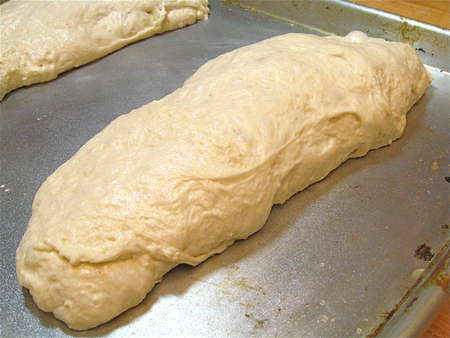
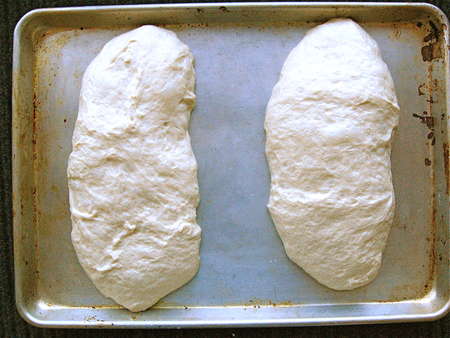
Pull/stretch it gently to make two logs, each about 10” x 4”. Place them on a lightly greased baking sheet.
img_7764.JPG

Cover, and let them rise for about 45 minutes, till they’re definitely showing some puff.

img_7766.JPG

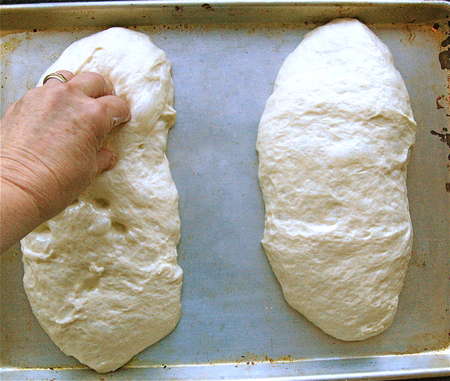
Dimple gently but firmly with your oiled or wet fingers. They’ll deflate a bit; that’s OK.

img_7769.JPG

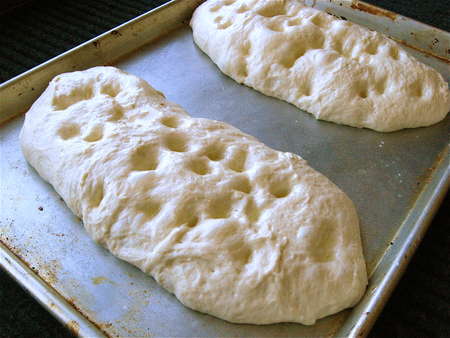
They should look about like this.

img_7778.JPG

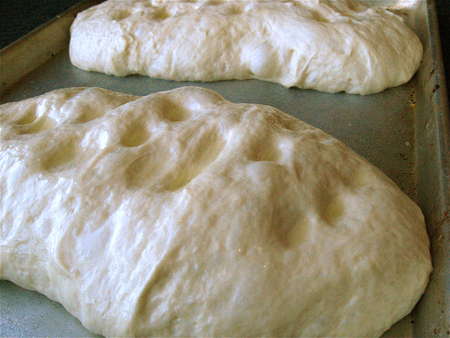
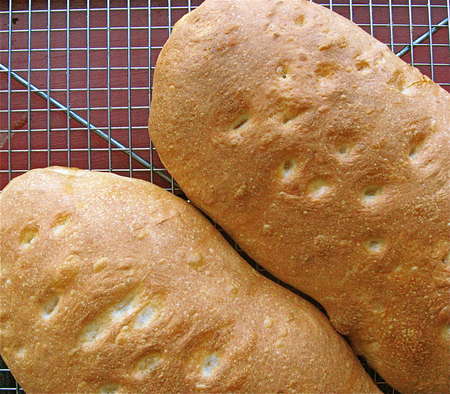
And after they’ve finished rising, they’ll look like this. The dimples will have filled in somewhat, but will still be apparent.
img_7786.JPG

Spritz with water, and bake till golden brown. For extra crispness, cool right on the rack in the turned-off oven; prop the oven door open with a folded-over potholder.
img_7865.JPG

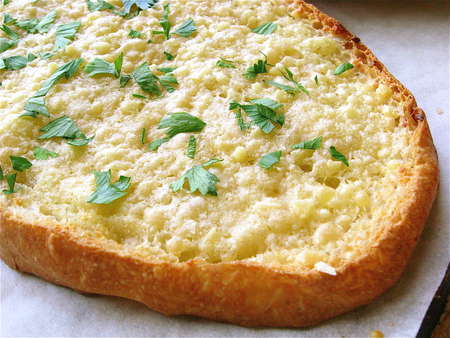
Next up: garlic bread. But not that squishy, pallid version made with garlic salt (ewwwww) and dried parsley. No, THIS gourmet garlic bread, made on your own homemade ciabatta, features butter, olive oil, fresh garlic, coarsely grated Parmesan, and a fresh parsley garnish.
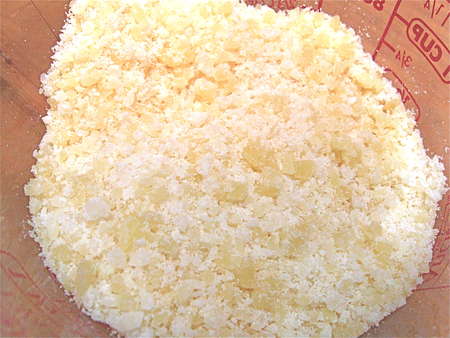
img_7749.JPG

Freshly grated Parmesan is key. PLEASE don’t use that stuff in the can. You need cheese that’s moist and nubbly in texture, not dry and sawdust-y.
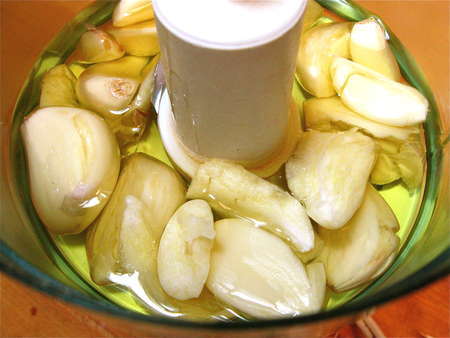
img_7854.JPG

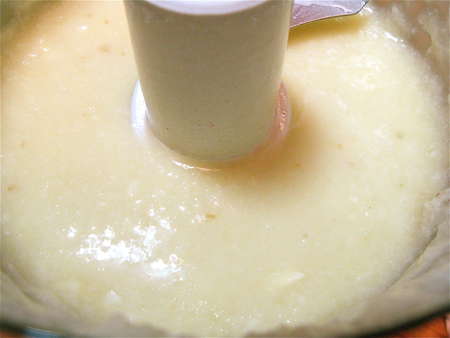
Next, fresh garlic cloves and olive oil…

img_7855.JPG

…emulsified in a mini food processor or blender. Stir in melted butter and a pinch of salt…

img_7857.JPG

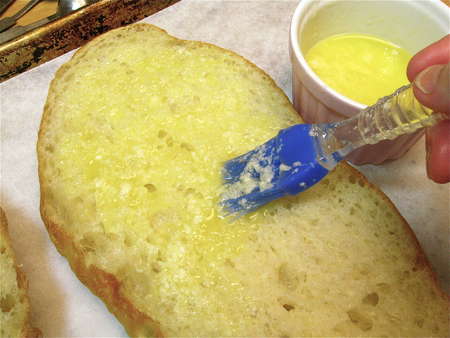
…then brush on the ciabatta, which you’ve cut in half to make two big top-and-bottom pieces.
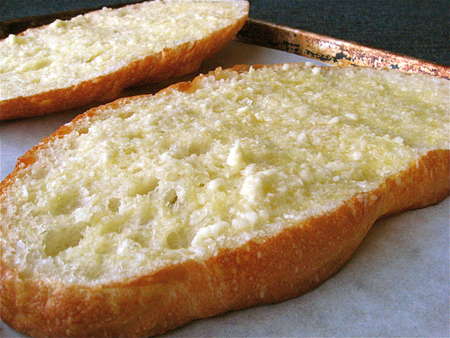
img_7859.JPG

Here it is, ready to go into the oven. No cheese yet.
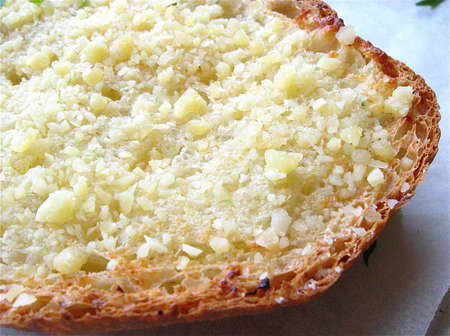
img_7867.JPG

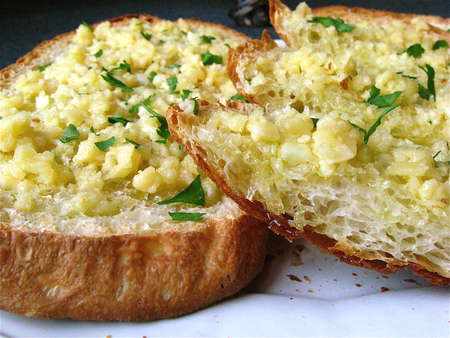
And here it is baked (notice the brown edges), and topped with Parmesan. The hot bread will soften the Parmesan just a bit.
img_5570.JPG

Sprinkle with freshly snipped parsley, if desired.
img_7873.JPG

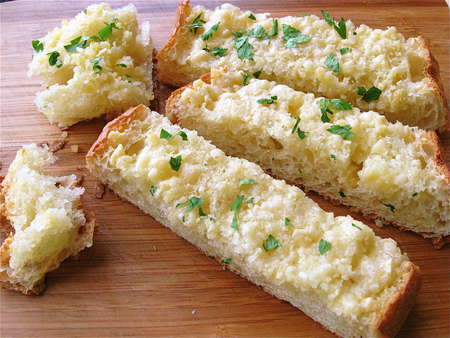
And serve to great acclamation by garlic lovers everywhere.
img_5604.JPG

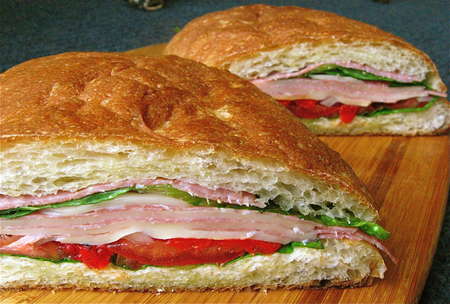
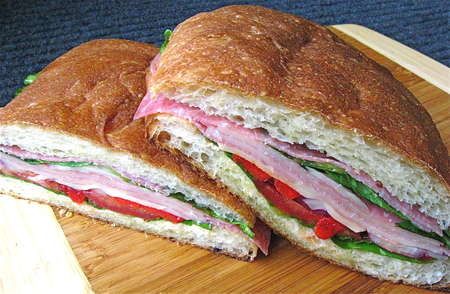
Be still my heart! This is Italian pan bagna, literally “bathed bread.” Doesn’t it look good? A “true” pan bagna is made with tuna and hard-boiled eggs, but I’ve substituted some of my favorite sub (hoagie, grinder, hero…) fillings here.

img_5520.JPG

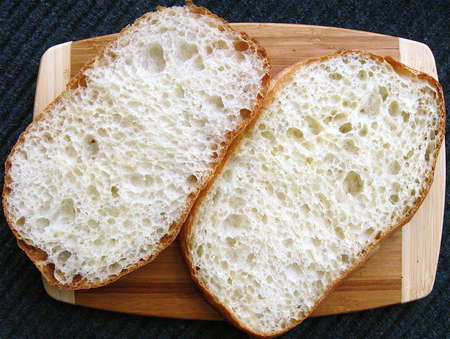
Cut the ciabatta in half around its circumference, as befits a  mega-sandwich.
img_5528.JPG

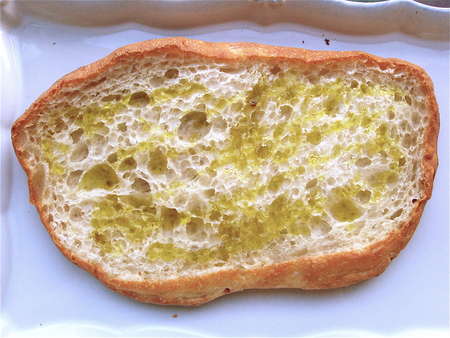
Drizzle or brush both halves with olive oil.
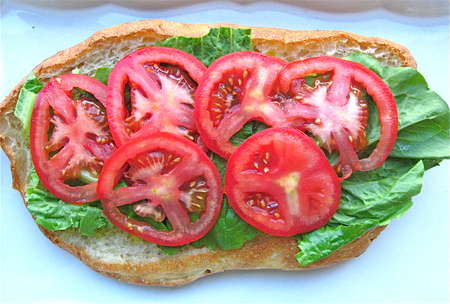
img_5529.JPG

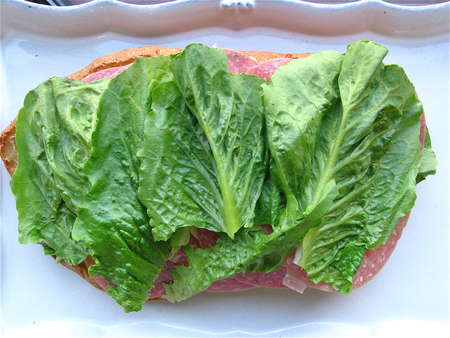
I like to start with a layer of lettuce, as it shields the bread from juicier ingredients, preventing it from becoming soggy.
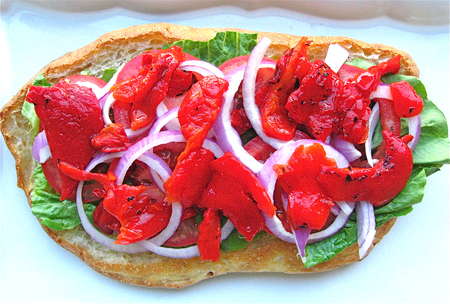
img_5531.JPG

Tomatoes, red onions, roasted red peppers…

img_5532.JPG

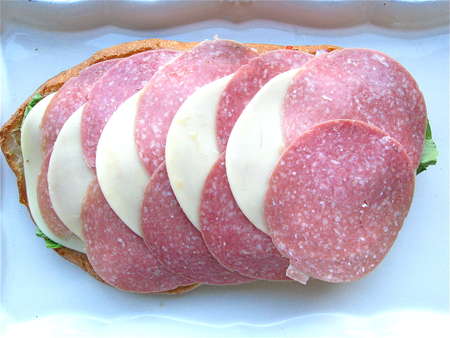
Provolone and salami…

img_5534.JPG

More lettuce, to enclose the juicy stuff from the top…

img_5535.JPG

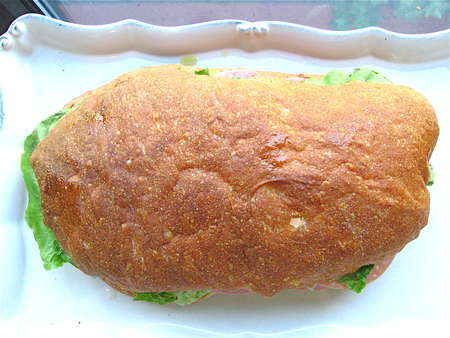
And here it is, not QUITE ready to eat.
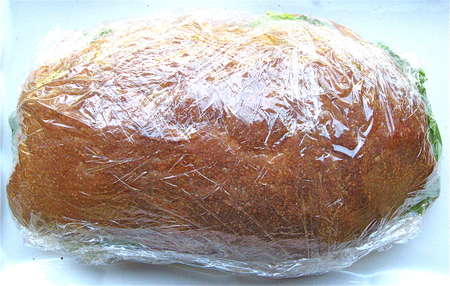
img_5537.JPG

Wrap the pan bagna in plastic wrap, then in aluminum foil.
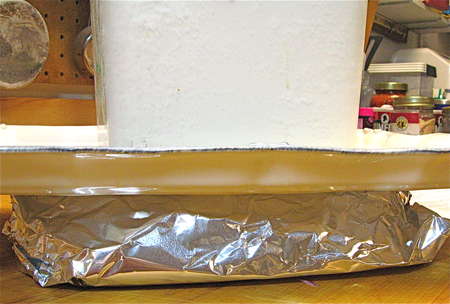
img_5538.JPG

Finally, weigh it down with something heavy for a few hours. Here I’m using a baking sheet topped with my flour bucket. This weighing down compresses the sandwich and its filling, melding everything together nicely.
img_5599.JPG

Unwrap, slice, and serve. Enjoy!

Read, review, and rate (please!) our recipe for Ciabatta Three Ways, including bread, garlic bread, and pan bagna.

Buy vs. Bake, Ciabatta

Buy: Panera, Ciabatta, 6.25 ounce loaf, $3.29

Nature’s Promise Ciabatta Bread, 11 oz. loaf, $3.49

Bake at home: Ciabatta, two 12-ounce loaves, 55¢ each

Buy vs. Bake, Garlic Bread

Buy: Morgan Street Brewery, St. Louis, MO. Three Cheese Garlic Bread, fresh-baked with provolone, mozzarella and Parmesan, $5.25 

La Famiglia Giorgio, Boston, Mass. Garlic Bread: Slices of French bread brushed with extra-virgin olive oil and minced garlic served hot from the oven,  $3.95

Bake at home: Garlic bread with fresh garlic, butter, olive oil, fresh Parmesan, and fresh parsley, one open-faced half-loaf, $1.36.

Buy vs. Bake, Pan Bagna

Buy: Patisserie Didier Dumas, Nyack, NY: Pan Bagna, a crunchy baguette with basil pesto, tuna salad, tomato, mesclun leaves, and  slices of hard-boiled egg, $6.95

Bistro Moderne, Houston, TX: Pan Bagna au Thon: Provencal tuna sandwich with tomato, eggs, artichokes and radishes, $15

Chez Jacques, Milwaukee, WI: Pan Bagna, chicken or tuna, $7.50

Make at home: Pan bagna stuffed with Boar’s head provolone and salami, lettuce, tomato, red onion, and roasted red peppers, half of one large (12”) sandwich, $2.92


Pin It

56 Comments on ““How do you make that bread with the big holes?” Secrets of ciabatta revealed.”

  1. Ivete Says:

    Thank you for the step-by-step photos! Every time I’ve made super-wet dough bread I always think I’m doing something wrong . . . it just doesn’t LOOK like bread! Now I know what it’s supposed to look like and will be trying this recipe next time I want those awesome holes!

    Here’s my burning question about this type of bread: how the heck do you get the dough of your hands/fingers after handling such wet dough?

    I have to scrub with a brush to get it all off . . . and then I worry about the dough going down the drain and getting stuck in the sink (did you ever clog your sink with dough? I have, it wasn’t pretty). Please tell me I’m not the only nutcase who thinks this is the worst part of wet-dough bread!

    Hi Ivete,
    Nope, it isn’t just you! I can’t think of any bakers who love the clean up of wet dough. The easiest thing to do is a dry flour wash, or ‘dry wash’. Over the trash can, take a good handful of flour, and rub it all over your hands. It will stiffen up the dough on your fingers, and it will rub right off. You definitely don’t want to do this over the sink, it will clog for sure.
    Happy Baking! MaryJane @ The Baker’s Hotline

    Also, I oil my hands with olive oil when shaping this bread. Keeps the dough from sticking, AND makes your hands nice and smooth to boot! PJH

  2. fishes and loaves Says:

    O, thank you for this wonderful post and such a great bread recipe. Not to mention the neat options for serving it up. I’m so grateful that you go through the whole process for us. You save me lots of mistakes and have put the “fun” back in baking bread for me!

    Can’t wait to make this one and share it with all my foodie friends!

  3. Ivete Says:

    Thanks for the cleanup tips! I can’t believe it never occurred to me to grease my hands, seems so obvious! And the “dry wash” is also a great tip, I’m definitely trying both next time! Thanks!

  4. Trish Says:

    As usual another winner of a recipe from K.A. – I can’t wait to try this!

    Trish

  5. rimholz Says:

    What will happen if I use bread flour for this recipe rather than all purpose flour?

    It’s fine, just use more water. Try an extra 2 tablespoons, see if it gives you that nice, soft, shiny dough. If not, add a bit more and knead till smooth… PJH

  6. Susan Says:

    Oh, baby. That pan bagnat is the absolute favorite lunchbox sandwich for my children. I also love it because I can make one big sandwich the night before, have a child sit on it(!) — well wrapped, of course — for a few minutes while they do homework to squash the sandwich — they love that part — then put it in the fridge under a brick until morning, when I can slice off pieces and individually wrap them for each lunchbox. I can add just about anything to that sandwich — roasted peppers, caramelized onions, goat cheese, pesto, tuna or sardines even — and they still love it.
    I can’t wait to make it with this bread!!
    We all thank you, PJ!

    Interesting (for word lovers) difference here, Susan – pan bagnat is the French (northern Mediterranean) version, pan bagna, the Italian (southern Mediterranean). Pan bagnat, as you mention, almost always has sardines or tuna, plus hard-boiled eggs; pan bagna can have anything. I love the vision of your kids sitting on the sandwich; I’ll bet there’s some giggling going on there for sure. What a good mom, sending the kids off with such a creative lunch! And yes, I’m sure you’ll like it on this ciabatta. Have fun- PJH

  7. Dave Says:

    Can you leave starter out too long? I wanted to make this after dinner tonight so I made the starter last night. Of course, not planning ahead that puts it at about 20 hours before I would get back to it. Do I need to take the afternoon off and make this?

    Starter is pretty flexible. If it’s bubbly, just put it back in the fridge until you get the time to make the bread. You will need to feed it again before you use it, though. Molly

    Dave, if you’re talking about the overnight starter for this ciabatta – as opposed to sourdough starter – just put it in the fridge and use it later tonight. No need to feed it, it should be fine. PJH

  8. Cindy Says:

    Your recipe calls for instant yeast. But we only have regular Fleischmans. How would that change things? You would need to dissolve your yeast in a small amount of the water called for in the recipe, before you added the remaining ingredients. You might want to add an additional 1/4 teaspoon of yeast to the dough, as instant yeast is a little bit stronger than active dry. But have fun with it. Mary @ King Arthur Flour

  9. Andrea Says:

    Ohhh…you mentioned Chez Jacques! If you’re ever in Milwaukee, that restaurant is INDEED a treat.

    But…I like to make my own. :) I looooove. ciabatta. Foccacia. Mmm…

  10. Kelly Says:

    Thanks for the tutorial! Ciabatta bread has been on my want-to-do list forever, but sadly, I don’t have a mixer! I’ve always told myself that someday I would try it by hand, just to see if it could be done, but haven’t worked up the nerve to. Thanks for the tutorial, maybe I’ll get to use it one day!

  11. Sally Says:

    Hello

    this is the same Sally who had problems with the sourdough bread posted a while ago

    I ended up ordering the sourdough starter from King Arthur and it arrived a couple of days ago – it is now ready to use!!!!

    I would love to use it to make this ciabatta bread – do you think it would work? Any adjustments would be necessary? Or should I not risk it?

    thanks again for your input….

    Sure, Sally, try this: Substitute 1 1/2 cups of “fed” sourdough starter for the overnight starter. Add an additional 2 to 4 tablespoons water to the dough. Let us know how it works! PJH

  12. Paula Says:

    Recipe sounds fantastic. Working with wet doughs have always scared me and I think I now have a new sense of confidence. I find that wearing oiled plastic disposible gloves makes handling dough much easier and the dough tends not to stick to the gloves. Clean up is also easier, just take off the gloves and throw away.

  13. Claire Says:

    I’ve made the ciabatta twice now and it always spreads much more than your pictures (and never gets that puffy). I scale my ingredients so I’m confident that I’m measuring correctly. Should I be adding more flour? I’m so frustrated. I would add 2 tablespoons more flour to start with. As PJ said, practice makes perfect. Keep good notes, remember how the dough feels when it works the way you want it , too, etc. Remember to have fun with it. Mary @ King Arthur Flour

    Claire, are you using King Arthur Unbleached All-Purpose Flour? It sounds like you have just a tad too much liquid in your recipe, which could be the case if you live somewhere humid, and your flour has absorbed moisture. Does your dough look like the picture? Soft, smooth, silky/shiny, able to hold its shape? Are you using instant yeast? SO many variables, but once you get the hang of it, it’s really a great bread. – PJH

  14. Maureen Brandreth Says:

    For Kelly, without a mixer or dough machine: take heart!
    there is a wonderful method of making artisanal breads developed
    by Jim Lahey of the Sullivan Street Bakery in NY City and publicized by the NY Times. Variations of it have appeared all over.

    Basically, the dough has the same rising time, but no kneading
    is needed! There are multiple rises, and the photographs here
    are very similar. The rising time can be from 12-18 hours.
    I used King Arthur European-Style Artisan Flour. It produces 1 round loaf.

  15. Dave Says:

    My bread came out great. it tastes really good. My only issue was that it “rose” on the lightly greased pans outward, not upward. I did have some issues with the dough to begin with. I started with bread flour and then switched to all purpose and the dough just stuck to the flat beater when I tried to kneed it in my stand mixer. Not sure if it was too wet or too dry. (I am too new at this)

    Other than that, my girlfriend loves it and I love it. Will have to try again and see what i did wrong.

    Next is the chocolate chip muffins. Chocolate Chip Muffins FTW!!!

  16. Shirley Says:

    I love this recipe Oh my it was really good . The aroma texture was really good . I just didn’t get it brown and crusty as I wanted but my oven temp. is off I like how you show the stepgreat help. thank you

  17. deb devo Says:

    I hope you understand how much joy you bring into people’s lives. I check this blog every morning and when I see a new picture I’m telling you that my heart speeds up and I am as interested in your ’story’ as in the recipe. I don’t know how you come up with all of these new recipes so often. I LOVE this blog and today, just after 9 in the morning, I am MOANING over the garlic bread and sandwich pictures. I have been a yeast bread maker for a long time (even teaching some people who were too scared to try on their own), but I have yet to try artisan type bread. Your pictures and encouragement of everyone are great and I will definitely try this. THANK YOU VERY MUCH for this blog and all of your work and commitment to good baking!

    And thank YOU, Deb, for taking the time to connect. Glad you’re enjoying it. Baking is all about creating and sharing—who could ask for anything more? – PJH

  18. Alvara Says:

    I made the ciabatta and it tastes great! While in the bread machine I was afraid that it was not wet enough and I added a tablespoon of water. I guess that was a mistake because my loaves spread out too much. Now I know for next time.
    My sourdough arrived in the mail yesterday. I fed it and now that is resting on the kitchen table. I can’t wait until I have it all ready to go. Now I have to go stock up on KA flour.

    Me and my fellow 167 King Arthur Flour co-owners thank you for your loyalty, Alvara! Have fun- PJH

  19. Mary Cay Says:

    My favorite ciabatta is a multigrain one at our local Hy-Vee grocery.What would you do to make your recipe with whole grains or as high a proportion as possible.Love your site!

    I’d start with half King Arthur white whole wheat flour – plus add some of our crunchy Harvest Grains Blend, maybe 1/2 cup. Increase the water by 3 tablespoons. I’m making an experienced guess here, so see how it goes- good luck! – PJH

  20. Susan Says:

    Hi, PJ. In response to your post about using fed sourdough, here’s an update — I used 6 1/2 ounces of fed sourdough starter instead of the overnight starter in your recipe, and then used all of the other ingredients in your ciabatta recipe. The dough is exactly as pictured — gorgeous, shiny, slack and elastic. It’s a great way to use fed starter!
    Thanks.

    YEE-HAW – glad it worked out well for you. And now we all know another way to use sourdough starter… PJH

  21. Allie Says:

    I made this bread today and it turned out perfectly. The recipe was very easy to follow. I used my bread machine for all the mixing and kneading and stuff. I’m so glad I found this blog. I plan to try that 2-hour apple pie next, if I can find some real apples off a real tree around here somewhere.

  22. SallyBR Says:

    I am way behind in my bread attempts…. instead of making the ciabatta, I decided to go BACK to the sourdough loaf and try it using the KA starter

    am I glad I did it or what???? It turned out spectacular! So I guess it is true, each starter has its own “personality” -

    I did not want to post in the sourdough thread, because it’s way in the back now, but will try the ciabatta in the near future, now that I need to keep my starter going!

  23. SallyBR Says:

    Reporting back again…. with special thanks for Susan – I used her method, 6.5 ounces of fed starter and made ciabatta last night

    turned out absolutely great, I will be making it again and again. Perfect for two people, extremely simple and easy to make

  24. Kathleen Says:

    But where’s the recipe?

    Kathleen, look at the very end of the pictures – you’ll find a link. PJH

  25. Kathleen Says:

    How did I miss that? Thank you! I HAVE to make this bread! My hubby doesn’t like sourdough (poor man), but enjoys this kind of bread.

  26. Mary Lu Says:

    I wanted to try the ciabatta recipe using my sour dough starter which needed feeding. I only had 4 ounces of AP flour, so I put in 4 oz. of wh wheat flour to come up with the 8 ounces needed. Is this bad? I am worrying that the oils in the wh wheat flour will not be good for the starter. Also, I normally discard the leftover starter when I do a feeding. You know how it says to remove all but 4 ounces. Is that right?Mary Lu, The whole wheat will work fine. Just change back once you have replenished your flour supply. Yes, you do discard at feeding. Call the Baker’s Hotline if you need a hand. Frank from KAF

  27. Mary Lu Says:

    Frank, thanks so much for your quick response. I am so happy to have this blog to read and to have a way to ask questions about my bread-baking adventures. This is terrific.

  28. Mary Lu Says:

    This ciabatta recipe only calls for 2 ounces of water and only 61/4 ounces of flour? I’m going to give this a go today, but I’m surprised by how little water and flour is required for two loaves. The only other ciabatta recipe I have (from the KAF Baking School I attended in August) calls for 8 ounces of water and 13 ounces of flour to yield two loaves. Just curious. Is it the nonfat milk or olive oil that produces a slack dough? I’m excited to try this. I’m going to use my sourdough starter.

    If you add the flour from the starter and the amount for the dough you will have 12 ounces of flour and again add the amount of water in the starter to the amount of water in the dough and you will have 10 ounces of water. It is the ratio of flour to water that creates a slack dough. Joan @ the baker’s hotline

  29. Mary Lu Says:

    I made the ciabatta using the sour dough starter and it came out great-tasting. The volume was different. It produced two loaves around 7 ounces each. This is actually perfect for me. Anyway, I used 6-1/2 ounces of starter as suggested by another baker on this blog and then followed the rest of the recipe as is. Thanks for all the help. Thanks for letting us know. Mary @ King Arthur Flour

  30. Rachelle "Mommy? I'm Hungry!" Says:

    This is one bread I’d love to learn to make. Seems easy enough thanks to your tutorial. Looks delish! Bookmarking this!

    Would love to hear how this turns out for you. Be sure to let us know!
    Happy Baking
    MaryJane @ The Baker’s Hotline

  31. Tom Says:

    I’ve never been happy with my ciabatta. My wife was out of town this past weekend so I decided to experiment to keep myself occupied. I also decided to follow directions precisely! (not my usual way of doing things!) I turned out two perfect loaves – so I did it again just to be sure it wasn’t a fluke. Thinking back, I don’t think I was mixing the dough nearly long enough in previous attempts. The step-by-step pictures are a huge help in getting things right.

    Tom

  32. David L. Greer Says:

    Allow me to submit several cooking/baking tips which you might wish to share site wide, etc..I’m surprised at the number of cooks who are amazed at these simple tips…1) Instead of wacking eggs on hard narrow edges of bowls, etc., only to have them shatter with the yellow and white mixed when you wanted to seperate them plus having to fish the shell bits from the bowl mixture…Try wacking the egg on the cutting board or a 2 fold kitchen towel on the counter…the shells break more evenly plus place egg seperately in a custard cup, etc., to assure it is good before adding to recipe mixture….2) Liquids used in recipes are often mixtures of several ingedients, i.e., water/juce/pulp..water/milk-solids, water/broth, which seperate while stored with the lighter ingedient (water/oil) on top and out first leaving heavier ingredients in the bottom.. Shake or stir before using for an even mix..

  33. Anna Says:

    I have a quick question – my dough did rise and everything looked as on your pictures, but when I put my bread in the oven it deflated. At first loafs rose and I was so happy to see them all puffed and big and then they deflated. What did I do wrong?

    Anna, they rose a bit too much before you put them in the oven. Then, in the oven, they rose to their ultimate, and sank before they could set from the oven’s heat. Ciabatta can be tricky, no doubt about it. Persevere – you’ll get a feel for how much they should rise before banking through practice. PJH

  34. Trang Says:

    I’d like to try this sometimes but couldn’t seem to find your recipe. Is it listed on this page or somewhere else? Thanks.

    Trang, the link to the recipe is at the end of the photos, but go here: Ciabatta. enjoy – PJH

  35. Jenny Says:

    This looks great. I’m off to make my starter right after this.

    I’ve tried a ciabatta recipe before and after mixing the mixture didn’t quite develop into that beautiful elastic dough like in the picture. It stayed very watery and individual gluten strands got stuck in the paddles of my mixer while the rest of the batter had the texture of water. Any ideas?

    Back to the drawing board.

    Hi Jenny – sounds like you crossed the tipping point into too much water. Also, add the water to the overnight starter first, mixing to combine; then add the flour. They go together more easily that way. Try, try again – remember, the journey is just as important as the destination. You always learn something along the way. PJH

  36. Melanie Says:

    So my dough seems to be rising and everything tastes good, but it does not rise near as high as in the pictures. It tastes great and has nice holes, but not thick enough to cut into a sandwich. It seems to grow outward on the pan instead of upward. I just realized I was using active dry…could that be my problem? Also my dough seems shiny but not AS shiny as the pics. What improves that?

    Yes, Melani, active dry just plain isn’t as active or fast as instant. As for shiny – knead longer, I’d say. Hope you’re not kneading by hand. In a stand mixer, it would be about 7 minutes, I think? Bread machine should make it shiny. Then again, mine might simply LOOK shinier in the picture because of the lighting or something… As for rising up, not out, it sounds like your dough is a tiny bit too much on the wet side. Make it a tad less wet; knead it more to develop the gluten more; and give it another try, OK? good luck – PJH

  37. JohnF Says:

    I have a stand mixer, but am not sure what beater to use. Your receipe says use the flat beater at medium speed for 7 minutes. Is this “kneading” ?

    John, usually you’d switch to the dough hook, but for this very slack dough, yes, you stay with the flat beater for 7 minutes – that does the trick. PJH

  38. Susan Says:

    Quick question: why do we dimple this bread? I’m just curious, especially since the dimples mostly disappear with the final rise and the cooking. Thanks for all your wonderful recipes and tips!

    Good question, Susan – it’s a matter of timing and daring. I don’t dare suggest to people to dimple TOO forcefully, as it’s kind of an art to know just exactly how far you can go, to make the dimples still show after baking (giving ciabatta its classic look), without deflating the loaf. So I kind of split the difference – having people dimple pretty forcefully, yet giving the bread a bit of a chance to “re-inflate” itself. When I do it myself, I dimple pretty heavily right before the bread goes into the oven; usually it springs back OK, and I end up with some of the dimples still showing. Next time, experiment – try more forceful dimpling right before you bake, vs. the original method. See what happens. :) PJH

  39. chevron Says:

    I might be misinformed,but to me, ciabatta has larger more clearly defined holes. Are you sure you mix this bread that long? It appears from the pictures, the bread is more textured and not that chewy.

    To each his own, as far as holes go. I don’t think there’s any definition, that I’ve ever seen, of how large or regularly/irregularly spaced the holes in ciabatta should be. After all, yeast is a living thing; hard to predict how it’ll react in your kitchen, under your hand. I think if you LIKE whatever you make, it’s right; never mind how it’s “supposed” to be… PJH

  40. Bunny Says:

    Can this bread be baked on a oven stone or will it make the bottom crust too crisp?

    Yes, it will be wonderful on an oven stone – go for it! I suggest shaping it on parchment and sliding it, parchment and all, onto the stone. PJH

  41. bunny Says:

    Forgot to ask…why not make a collar out of parchment paper to coax the bread to rise up instead of spread out?

    Because ciabatta is supposed to be flattish – it’s not a tall bread. Ciabatta means “slipper” in Italian, so it’s supposed to be oval and rather flat. But if you want a taller bread, you could certainly “collar” it with parchment, or even put it in an Italian bread pan (looks like a fatter baguette pan). PJH

  42. Melanie Says:

    If at first you don’t succeed try, try again. Third time was the charm for me! I ended up having to add about one quarter cup additional flour and it finally worked! I also used about one cup white whole wheat flour. Delicious and a perfect rise, finally! Making the perfect loaf really does take some trial and error.

    Thank you so much for your comments and suggestions. Often we expect stellar results from our first try – your comment helps us all to understand that working out a recipe to find what really works for you is worth the trial and effort….and ends with major reward! Be sure you write down those adjustments on your recipe so you will remember them for future baking. Irene at KAF

  43. kevin Says:

    my ciabatta comes out of the oven crisp with great crumb, but as it cools the crusts gets soft. any ideas? thanks

    Kevin, when it’s done, turn off the oven, take the ciabatta off its pan, put it on the oven rack, and prop the oven door open with a potholder an inch or so. Let the ciabatta cool right in the oven. This won’t keep it oven-fresh and crisp endlessly, but it’ll definitely stay crisp longer. What’s happening is the moisture inside the ciabatta, when it’s done, is migrating out to the crust, where it hits the cool air of your kitchen, condenses, and turns to water, making the crust soft. If you leave the ciabatta in the cooling oven, the water migrates out and evaporates in the hot oven air, rather than condensing. Give it a try – you’ll see some improvement. PJH

  44. kevin Says:

    thanks, worked great

  45. Bonnie Says:

    I just finished reading all the tips from you and fellow bloggers. I tried this once and produced inch high tasty loaves. Now I’m armed with collective knowledge and will try for higher loaves – thanks for the parchment collar and Italian bread pan ideas. I’ve been waiting for the courage to try again, armed with my KAF Artisan Flour. Thanks for the pictures and info!

    Good luck, Bonnie – you can do it! PJH

  46. Kelly Says:

    This may be a silly question. But the recipe says mix at medium speed in a kitchenaid. What would be medium? Mine goes up to 10, but I don’t think I have ever used it over 4 because speed 4 is pretty fast. Thanks for the help!

    Kelly, I consider medium the next speed up from slow, if you have a fairly modern KitchenAid. If you have an old model with the ultra-slow first speed, medium would be two speeds up from slow. Hope that helps – PJH

  47. Lynne Wesolowski Says:

    In general, my hearth-style breads never get as golden as I’d like, even when they are completely baked. They look anemic and unappealing.

    Somewhere in K-A’s website I once came across tips to get that golden color for these loaves. Can you bring them back for me? Thanks!

    Sorry, Lynne, don’t quite know what you’re talking about – try our baking tips section, see if that’s what you remember. Could be you’re letting the dough rise too long; if it rises too long (total – in the bowl, and once shaped), the yeast consumes all of the sugar; and since sugar is what helps crust brown, the crust won’t brown well. Try for a shorter amount of rising time; or bake at a higher temperature. You can also try brushing the crust with milk or oil before baking, or even a beaten egg… PJH

  48. Shiyiya Says:

    I’ve made this several times for me and my parents, letting the starter go for up to 24 hours (I likes the yeasty flavour!), and it was wonderful. My dad said the first batch I made was the best ciabatta he’d ever had ^_________^

    It’s really fascinating how you mix the ingredients into a wet batter, let the kitchenaid work for ten minutes, and have a coherent (and very sticky) dough! Gluten is cool.

    Gluten does indeed ROCK. PJH

  49. Gian Says:

    Susan said she used 6.5 oz of fed sourdough starter instead of the over night starter. I weighed out that amount of my starter and it seemed to be a very small amount. It seemed to make sense that the starter would replace 6.25 oz of flour and the yeast but what about the 8 oz of water? I made up the difference with another 6 oz of my fed starter. Hope it works, I’ll let you know. I’ve been trying to get big holes in my bread and everyone loves the sourdough flavor. Is the big holes from the slackness or from lots of gluten formation? Or both? It’ll be fun trying.

    Hi Gian – Starter would replace half water/half flour by weight – so about 3+ ounces of flour (about 3/4 cup), and 3+ ounces of water (generous 1/3 cup). You wouldn’t usually use it to replace the yeast, unless you were prepared to give the bread several long rises. Big holes are always a mystery; and one I haven’t quite solved yet. Often they’re the result of a slacker dough, but not always; you can get bug holes form a less-slack dough, too. And you’re right- experiments are always tasty and interesting! PJH

  50. Gian Says:

    PJH- I’m doubling the recipe next time, those two little loaves never had a chance, they were gone in two days! I only substituted the yeast in the starter part of the recipe, the rest of the bread recipe I followed as is, almost. I added 3tsp of vital wheat gluten, suspecting it’s the gluten that causes the big holes. Maybe not, I didn’t get BIG holes like in that very first pic above but I did get a decent variation in holeyness. The crust came out excellent, so crispy and oh so thin and the flavor was great.

    COOL, Gian. Glad to hear you’re experimenting and figuring out what makes a great loaf of bread – PJH

  51. Beau Says:

    I am asking this question prior to making my breads. Last night I did 2 bowls of starter, one for the ciabbata, and one for your golden focaccia.
    Can I follow your recipes and make the dough, then put it in the fridge, shaped and on bakers sheets? Then the next day pull the pan out of fridge and let the dough rise then put in oven and bake. Will being refrigerated overnight ruin the results.
    I also bought a bag of French-style flour and Italian-style flour. Would the Italian flour be suitable as a substitute to the regular KA flour?
    Will there be any difference in taste by using the specialty flours?
    Can’t wait to make these loaves, but wanted to hear from you first.
    Thanks

    Beau, that should work; the breads will gradually rise in the fridge overnight, so I wouldn’t give them much of a rise once they’re shaped; just cover and refrigerate. Overnight refrigeration will actually improve their flavor. Use French-style flour where you’d use all-purpose flour, in breads. Should be no difference in taste, or just slight; French-style may rise a bit better. Use Italian-style flour for flatter breads – bread sticks and pizza especially; and fresh pasta. You would definitely NOT substitute Italian flour for AP – it’s a substitute for Italian 00 flour, which you’ll find called for in Italian recipes. PJH

  52. Recipe Says:

    Where is the recipe for this bread?
    Click here for the recipe. Molly @ KAF

  53. gary darcy Says:

    could you use a similar dough to make donuts? i find donuts to dense and would like to have larger air pockets
    thanks gary

    Gary, they’d be very atypical doughnuts; most yeast-raised doughnuts have quite a bit of fat in the dough, while this is practically fat-free. I think they’d be rather tough. Have you made yeast doughnuts in the past, or cake doughnuts? Yeast doughnuts are lighter than cake doughnuts; PJH

  54. gary darcy Says:

    no , have not yet tried .do you have a recipe for yeast donuts that can be filled with jam. thanks gary
    Hi Gary,
    Just pop an email to bakers@kingarthurflour.com with recipe requests, and we’ll be glad to help you out the best we can. ~ MaryJane

  55. jlamb814386 Says:

    I have a Bosh mixer. Great mixer but only two speeds – fast and super fast. I have a dough hook and cookie dough blades. Which would be best to use for Ciabatta. I also have a Zo bread machine. Would that be a better choice. Thanks, J

    I’d use either – the Bosch on the slower speed using the dough hook, or the bread machine. PJH

  56. Gwen Says:

    I’m a college student, and unfortunately I don’t have a nicer mixer (although I think I might get one as a graduation present!). Can I still make the dough with a simple handheld mixer with the basic beaters? Thanks!

    Yes, I’d think this would work just fine, Gwen. Have fun, and enjoy the ciabatta. PJH

Post a comment.