
Save that sourdough! Turning unfed starter into yummy pizza crust.
November 5th, 2009 by PJ HamelRecipe: Sourdough Pizza Crust
How many different pizza recipes are there in the world?
Well, how many imaginative pizza bakers are there? Millions?
Then there are certainly millions of pizza recipes.
If Pizza Hut One-Topping is the base of the pyramid; and the “Special Pie” (Brussels sprouts, béchamel, shaved chestnuts, bufala mozzarella and smoked bacon) at New York City’s current hot pizza restaurant, Co, is near the top; then think how many variations on the pepperoni/Hawaiian/barbecue theme lurk in between.
We have 39 pizza recipes online right here at kingarthurflour.com. And that’s not counting pizza bread, sweet pizza, pizza sticks, and other variations on the pizza theme.
So how could I possibly introduce yet another pizza recipe to you, our dear but perhaps a bit pizza-satiated readers?
I’ll tell you how. Because this particular pizza is a multi-tasker. Not only does it slip easily into place among its 38 brethren in the recipe database; it solves a problem.
Yeah, the “What’s for dinner” problem, for sure. But also the “What to do with that cup of sourdough starter I’m supposed to throw away” issue.
Throwing food away? It’s anathema to most of us. Stale bread goes into bread pudding or bread crumbs. Crumbled cake, into a trifle or layered dessert. Cold pancakes, if not wrapped for future toaster-warming, go to the birds.
And the cup of “discard” starter from your sourdough feeding? Right here, baby: Sourdough Pizza Crust.
Before we start, let’s examine some sourdough dynamics. The less-used your starter, the more liquid on top, the more sour it’s likely to be. Using a starter that hasn’t been fed for weeks (or months) will yield a pizza crust that rises slowly, and tastes quite tangy. This type of crust is handy when you want to make dough in the morning, and have pizza ready for dinner.
On the other hand, a starter that’s fed regularly will yield a less-sour crust, one that will rise much more quickly. This is a great “weekend” crust, as you can shape it at 8 a.m., and have pizza for lunch.
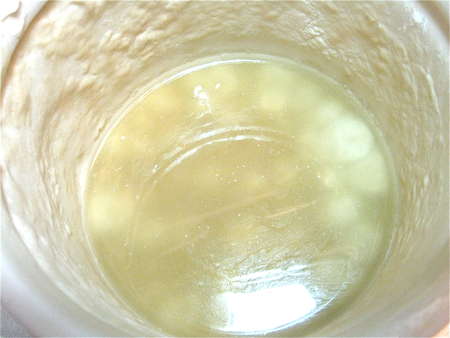
Sigh… If you’re anything like me, your sourdough starter often looks like this. Forlorn. Neglected. BAD MOM!
But sourdough – like one of its basic components, yeast – is oh-so-forgiving. (Though, if you’ve truly managed to kill your starter, we offer fresh sourdough starter here at King Arthur.)
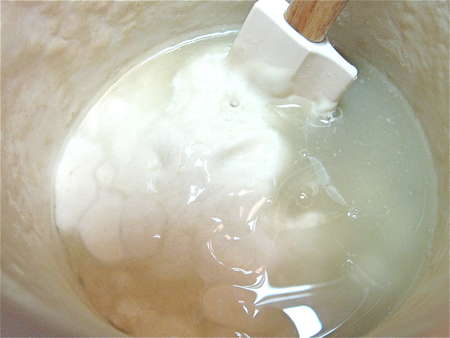
Pour off all but about 1/4” of the liquid on top, then stir the remainder into the dough beneath.
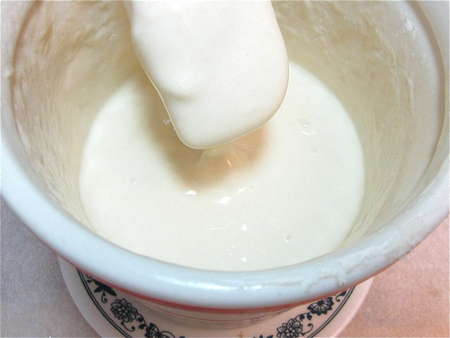
If you stirred in all that liquid, it would make the sourdough too thin. But stirring in just enough adds to its flavor – the liquid is alcohol and acids generated by the sourdough, and both are flavor enhancers.
Now comes the part where your recipe says “Discard 1 cup of your starter, and add 1/2 cup of water and 1 cup of flour to the remainder.”
Well, that’s fine. But if you just can’t stand throwing ANYTHING away – go ahead and use it. To make delicious waffles or pancakes. Or to make this chewy/crusty Sourdough Pizza Crust.
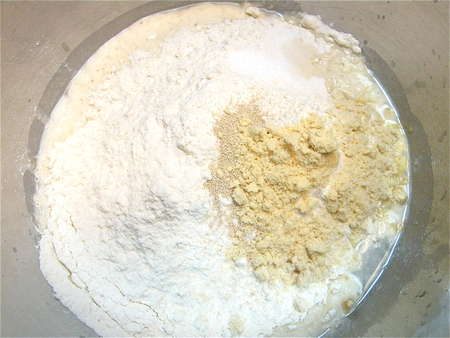
Combine the following in a mixing bowl:
1 cup sourdough starter, unfed (straight from the fridge)
1/2 cup hot tap water
2 1/2 cups King Arthur Unbleached All-Purpose Flour
1 teaspoon salt
1/2 teaspoon instant yeast*
4 teaspoons Pizza Dough Flavor, optional but delicious
*For a faster rise, increase the yeast. How much yeast for how fast a rise? Don’t know; depends on your starter and your house and your micro-climate.
I don’t want to discourage anyone, but this isn’t the type of recipe offering precise directions and yielding exact results. This is sourdough, the wildest of all the yeast breads. You need to take some chances as you learn to bake with it.
“If I increase the yeast to 1 teaspoon and let it rise in the pan for 2 hours, will the crust be thick, or thin?” I’m telling you in advance – I don’t know. Try it and see – next time you’ll know. And whatever you do will be acceptable – thick or thin, the crust will definitely be tasty.
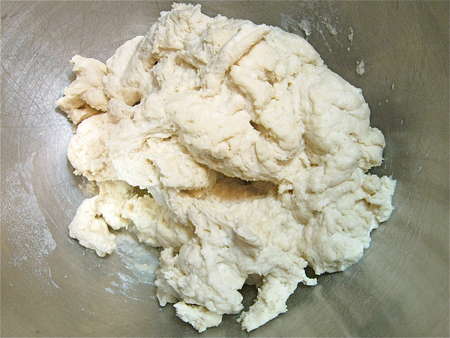
Mix the ingredients to make a rough dough.
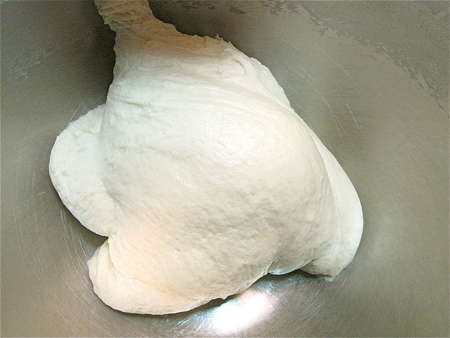
Then knead to make a soft, elastic dough. I kneaded this for about 7 minutes in a stand mixer. Feel free to use your bread machine, set on the dough cycle.
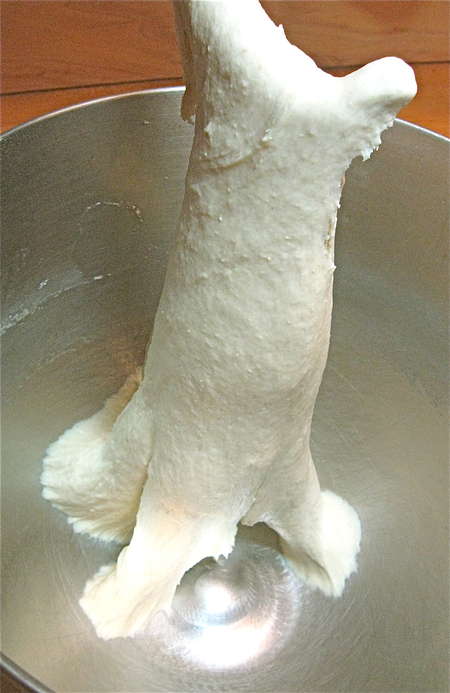
This is what I mean by elastic. Love that gluten!
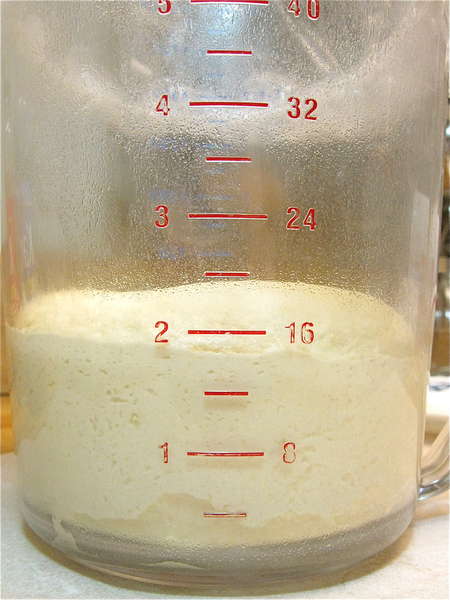
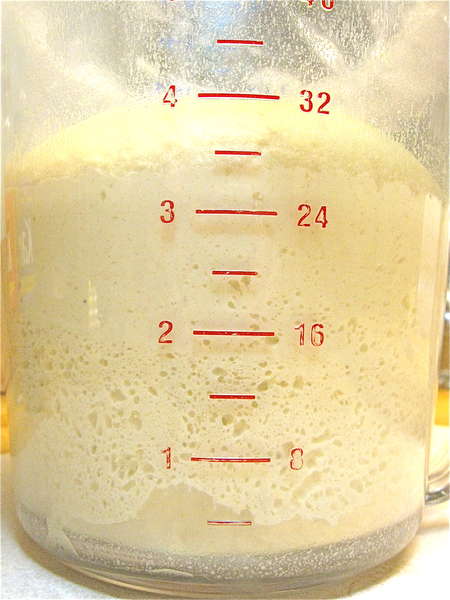
Now you have a choice. You can place the dough in a lightly greased container (like this 8-cup measure)…
…and let it rise till doubled, which will probably take several hours.
Or you can skip this initial rise, pat the dough into the pan, and let it rise till it’s as thick as you like, which will take awhile for a thick-crust pizza.
What’s the advantage of each? If you’re going to be around the house, I think you get slightly lighter texture by letting the dough rise once in a covered container, then deflating it, patting it into the pan, and letting it rise again. Deflating the dough gets rid of excess CO2, and redistributes the yeast
However, if you’re leaving for the day and want pizza crust ready to go in the late afternoon, simply patting the dough right into the pan, once it’s kneaded, means you don’t have to worry about it for the rest of the day.
For two thinner-crust pizzas, divide the dough in half, shaping each half into a flattened disk. Drizzle two 12” round pizza pans with olive oil, tilting the pans to coat the bottom. Place half the dough in each pan. Cover, and let rest for 15 minutes. Gently press the dough towards the edges of the pans; when it starts to shrink back, cover it, and let it rest again, for about 15 minutes. Finish pressing the dough to the edges of the pans, and cover them to prevent the dough drying out.
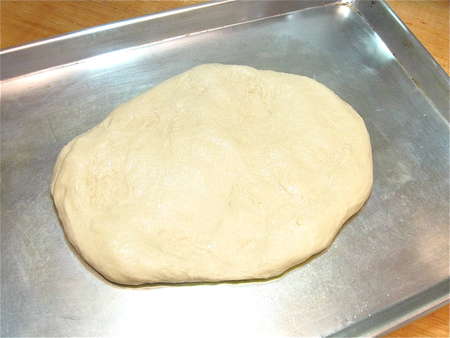
For a thicker-crust pizza, drizzle a half-sheet pan (18″ x 13″), or similar sized pan; or a 14″ round pizza pan with olive oil, tilting the pan to coat. Shape the dough into a flattened disk. Place it in the pan, cover it, and let it rest for 15 minutes.
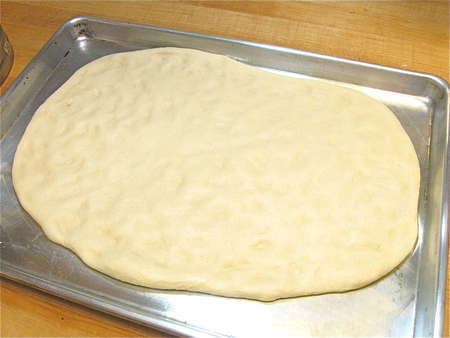
Push the dough towards the edges of the pan; when it starts to fight back, cover it and let it rest for 15 minutes.
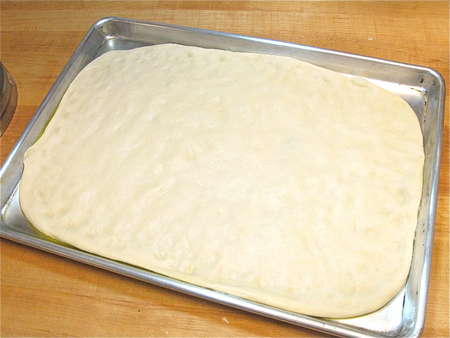
Come back and finish pushing the dough to the edges of the pan.
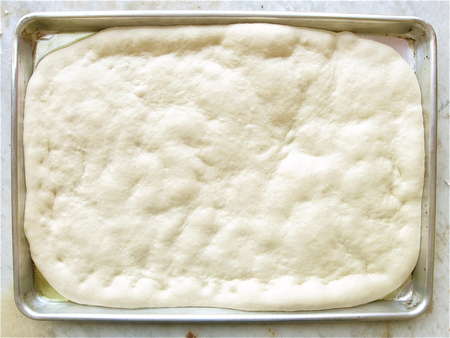
Cover the pan, and let the dough rise till it’s as thick as you like. For thin-crust pizza made from fairly fresh starter, this may only be an hour or so. For thick-crust using an old, little-used starter, this may take most of the day. Keep in mind that this crust doesn’t have a lot of oven spring; what you see going into the oven is pretty much what you’ll get coming out.
There are no hard-and-fast rules here; it all depends on the vigor of your starter, and how you like your crust. Once you make it a couple of times, you’ll figure out what time frame works for you.
Towards the end of the rising time, preheat your oven to 450°F.
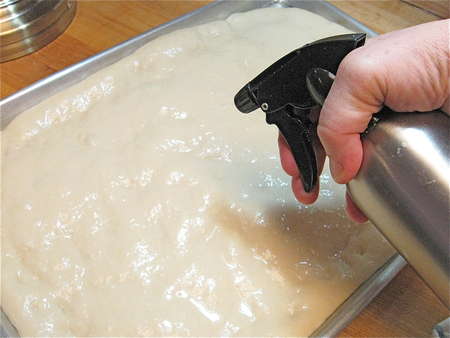
Just before baking, spray the crust with water. This will encourage it to rise to its fullest.
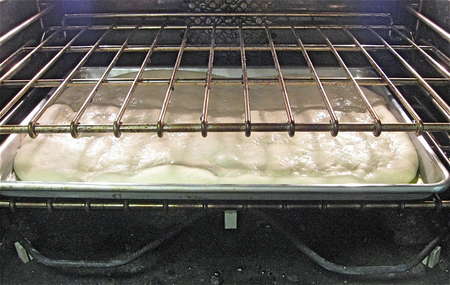
For a thicker crust, pre-bake the crust for about 8 minutes before topping.
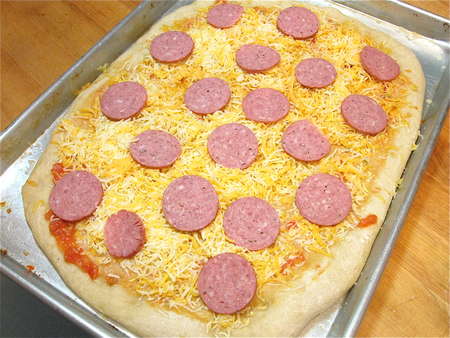
Layer with your favorite toppings…
… then bake till toppings are hot and cheese is melted and bubbly, about 10 minutes.
For thin crusts, bake for 4 to 5 minutes, then top and bake for an additional 8 to 10 minutes, or till toppings are as done as you like.
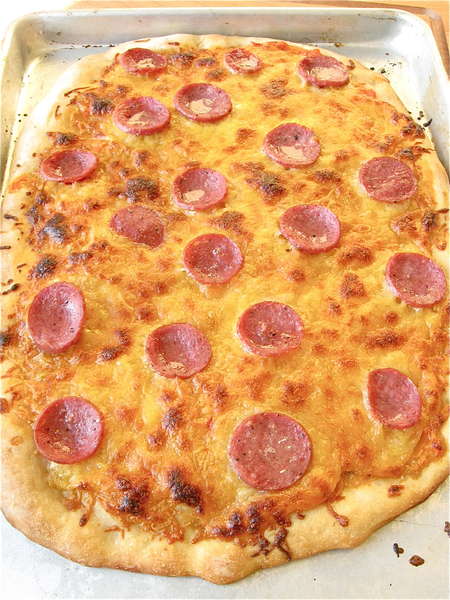
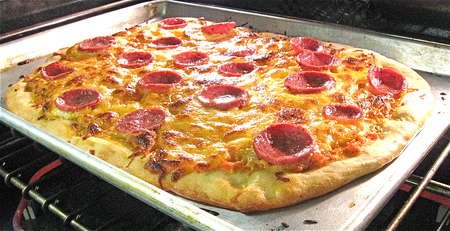
I like to put the pepperoni on top of the cheese – no reason, other than that I think it looks prettier.
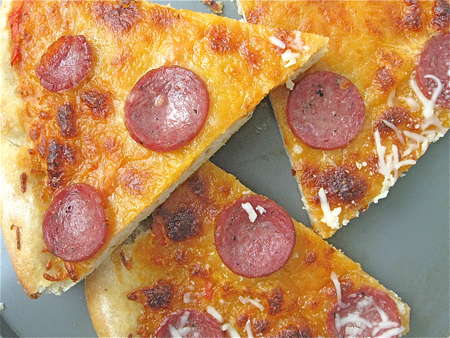
Here’s some thin-crust pizza that I garnished with a bit of mozzarella once it was out of the oven.
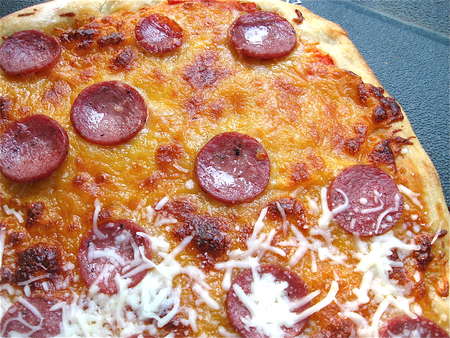
I wanted to see what it would look like. Looks kinda weird; tastes great!
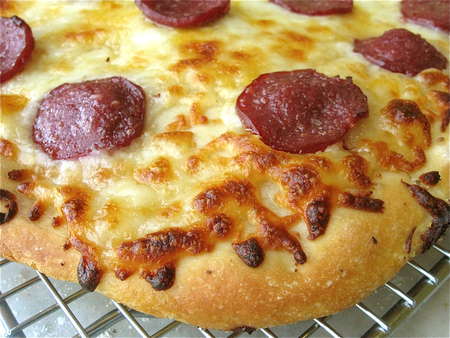
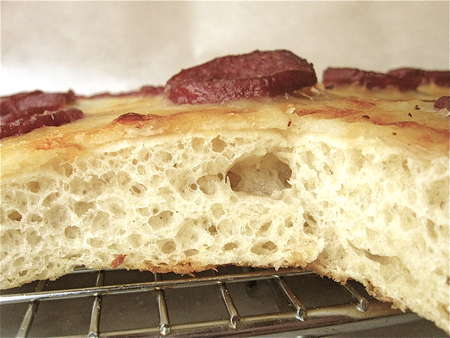
Here’s a thick-crust pizza. I’m in the thick-crust camp – none of that New York City, coal-oven burned cracker crust for me, thanks.
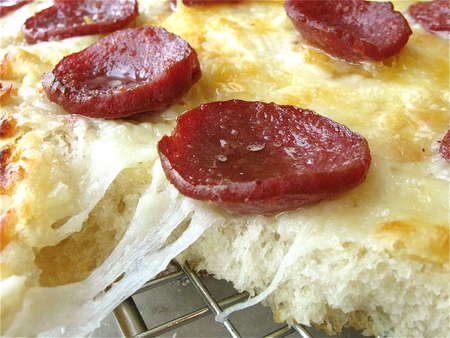
Now THAT’S what I call a nice crust. And cheese. And pepperoni.
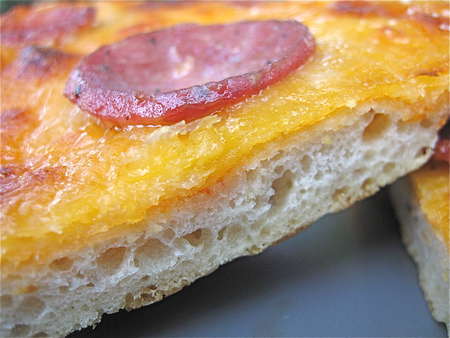
Medium-thick version…
…and extra-thick. It’s all in what size pan you use, how much yeast, and how long you let the dough rise. Yeast dough is nothing if not accommodating – to both your schedule, and your culinary whims.
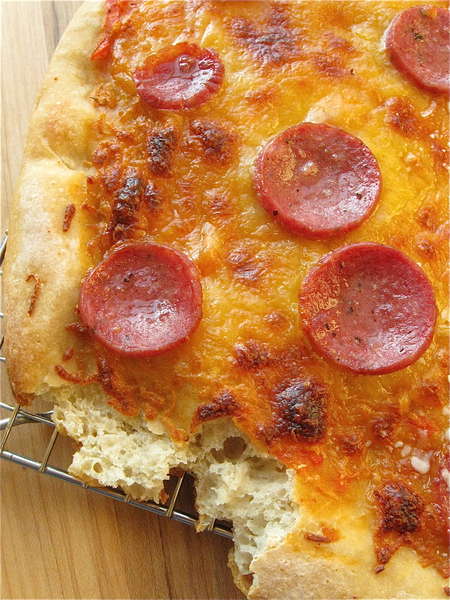
Well, you can’t serve pizza without tasting it first to make sure it’s edible, right?! Trust me, this was more than edible. It disappeared in a flash – with nothing at all left for the birds.
Read, rate, and review (please!) our recipe for Sourdough Pizza Crust.
New to sourdough? Find the help you need for all of your sourdough baking at our Sourdough Essentials page.
November 5th, 2009 at 5:49 pm
What a great idea! I’m definitely always looking for ways not to waste that starter, so I will definitely be using this!
November 5th, 2009 at 6:11 pm
Wow! I can’t wait to try this. I hated throwing away that one cup of starter every time I refresh my starter. Guess my husband and I will be eating a lot of pizza!
Thanks, PJ!
Go for it, Susan – what do they say, reduce, reuse, recycle… not sure which of those fits the starter, but seems one of them must! PJH
November 5th, 2009 at 7:27 pm
PJ
Sourdough starter can really die and it smells really bad. I brought another batch and I began to feed according to directions. The starter did not bubble and become alive like the last time. I realized I was using different bottled water…the water was calcium chlorinated. I went out and brought natural spring water and the sour dough is now alive and growing well. I plan to use some whole wheat in my discarded starter to start a whole wheat starter.
This pizza dough well be used over Thanksgiving weekend when our family gathers and the turkey is finished…I believe by Saturday. Kids and pizza go well together but I do not want to spend the weekend cooking. Will I be able to make this pizza dough, partially cook and freeze? Something like the “Now and later pizza” which is now my basic pizza dough.
I can not tell you how my cooking skills have improved since using your products and recipes. The blog is especially informative. Thank you, Pat
Pat, thanks for your kind words. Yes, sourdough can go bad – if it smells BAD rather than acidic/alcoholic; or if it gets a pink tinge, it’s time to discard the whole thing and start again, as some unfriendly bacteria have managed to get in… You know, for kids, I’d suggest your No or Later recipe – it’s a bit fluffier, and not tangy. A lot of kids would find sourdough pizza crust too strong-tasting. Yes, you can parbake and freeze any pizza crust – just bake it till it’s set but not browned, cool, and freeze. But stick with the Now or Later Thanksgiving weekend – Good luck. PJH
November 5th, 2009 at 8:07 pm
It’s nice to know that in a world of hyper-precision, mega-anal-retentiveness and gluten-free everything, I can still come to the Bakers’ Banter (or the Bakers’ Circle) and be surrounded by warm bready goodness. Sourdough is great and half the fun of baking is charting it alone. More often than not the bread will guide you and tell you what to do.
This recipe looks marvelous; I’m terrible with pizza crusts, so I’ll really have to try this! In the future do you think you could do anything with flavored sugars? I am a sucker for them. I have sugar jars with orange peel, vanilla beans, lavender, rosemary (rosemary sugar is amazing!) and rose petals; the sugar picks up such an interesting flavor and really improves baked goods. Besides, I’m sure I’m not the only reader with a big sugar stash.
Just today I decided to mix pearl sugar and sparkling sugar; then pearl sugar, sparkling sugar, and cinnamon-sugar; then pearl sugar, sparkling sugar, and plain cinnamon. I’ve had a grand time putting about 1/4 teaspoon of any of our flavorings into some sparkling sugar, and shaking it up – peach sugar, anyone? How about cranberry? Praline? I will totally suggest to MJ she think about this – sounds like it would be right up her alley, Janey – What do YOU do with your flavored sugars? PJH
November 5th, 2009 at 8:12 pm
PJ, if you rub olive oil on the crust before spreading the sauce the sauce will not soak into the crust as much otherwise. Thought you might want to give it a try …
Really! I didn’t know that… Thanks, Elizabeth, I’ll definitely try it next time. PJH
November 6th, 2009 at 6:23 am
Praline sugar! Cranberry sugar! Oh my goodness this could change my entire Thanksgiving. A mild coffeecake with praline sugar, a pull-apart loaf with cranberry sugar and walnuts and raisins…I need to stop myself but it’s too late already!
I use rosemary sugar for one of the best cakes I’ve ever had, slightly sweet rolls, a teeny bit on meats; rose and/or lavender sugar is great in shortbreads and tea cookies and anything with a lot of butter; orange sugar really adds a zing to sauces and ham and cocktails; I use vanilla sugar in just about every recipe (it is a must for cinnamon rolls). Vanilla sugar is definitely the most flexible and can be substituted for regular sugar in just about every recipe. Vanilla sugar cookies, mmm…
Oh my. My first thought was tea parties and your wonderful flavored sugar treats! Try to squeeze one in (tea with the girls?) during the holidays. Irene @ KAF
November 6th, 2009 at 7:41 am
Yum! I make sourdough crust pizza just about every week. I love my KAF sourdough starter.
It’s tonight’s dinner. (being near New Haven, the birthplace of American pizza, as in Pepe’s Pizza, we go for the thin New Haven style crust).
I have made the crusts on the weekend and formed and then frozen, so I could pull it out after work to make fresh pizza. I’ve also applied the cheese and toppings and then frozen. Both methods have worked well.
I bake directly on my KAF pizza stone.
Whenever my starter is bubbling really well, I pull out a tsp or so and add to the original container in the freezer. It’s “backup” in case my much-abused main starter fails.
I used to keep a whole wheat starter, too, but find that whole wheat and rye starters are much more volatile than white starters. Now I just use white starter and white whole wheat flour when I make sourdough whole wheat recipes.
I never discard anymore. I feed my starter after using and put right back in the refrig. I pull out before using, do a small feed and let it come to room temp, use what I need, and do a small feed again. Then put it right back in the refrig. It never fails me. I think when you feed and put in refrig right away, it “eats” s l o w l y. Anyway, works for me!
Yum is right! Thanks for sharing your pizza and sourdough tips. Irene @ KAF
November 6th, 2009 at 9:48 am
Another tip for thin crust – chill the dough and roll it out cold. The dough feels very stiff but allows it to be rolled very thin without the ‘pull-back’ from the gluten. Happy Baking!
November 6th, 2009 at 10:13 am
Can I make up the dough and freeze w/o parbaking? We often do this with our “regular” pizza dough — which we make w/ KA’s pizza crust flour/mix. I actually prefer pizzas made w/ the frozen dough; to me, they’re thinner and crispier. I’m a fan of crispy crusts!!
Sure, Meredith – let the dough rise once, then shape into balls, wrap well, and freeze. Since you already do this, you know the routine about letting the dough thaw, come to room temperature, etc. Enjoy – PJH
November 6th, 2009 at 10:21 am
While we love pepperoni and always have it on hand, we have trouble with all the grease–see those little grease puddles in the middle of the pepperoni slices as the edges curled up during baking?? You can be rid of that excess grease if you put your pepperoni between paper towels and zap it in the micro for a minute or so; the paper towels absorb the grease before you put it on the pizza and you have puddle free pepperoni after baking–just be sure not to zap it too long–you just want to degrease it not totally cook it…sure beats the kids having to use up all those paper napkins sopping the grease all up before they’ll eat it. I just love this blog–thank you all so much for sharing with us and allowing us to share back!
November 6th, 2009 at 10:47 am
My family will love this! I have been thinking I would like to try making a crust with sourdough, and lo and behold here it is! My babies (19 months and 30 months) love sourdough bread the best, along with the sharing bread you blogged recently. Those two breads are their favorites, so they will love a sourdough pizza. My husband too, he always asks for sourdough. Before I started making all yeast products myself I often bought the store made frozen pizza dough, took it out in the am and made pizza that night. Could I possible make a lot of the dough, and place recipe sized balls of dough in baggies in the freezer, or would it just be better to keep making it fresh? Thanks for always answering everyone’s questions, it is great knowing we all have support in our baking endeavors!
Definitely freezable, Lish – let it go through one rise, then deflate, shape in balls, and freeze. Best to use them within 2 months, OK? PJH
November 6th, 2009 at 12:03 pm
I have always been afraid of starters but I will have to try this. We love homemade pizza at our house.
Thanks Janey, for the idea about the sugars. I too, love my vanilla sugar. I grew some lavendar this year and have never used it in anything. It is still alive and well so I will just have to go pluck some and stick in some sugar. Do you put whole fresh stems in or do you dry it first?
Does anyone have a recipe for crescent rolls? My family loves the canned ones at Thanksgiving but I know if made them from scratch they would be oh so much better. Thanks.
Hi – Try our Butter Roll-Ups recipe – I hope it’s just what you’re looking for… PJH
November 6th, 2009 at 12:31 pm
This sounds like a wonderful use for my sadly neglected starter sitting at the back of my fridge. My 15 year old son will be delighted! (The rest of us won’t exactly be disappointed either.)
For those who make ahead and freeze the dough – do you leave it in the pan, wrap it in plastic or foil? Do you always form the crust before freezing or can it be left in a lump?
It can be left in a lump, Wendy – let it rise once, deflate it, shape it into a ball, wrap well, and freeze. At the other end, leave yourself enough time for it to thaw, AND come to room temperature, AND rise – once you do it a few times, you’ll get the timing down. Enjoy – PJH
November 6th, 2009 at 12:43 pm
Sourdough pizza crust sounds so good!! Right now I’m sold hook, line and sinker on the King Arthur Perfect Pizza Blend. The directions on the bag yielded the best pizza crust we’ve ever made. It will take a real push for me to try pizza any other way, although I am considering trying your Sir Lancelot flour and the Italian-Style Flour so I can do more experimenting.
November 6th, 2009 at 12:52 pm
This looks great! I’m going to use some of my starter to make one of these this weekend.
November 6th, 2009 at 1:10 pm
I made up a sourdough starter a couple weeks ago and have been trying different things every few days. Over the weekend I decided that I’d make pizza tonight using a sourdough crust. I saw sourdough pizza dough recipes elsewhere, but I decided to go with the KAF recipe. The same exact recipe that you blogged about! Great minds think alike I suppose.
So this morning I started the dough a little before 8 am. About 3 hours later it had risen sufficiently. It’s 1 pm now and it’s rising in the pan. It’s still thinner than I’d like, but I hope it doesn’t go too quickly this afternoon because I don’t have any room in the fridge.
The pizza is going to be a cheeseburger pizza with ground beef, ketchup, mustard, cheddar and dill pickles. I thought that a cheeseburger sandwich would be good on a sourdough bun, so it’s worth a shot making it into a pizza. If I can get away with it, I might put some onion in the beef as I brown it, but DH and DD are picky, so maybe not.
Oh, I omitted the Pizza Dough Flavor because I don’t have any. Is that only available online or can it be found in stores too? Sounds like a good choice for a pizza. Save me some ! I’ll be over after work! LOL.
The Pizza Dough flavor is only available through our store here in Norwich or web site. Mary @ KAF
November 6th, 2009 at 1:26 pm
Okay, I live in the Denver area and have to admit that Double D’s pizza is fabulous. And they don’t skimp on their toppings–my medium pizza from there was pretty hefty, so they’re worth the price as an indulgence.
But my last use of my sourdough starter was for pizza crusts–came out flatter than I like (probably because I hadn’t used my starter in quite some time) and will have to try again with your tips! So glad you have a sourdough pizza crust recipe, as so far I haven’t had a single KAF recipe fail me yet. Thanks!
November 6th, 2009 at 1:31 pm
If you ever do a thin crust pizza, I suggest to put the preheat a pizza stone as close as possible to the top element at broil. This will make the pizza stone as hot as possible and the element as hot as possible also. Slide the pizza in for 3-5 min. Make the dough stlightly on the sticky side also.
This tries to replicate a wood stone oven which reaches temperature of about 6-700 degrees. It makes a nice colourful crust and the cheese melts and bubble as it should. At lower temperatures the crust is soaked and the vegetables kind of boils instead of broil.
Give it a try, I tell you! Thanks for asharing that tip. We learn so much from our readers! Mary @ KAF
November 6th, 2009 at 1:39 pm
I’m always on the lookout for new and improved pizza dough–this sounds wonderful and I can’t wait to try it tonight!!!
November 6th, 2009 at 1:56 pm
I have actually been doing this every week for a year since I got my sourdough starter from a friend of my girlfriend’s aunt. I hated the idea of throwing away starter and adapted one of the other pizza recipes on this site (I think it was the brick oven pizza recipe) which used a poolish. The sourdough starter adds the perfect tang to the pizza crust, and after making it that way for so long if I make it without the sourdough the first bite tastes like there is something missing. Also, croûtons made from sourdough bread are amazing. Oh yeah!!! They are the best. Mary @ KAF
November 6th, 2009 at 2:12 pm
What’s the point of “throwing out” part of the starter anyway? I’ve used my starter for 2+ years, baking 1-2 times a week, and just manage the amount I feed.
Some people find that they start having an overabundance of starter – this is simply to prevent having too much around… PJH
November 6th, 2009 at 3:49 pm
I know what I’m doing when I refresh the starter tomorrow… I actually made your sourdough pancakes two weeks ago–WOW!!! My fiance asked if we could have them every weekend!
November 6th, 2009 at 4:12 pm
Thanks for the sourdough pizza recipe. I am always looking for ways to use my starter as I am part of the “I don’t want to throw anything away” club. We have blueberry sourdough pancakes once a week and now we can add sourdough pizza. I have a question about pizza stones. I have one that was a gift and it doesn’t get used too much. Would I put the dough directly on the stone for the second rise? I thought you were suppose to preheat the stone. So if I preheat, what is the best way to get the pizza and toppings onto the stone in a hot oven without a crisis? Thanks as always for all the advice you give. I like to let the pizza rise on a piece of parchemnt paper then use a peel to slip that parchment and all right onto the pizza stone. Mary @ KAF
November 6th, 2009 at 6:09 pm
A quick use of sourdough starter in addition to pizza crusts is biscuits. Take the starter usually one cup and 1 cup flour add 3/4 teaspoon soda nd 1/3 cup butter or oil. Drop by teaspoon full onto greased or parchment lined cookie sheet.
Can be cut in half if you don’t have a lot of starter to “discard” can also be baked in muffin tins with cinnamon & sugar (1 teaspoon of dough add cinnamon & sugar and another teaspoon of dough & more cinnamon & sugar.
Bake about 10-15 minutes at 350ºF
I’ve also made blueberry muffins by adding up to 2 cups of well rinsed blueberries to the dough.
Ooooh, great idea, Kathe! I’ll try those biscuits. I’d be a little hesitant about the liquid – usually tender biscuits are mostly flour and butter with a little bit of milk or buttermilk or cream to bind. But I’m often surprised by how well things turn out, baking-wise, when I’m questioning them from a chemistry point of view.So I’ll definitely give this a whirl – thanks again. PJH
November 6th, 2009 at 6:38 pm
I am amazed to know the starter is as forgiving as it is. I love sourdough but have been afraid to get a starter because, well, with two young children at home somethings fall by the wayside quite easily. I had thought that if I didn’t feed the starter every x days, I’d kill it and that’d be the end of that. I’m also pleased to know that a little “neglect” makes it taste better (at least in my book). You give me hope (and another item for ye ol wishlist).
I do have a question about how it is shipped. Heat isn’t so much an issue now, but is there a time of year where shipping the starter becomes a problem? I would cry if it was DOA.
Just imagining a grilled veggie pizza on sourdough (perhaps sans cheese) is making my mouth water.
Christina, there’s no problem shipping sourdough at any time of the year; we feed it, then give it a rest, and it’s stable and happy before it goes out the door. We don’t seem to have any issues with shipping temperatures. As I said, it’s very forgiving. So keep that grilled veggie pizza front-of-mind and ye ol’ wish list handy…
PJH
November 6th, 2009 at 8:55 pm
tonight’s version was chicken bacon ranch.
Top crust with a homemade (lower fat) ranch dressing, can add in some ricotta.
Top that with about a half a block of grated Cabot 75% reduced fat cheddar (Cabot is right up the highway from KAF!! Great road trip, especially if you stop at Ben & Jerry’s, too!)
Add 4 grilled diced chicken tenderloins and about 1/3 lb cooked crumbled turkey bacon.
Delicious!
Re the pizza stone and the second rise- I do the first rise in one of the KAF large measurers with handle. Then I roll or press out on a piece of parchment. I preheat the oven at 500. Sprinkle cornmeal liberally over the top of the pizza, and using a cookie sheet, I invert that on my KAF peel. (you want to end up with the cornmeal side down on the peel).
Then top the pizza and slide into the hot oven, reducing temp to 450 (convection for me)
Point is, I didn’t like cooking on the parchment. For me, the crust was too soggy. I wanted the stone to draw out some moisture and give a chewier, crunchier crust. I tried it several different ways and this is what works best for me. (I found the pizza won’t slide off the peel without liberal cornmeal under it)
Sounds perfectly yummy, Cindy – can I come live with you?
If you ever have trouble with cornmeal burning, try semolina – it has that same gritty texture, like little ball bearings, that allows pizza to slide onto and off the stone; but it doesn’t burn as readily. Enjoy – PJH
November 7th, 2009 at 8:12 pm
I tried this today with my discard starter and it was great! The crust came out wonderfully.
I tried putting one of the pizzas in the freezer after putting the toppings on. My husband is our weeknight dinner cook, and he frequently turns to frozen pizza. I’d love to have a homemade alternative.
Thanks.
GREAT, Jo – glad it worked out for you. And I’m betting the frozen one will be just as good – thanks for sharing. PJH
November 7th, 2009 at 9:02 pm
I made the sourdough starter using rye from the KA Whole Grain cookbook – it made delicious bread and we all loved the sourdough waffle recipe I found from you all too. But I was never sure about using a rye starter with non-rye recipes. It seemed to work ok but I always felt like I was doing something wrong. Then I started feeding the starter with whatever I had on hand – wheat, rye, white – and it still seemed to work ok but again I felt like I was doing something wrong. Eventually I tossed the whole thing because I left it out for too long without feeding it and was afraid I’d totally ruined it. I would like to start over but need encouragement that I’m not messing up too badly. I’m also constantly caring for kefir grains and kombucha mushrooms so the sourdough is just one more thing….but a tasty thing.
Lee, there is NO SUCH THING AS WRONG in baking! Truly. We all make choices with ingredients – some work out – some are for the birds (literally!) Starter made with whole-grain flours is often actually more vigorous, as the yeast likes all the extra minerals. If you use a lot of starter in any particular recipe, you may find it doesn’t rise as well, due to less gluten. But in things like pancakes, it just doesn’t matter. For lots of good information on this subject, read the sourdough information in our Whole Grain Baking cookbook. So, go ahead and start over – and keep experimenting. That’s where great new recipes are born, in your imagination and willingness to try something new. PJH
November 8th, 2009 at 8:38 pm
I have a question about preheating the pizza stone with the broiler – this won’t break the stone? How long do you preheat the stone with the broiler? Do you cook the pizza on broil as well?
Thanks!
- Kayler
Kayler, don’t use the broiler; heat your oven to 425°F or 450°F. Good-quality pizza stones can take the heat without breaking; that’s what they’re made for. Good luck – PJH
November 9th, 2009 at 7:21 pm
I’ve been on a pizza-crust hunt for years. Lately we’ve been using the Now-or-later recipe with good success. However, THIS recipe had everyone in the family exclaiming “This is it!” I topped it with pesto, sauteed thinly sliced red onion and sweet red pepper, some feta, mozzarella and parmesan reggiano and finally with some very thinly sliced tomato. Thanks thanks thanks!! I’m also delighted to read that the dough does freeze. Has anyone tried parbaking the crust and freezing that?
I haven’t parbaked this particular crust, Anne, but I do parbake/freeze pizza crust regularly, with great success. Just bake till it’s set, not brown’ cool; wrap well and freeze. Glad you liked the sourdough! PJH
November 11th, 2009 at 10:58 am
We recently had some issues with our frig., it decided to freeze everything in it. (EVERYTHING!) I took my starter out on Monday to feed it and see if it was still good after all the freezing and thawing. (It is!) I decided to use the discarded cup to make the pizza dough. It was great. My six year old proclaimed it to be the best pizza EVER and asked if I could make it every week. Thank you! It’s nice to be able to mix it and shape it before I go to work then have a great crust ready to go when I get home.
Sourdough is SO forgiving, isn’t it? Thanks for sharing, Laurie – PJH
November 12th, 2009 at 1:37 pm
I tend to make extra pizza crust whenever I can. What I will do is put parchment at the bottom of the pan, form the crust, make a full pizza (sauce, cheeses, toppings)… and then put it in the freezer. Once frozen I wrap it up really well and label.
It is better than supermarket frozen pizza, and when I wind up at the hospital late, i can call the hub to start dinner for the kids without me, and pull pizza from the freezer. I put the oven on 425 and bake for about 20-25 minutes. it is perfect.
I do find if we push the oven to 450 it browns too fast before the middle is done perfect.
Linda
November 15th, 2009 at 5:11 pm
I had about 1 1/4 cups of biga left over from a bread baking project several weeks ago. It wasn’t as liquid as your sourdough starter, but I forged ahead by adding a little more water to the dough. After dividing it in two, I had a pizza today and a crust for later. What a lot of fun. And I didn’t have to get rid of the scrap of biga that I’d left in the fridge far too long.
Reuse, recycle… yeast dough is endlessly flexible, isn’t it, Donna Jo? Thanks for sharing – PJH
November 15th, 2009 at 10:04 pm
Great concept! I refreshed my starter yesterday and baked a pizza for dinner tonight. I made a thick crust and it turned out really, really well. Mmmmm. Peperoni, kalamata olives, red onion, red pepper, mushrooms, roasted red pepper sauce and cheese. Next weekend, I’m going to make it 30% white whole wheat with artichoke hearts, pesto as the sauce, feta, kalamata olives and red onion. Thanks for another great way to use starter – I don’t always bake enough sourdough to keep up with the starter. -Tom
Sounding good, Tom – Hey, I was just looking at your friend’s pictures of Klamath Falls on Facebook – wonderful how we can travel all over the country without ever leaving our laptops, huh?
PJH
November 15th, 2009 at 11:48 pm
When you say “But if you just can’t stand throwing ANYTHING away…” do you mean to stir in all of the extra liquid? I always have much more than 1/4 inch. But then I was told to feed my starter with equal amounts of water and flour as I took out. So if I use 1 cup starter, I mix in 1 cup water and 1 cup flour to the starter. Sounds like I should just be using 1/2 cup water.
Barbara, pour off all but about 1/4″ of liquid, then stir that in. And then feed with equal amounts, BY WEIGHT, water and flour, which would be 1 cup flour and 1/2 cup water. Make sense? PJH
November 22nd, 2009 at 8:50 pm
PJ – You know if it has sourdough, I have to like it. Made this today and got great rise from it as thick crust. Great way to use unfed starter. Of course my favorite thing with the starter you don’t want to throw away is giving it away with care instructions, the rustic sourdough recipe and the baguette recipe. But this is a close second. I made an extra crust for my daughter to use or freeze.
Recipe worked well as written, although I had never baked a pizza crust before topping it. I think I might bake it a touch longer next time, and at a higher temp. Also, most recipes for pizza dough seem to have oil in them. This one does not need it. Next time I will try thin crusts, and I am anxious to use some whole wheat too, as it seems light enough to be able to add third or so.
Keep on sourin’ your dough – Ron
Great, Ron – thanks for sharing. Glad to hear it worked so well for you! And you keep on sourin’, too…
PJH
November 27th, 2009 at 2:52 pm
I’m new to sourdough, but this is the first time I’ve seen it recommended to pour off part of the liquid before stirring the starter. Do you think I should always do that? Won’t the starter get thicker and thicker each time?
It’s a balance, Steve; I pour the liquid off when there’s a lot of grayish liquid on top, after I’ve let it sit for a month or two without feeding. Otherwise, if I feed it regularly, there’s not that much liquid, and I just stir it in. If you stir it in every time, even when there’s a lot of liquid, it gets too thin. if you never stir it in, it gets too thcik. Just play it by eye/ear; you’ll be fine. PJH
November 28th, 2009 at 10:04 pm
Just a quick note to say that the frozen pizza did come out just as good. I think I’ll make a few more tomorrow.
I have to say though that the crumpets you had in your blog several months ago are my favorite use for “discard” starter. It’s such a easy recipe, and they work well in the freezer if I don’t have time to eat them up right away.
December 10th, 2009 at 2:06 am
Tonight we ate the third sourdough pizza in five days. The sourdough adds a subtle flavor and a chew to the crust that is terrific. We couldn’t be happier – hot Italian sausage, homemade pizza sauce from our summer tomato harvest, fresh bufala mozzarella, asiago and provolone with basil. What’s not to love? I was most impressed with the results of the “bake crust before filling” step. We missed it the first time and didn’t have the consistently chewy, crunchy crust we love. Also highly recommend the first rising. On this last pizza, we took the dough ball wrapped in plastic from the fridge and it fairly leapt into shape on the pizza pan.
Hey, thanks so much for sharing your success – isn’t it exciting to find a new recipe you love?
PJH
January 14th, 2010 at 10:27 am
I’m new to sourdough…bought the fresh starter about a month ago from KA and have been feeling badly about throwing away the cup when I feed it. We love our pizza here so this will be perfect!
I have to ask, what kind of pepperoni have you used on those pizzas? It looks wonderful…the way it curls up. I was just having a discussion with my brother about a pizza place in my hometown who has pepperoni that does that and I would love to know what kind it is so I can pick some up!
Thanks!!
Jennifer, any type of thin-sliced pepperoni should curl. I may have been using turkey pepperoni here, but it’s the thinness of the slices that adds curl in the oven… PJH
February 8th, 2010 at 3:45 pm
I love this recipe! In addition to making an excellent pizza crust, it also makes a very nice focaccia. I make the recipe as given for a thick crust in a rectangular clay baking pan, brushing the dough with olive oil for the 2nd rise. I dimple the dough with my fingers about halfway through the 2nd rise and add the toppings just before baking. I usually top it with a sprinkling of coarse salt and whatever Italian or pizza seasoning herbs strike my fancy before baking. After about 8 minutes of baking I sprinkle the top with cheese (usually more flavorfull cheeses like parmesan or romano) and roasted garlic before returning to the oven for about 4-6 minutes. I’ve found if I put the cheese and garlic on at the beginning they get too brown.
I love having more ideas for using the extra starter!
June 8th, 2010 at 7:09 pm
Dear PJ Hamel,
Thank you for your wonderful recipes for sourdough starter. I finally made it successfully today. The last 3 times, i failed because i tried to do without salt.
The result were that the yeast were too powerful and they ate all my flour. My pizza had huge bubble and it was not necessarily bad because it was very crispy crust! And by the way, your recipe work well with bread machine with the dough program! :>
I’m afraid i have to ask you the same old question.
Is it alright if i prepare the dough and let it rise over night in the fridge since it took me so long, 6 hours total prior baking?
Absolutely – a good, chilly overnight rise for the dough will improve the bread’s flavor even more. Glad you’re having success – and thanks for sharing here. PJH
December 14th, 2010 at 2:45 pm
Two quick questions;
1. I have a dough setting on my cuisinart…will that be okay with this? I use it for my sourdough bread. if so, how long to knead…until it makes a ball or for 30 or 45 seconds?
2. Do you have this recipe in print-out format?
1) Yes, use the dough setting on your Cuisinart. You may need to let it rest in the machine for an hour or so longer, till it’s nice and puffy.
2) Recipe link is at the end of the blog. Here it is again: Sourdough Pizza Crust. Enjoy! PJH
June 20th, 2011 at 10:38 am
I think this recipe has a typo! .5 cup water, 2.5 cup flour ??
Only 20% hydration??? Yikes. For pizza, one should aim for at least 66%
We did this recipe yesterday, after a 48 hour cold fermentation. Way way too dry. And impossible to stretch or get a ‘window pane’.
Best, Bosque
Remember, Bosque, your starter is at least 50% hydration – so, adding the liquid in the starter to the 1/2 cup water, you get 8 ounces liquid; 3 cups flour = 12 3/4 ounces flour, which makes it actually a minimum of 63% hydration, probably more, since this doesn’t account for any alcohol generated by the fermenting starter. Was your starter really thick, perhaps? PJH
June 20th, 2011 at 12:07 pm
I believe this recipe has a typo!
It calls for 2.5 C flour and .5 C water. That is only 20% hydration!! Normal pizza dough is usually 66% or even 70%.
I made this yesterday, and didn’t catch the error. Very dry and unstretchable – no window pane etc.
Thanks. Bosque
Hi Bosque, I’m sorry to hear of your difficulty. This recipe is correct as written. The drier than expected dough might be related to the method you use when measuring the flour. Here is the method that we use in all of our recipes: http://www.kingarthurflour.com/recipe/measuring-flour.html If you “dip” the flour directly from the bag, you can end up with 20% extra. When figuring dough hydration, you’ll want to use the total water and flour weights to reach the final hydration percentage. In this case you need to include the flour and water in the stater, this totals out to about 8 ounces of water and 14.5 ounces of flour, yielding a final hydration of about 55%. Yes, that is still a little on the firm side, but definitely workable. Hope this helps. Frank @ KAF.
January 30th, 2012 at 12:33 pm
How would you suggest I go about it using a 50% hydration starter? Double the water? I’m new to sourdough so I’m still trying to figure these things out…
So, you mean your starter is 50% water by weight, which means it’s really stiff? You’d have to figure the amount of flour and water in the amount of starter you use in any particular recipe – e.g., if you’re using 1 cup starter, your starter is a generous 1/3 cup liquid + 1 1/4 cups flour (I say generous because there’s always additional liquid, due to alcohol from the fermentation process). That means for each cup of starter, you’d need to add an additional 1/4 cup water, to match the hydration level of a more typical 100% hydration starter. Kinda hard to explain here – call our bakers’ hotline, 802-649-3717, and they can help explain more fully, if necessary. Good luck with your sourdough adventure! PJH P.S. Just interested – why do you want to use such a stiff starter?
January 30th, 2012 at 4:19 pm
I was told by the person who gave me the starter that it was best for long term storage…
Well… maybe, if you’re storing at room temperature; though at room temp., you’d need to feed it at least once a day. I don’t think a dry starter does any better or worse, long-term, than a fully hydrated one, but I have to admit I haven’t done the side-by-side test. To each his own, eh? PJH
March 2nd, 2012 at 3:15 pm
Yesterday was “sourdough day”… started the day with blueberry sourdough pancakes for breakfast (yum!), and decided to make Sourdough Pizza for dinner! Of course, I didn’t start the process until about 1:00-ish, but my starter had just been fed the night before so I thought I’d be ok. For a little insurance though, I increased the instant yeast to 1 tsp. It worked great… dinner was on the table by 5:00pm! I went for the thick crust and used my 14.25″ diameter pizza pan. Mine has holes in the bottom so I lined it with parchment and drizzled on olive oil. Can you say…. to die for?!!! Really good, very filling, bottom was nice and crisp and added just the right amount crunch to the crust. VERY happy with this recipe! Thanks KAF!!