
Why would you ever choose to make your own English muffins?
Between Wolferman’s, Bays, Thomas’, and even some of the store brands, there are plenty of perfectly good English muffins out there, easy pickings for anyone with a few bucks.
So why make your own?
Well, there’s a secret many of us know; and if you’re in on it, you’re nodding your head right now, saying, “Yeah, that’s exactly why.”
The secret is something simple, really, and not baking-specific. Woodworkers know it. Fly fishermen do, too. Gardeners know it big time.
So what is it?
DIY.
A handy acronym for Do It Yourself.
If you love to bake, you’re always up for a challenge. That crusty raisin-pecan rye from the fancy bread bakery? “I can do that.” Lorna Doone shortbread cookies? “Those, too.”
Tastykake Butterscotch Krimpets? Italian Scali bread? Classic whoopie pies?
Done, done, and deliciously done.
So, why make English muffins?
Because, as British climber George Mallory said about Everest, “Because it’s there.”
Once you’ve enjoyed a big, buxom, freshly made English muffin, full of flavor and the signature nooks and crannies this breakfast treat is known for, you won’t want to go back to store-bought. Even quality store-bought.
Because you’ve climbed the mountain and earned the view – which is wonderful.
The following recipe makes 16 large English muffins. If you’re paying $3 to $4 or more for half a dozen top-quality English muffins, you’ll definitely save money making your own.
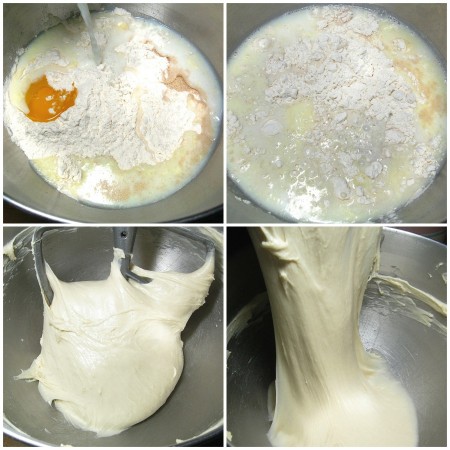
Place the following into a mixing bowl, or into the pan of your bread machine:
1 3/4 cups lukewarm milk
3 tablespoons butter
1 1/2 teaspoons salt
2 tablespoons granulated sugar
1 large egg, lightly beaten
4 1/2 cups (19 ounces) King Arthur Unbleached Bread Flour
2 teaspoons instant yeast
This is going to be a very soft dough, so you’ll need to treat it a bit differently than most yeast doughs. If you have a stand mixer, beat the dough using the flat beater paddle until it starts coming away from the sides of the bowl, and is satin-smooth and shiny; this will take about 5 minutes at medium-high speed. When you lift up the beater, the dough will be very stretchy.
If you have a bread machine, simply use the dough cycle.
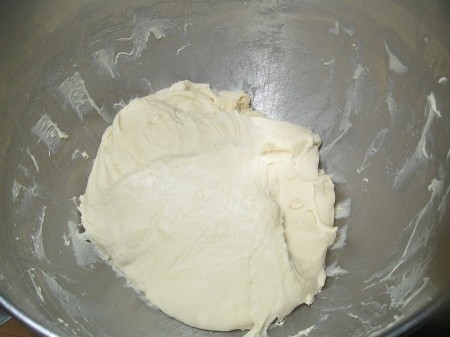
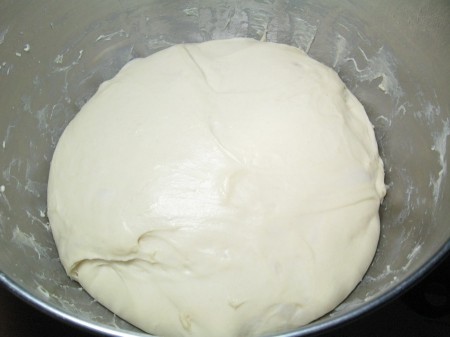
Scrape the dough into a rough ball, and cover the bowl. Let the dough rise until it’s nice and puffy…
…like this. It’ll take 1 to 2 hours or so.
Next, prepare your griddle(s).
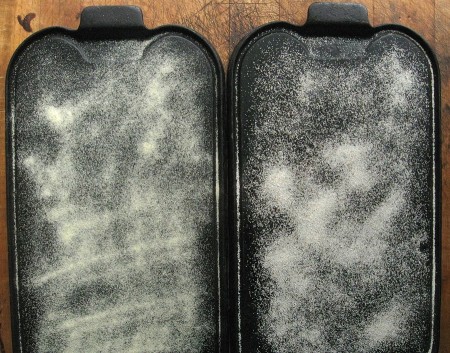
I’m fortunate to have two large cast iron griddles; each one stretches over two burners on my stove.
To give the muffins their signature crunchy crust, I sprinkled one griddle with semolina, one with farina (e.g., Cream of Wheat). I wanted to see which, if either, became less charred as the muffins cooked. And the answer is – no difference, use either.
Using two griddles allows me to cook all the muffins at once; but most of you probably won’t have two griddles, so you’ll need to cook the muffins in shifts. Whatever you use – an electric griddle, stovetop griddle, frying pan, electric frying pan – sprinkle it heavily with semolina or farina.
If you’re using a griddle or frying pan that’s not well-seasoned (or non-stick), spray with non-stick vegetable oil spray first, before adding the semolina or farina.
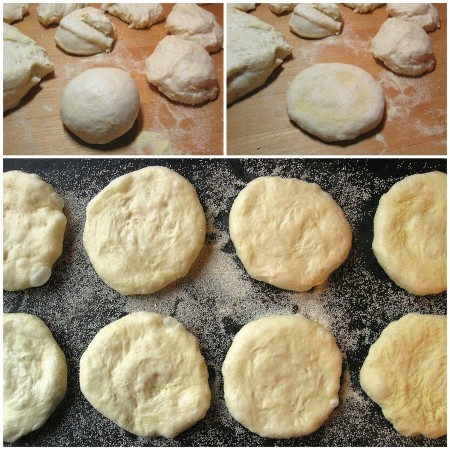
Divide the dough into 16 pieces. Shape each piece into a smooth ball, then flatten the balls until they’re about 3″ to 3 1/2″ in diameter.
The easiest way to handle and cook these muffins is to lay them right onto the surface you’ll be frying them on – in my case, the two griddles. That way, you don’t have to move them once they’re risen.
If you can’t do this, sprinkle a baking sheet heavily with semolina or farina, and place the muffins on the sheet; they can be fairly close together.
Either way, sprinkle the tops of the muffins with additional semolina or farina.
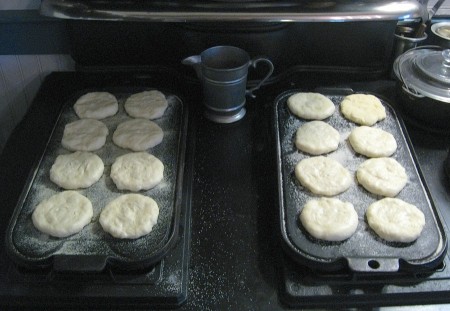
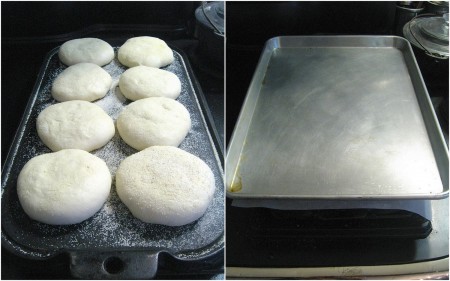
Here are my two pans of muffins, already atop their (unlit) burners.
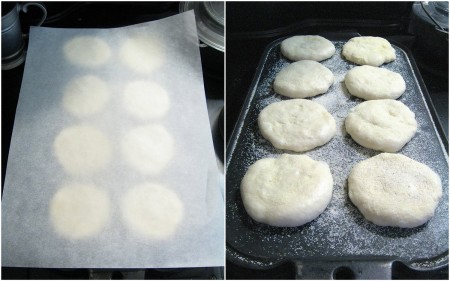
Cover the muffins (a piece of parchment works well), and let them rest for 20 minutes. They won’t rise like crazy, but will puff a bit.
Now comes the somewhat tricky part: cooking.
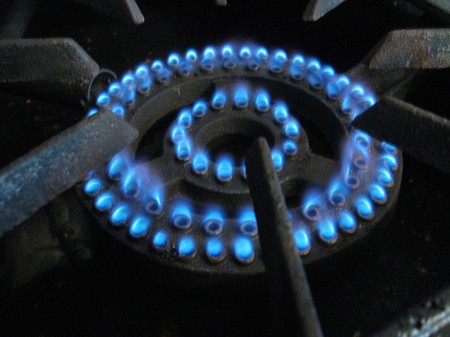
You need to find the exact amount of heat that’ll cook the muffins all the way through and brown them perfectly – simultaneously.
Cooking the muffins for about 15 minutes per side over VERY low heat worked well for me. But, unless you have two large griddles, this long cooking time may become problematic, as the muffins waiting to cook could over-rise and become fragile.
The solution? Slightly higher heat and a quicker cook on the stove (say, 7 minutes per side), followed by a short bake in the oven.
If you find your muffins are browning too quickly, turn the heat down. If they’re already as brown as you like, but still not cooked through, don’t panic; you’ll be able to finish them off in the oven.
But I’m getting ahead of myself.
Within a few minutes of when you’ve begun to cook the muffins, they’ll start to puff dramatically.
You want English muffins, not dinner rolls, so weigh them down gently to prevent further rising. A piece of parchment atop the muffins, and a baking sheet atop the parchment, works perfectly for me.
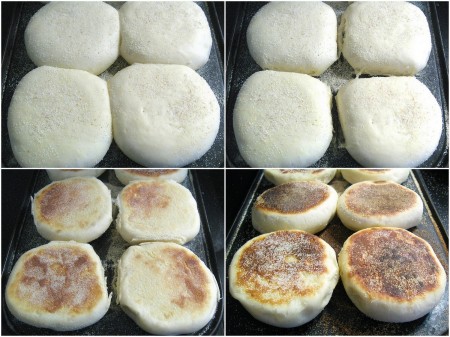
If they run into one another as they rise, simply use a sharp knife to gently cut them apart and separate them.
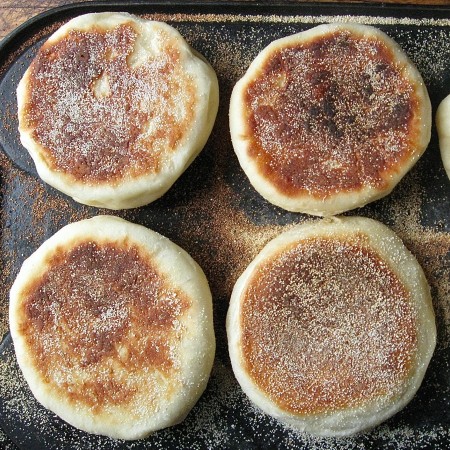
Bottom left, the muffins after they’ve been flipped over. Bottom right – I flipped them again, and it looks like they’re done.
Let’s see. REALLY nice crust, eh?
As you can see, the farina/semolina burned on the pan, but not on the muffins – score!
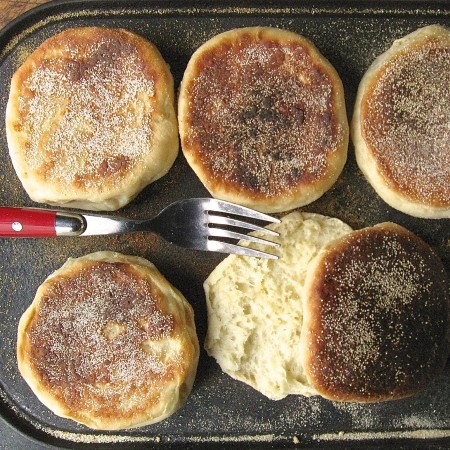
Let’s check the inside.
Hmmm, the edges look good, full of nooks and crannies; but the center is a bit doughy.
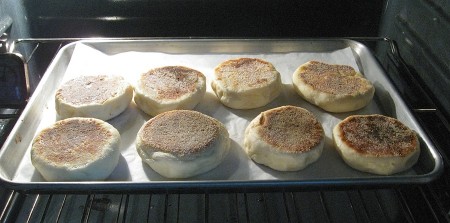
Into the oven they go – 350°F for about 10 minutes should do it.
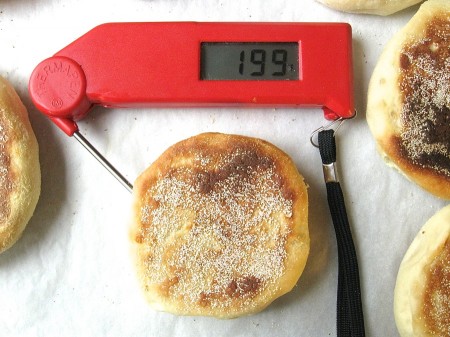
You want the muffins’ centers to register right around 200°F on your digital thermometer.
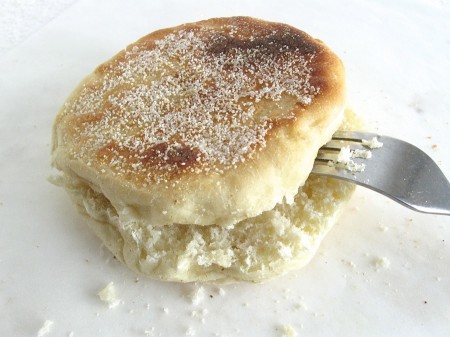
Let the muffins cool thoroughly before enjoying.
And remember: use a fork to split, not a knife to cut. Fork-split muffins will have wonderful nooks and crannies; knife-cut ones won’t.
Even easier – use an English muffin splitter. If you eat a lot of muffins, you’ll really appreciate this handy tool.
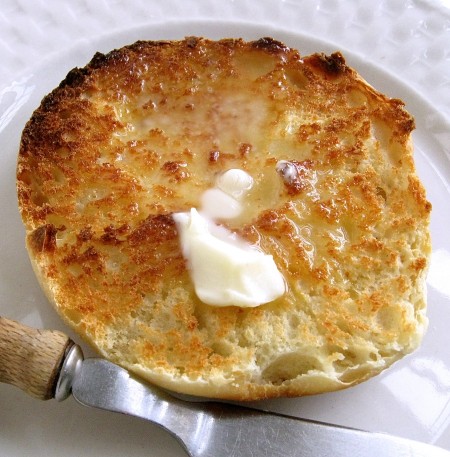
See? Is that one good-looking homemade English muffin, or what?
Move over, Thomas! Just like Jimi Hendrix did with Bob Dylan, we DIY-ers have got you covered.
Read, make, and review (please) our recipe for English Muffins.

Print just the recipe.


January 23rd, 2013 at 7:31 am
I have a recipe that was in the box when I bought 8 muffin rings. It makes only 8 but that’s enough for me. Mine have a rising period with half the flour and after they rise, add the rest of the flour and some butter. What I like about the recipe is that when you add the sticky batter to the rings and let them rise again, they can be popped in the over till they are golden. Very easy and they taste very good to me. I do like the rings as they are all the same size and I’m not very good at measuring out neatly.
The muffins look just like your last picture when buttered.
January 23rd, 2013 at 12:28 pm
Among small breads English muffins are one of my personal favorites. But I have never tried making my own – because I don’t have the rings. (Well, I might have tried using tuna fish cans – improvising as inspired by Mrs. Child. But it must have been very long ago if I did.)
It’s amazing how tempting, and beautifully shaped, these DIY English muffins turned out in the pictures! The baking part does seem tricky. I need to go over the steps again to figure out I could adapt these in my kitchen. So thanks, PJ and company, for this and all the great posts!
Some posts are quite foreign to me, like gluten-free baking. But these days I have met more people who said they want to try taking in less gluten in their diet, though they don’t necessary have medical reason to do so. I am glad that I could refer them to find GF recipes at the KAF site.
For me I love those posts highlighting a local favorite – for example, recently, Pamela’s pancakes. Keeping cloning those legendary goodies! It’s the next best thing short of being there. Thanks so much.
Anne, thanks so much for your kind words; we really enjoy sharing all our “finds” with readers like yourself. As for the English muffins, frankly, I couldn’t believe they came out looking so good, either! I’d never made them without rings before, but this recipe is really easy; it does take a bit of tinkering to find the best combination of low heat, timing, and perhaps a short finish in the oven, but it’s an interesting process and the end result is yummy. Hope you give them a try sometime – PJH
January 23rd, 2013 at 1:31 pm
I use the recipe on the English Muffin ring box, only it normally makes 9 English muffins. I have a large biscuit cutter the same size as a ring to use for the ninth muffin. I like baking them, I”ve never tried frying them as they all cook at the same time and don’t have to be watched.
I also do whole wheat English Muffins and Banana English muffins.
Wow, banana English muffins – there’s an interesting (and yummy sounding) concept, for sure. Thanks for the tip about the biscuit cutter/muffin ring – I’m sure others will take you up on that… PJH
January 23rd, 2013 at 9:55 pm
This looks terrific. I can’t wait to try this recipe. Other than timing/heat on the cooking, it’s so much easier than I would have expected.
But a question — the honey wheat English muffin recipe on this site is so much more complicated. Do you think this simpler version could be adjusted with at least part whole wheat flour?
Definitely, Elizabeth – try substituting 1 cup white whole wheat flour for an equal amount of the AP, see how you like the result, then go from there. Good luck – PJH
January 24th, 2013 at 1:12 pm
I adore English muffins, I’m a confident bread baker, but all the homemade English muffins I’ve had did not impress me with their lack of holes and lack of crust. And I DO love kitchen projects – that’s what my blog is all about! Yours are pretty, for sure. And I do make bagels. . . . hm.
I would want whole grain flour in there. For now, I’m going to stick with Thomas’ on sale.
We hope you’ll change your mind and give them a try. You can substitute some of the white flour with whole wheat or white whole wheat.
January 25th, 2013 at 8:15 am
I’m in Spain, so my flour tends to be a bit different but I made these exactly as in the recipe (using a medium egg, as I think ours are larger) and the dough was perfect. I used the lowest setting on electric griddle and shaped only half the dough at first, Then when the they were turned over, shaped the second lot. This worked great, avoiding any possible over proofing. Cooked for the full 15 min on each side.
Perfect, and I’m a Brit!
Thanks for the feedback, Sandra – always nice to hear from you! Glad they turned out, even with the necessary modifications – PJH
January 25th, 2013 at 12:15 pm
I made these the other day tossing in some of my throwaway sour dough starter – yum, best ever – I haven’t found the need to use rings(yet)…I put my muffin dough onto parchment paper to rise then put the whole sheet in my electric skillet – works for me and they keep their shape – keep those recipes coming – KAF, you are da bomb!!!
We love when our fellow bakers give out brilliant tips and ideas. Happy baking! Betsy@KAF
January 26th, 2013 at 11:27 am
Is it possible to bake these without doing the stove top cooking? And how would I go about doing that if I could?
It may be a better idea to use an English Muffin recipe that is made to be baked!-Jon
January 26th, 2013 at 12:38 pm
I have been making the sourdough english muffins from the KAF 200th anniversary cookbook for several years now. My husband would never go back to store bought. I have struggled a bit – my dough has always been more dry than the instructions seem to anticipate. I know the consistency now, and moderate the amount of flour and liquid to get a slightly wetter dough. I have never had rings – nor been able to pour the batter. My evolved process follows – and works for me.
I make the dough as directed, with the sourdough fed overnight. After the first rise, I roll my dough and cut it biscuit-style with a large plastic cup that seems just the right size. I cover a baking sheet with Cream of wheat (I used cornmeal at first, but hubby complained about the hard bits). I lay all my cut muffins out on the sheet, cover with plastic sprayed lightly so as not to stick. My flat non-stick skillet is large enough for four at a a time. I do not need to spray the skillet, but after placing my muffins on heat, I actually cover the skillet with the square glass of my electric skillet. Its not air tight, but creates nice steam. That’s 10 minutes on the first side. After 10, I remove the cover, flip the muffins, and cook another 10 uncovered. All on very low (but not lowest) heat of my gas range. I don’t think we’ve ever waited until they were completely cool to sample one! Those in the waiting line will rise a little higher, but remain sturdy not fragile.
Thanks for the great tips!-Jon
January 26th, 2013 at 9:25 pm
I’m so excited for this recipe! I have been combining two of the other English muffin recipes from the website to get the ingredients I wanted to use with the stove top cooking method. I don’t have English muffin rings, so I have been gently rolling out the dough and cutting circles with an upside down drinking glass. This method worked well (and tasted great!) but the muffins sometimes lost the nooks and crannies. I’m going to give this recipe a try tomorrow and see how it comes out! I always make them with half whole wheat flour, I will probably give this a shot as written first to see how it goes. Thanks!
Good luck and be sure to let us know how it goes. ~ MaryJane
January 27th, 2013 at 1:58 am
I’m curious about the temperature of the griddle. I have an electric griddle and ‘low’ and ‘slightly higher’ aren’t very precise. And the recipe itself said nothing about temperature. Any idea of the temperature for those using electric griddles so there’s no guessing involved?
I usually do mine between 350°F and 375°F. You may have to fiddle a bit to find the best temp on yours. ~ MaryJane
January 27th, 2013 at 4:25 am
I make homemade English muffins because I live in Italy and miss my American breakfast. Yours look great, mine not so great, I will try again and again! Thank you for this recipe.
You’ll have to throw a big brunch, with all the tastes of home. ~ MaryJane
January 27th, 2013 at 8:29 am
These look so delicious. I do have a griddle so I will try them. I have never thought to make my own english muffins. Order from Wolfermanns as a treat from time to time. Thank you.
I’m so glad you’ll give these a try, I’m sure you will be thrilled. ~ MaryJane
January 27th, 2013 at 9:29 am
I want to try this using an electric griddle. Any tips on what temp to use?
I usually do mine between 350°F and 375°F. You may have to fiddle a bit to find the best temp on yours. ~ MaryJane
January 27th, 2013 at 6:53 pm
I use about 2 teaspoons of dried milk which gives me that nice coloring on the bottom. I also use a frying pan, to cook them, but finish them off in the oven (Just to be safe). They make an incredible looking and tasting english muffin.
Good tip about the dry milk – thanks so much for sharing. I’d love to see a picture of your muffins sometime – when we redesign this blog, I’d surely like to have it include the capability for readers to post their own photos… PJH
January 29th, 2013 at 4:28 pm
Fork-split is the only way to go. I learned this from a British gentleman, RH Bertram Hole, when i was a young boy visiting his gandson. It maximizes the surface area for butter, your favorite spreads, etc.
January 31st, 2013 at 1:05 am
Having piping hot English Muffins ready on a Sunday morning for my wife when she wakes up is always a good way to start the day
I’m wondering about putting the dough together the night before and letting it rise in the fridge. I’d think I’d reduce the yeast to around 1/4 to 1/2 teaspoon? What do you think? Any other tweaks you’d make?
The dough can rest in the fridge overnight, but you will not need to adjust the yeast amount. ~Amy
February 5th, 2013 at 12:18 pm
The dough was a little tricky to deal with as I do everything by hand, but apparently I did ok because these were awesome! I made the dough the night before and let it rise in the fridge for about 12 hours. I used an electric griddle set to 350, cooked the muffins for about 7 minutes a side and put them in a 350 oven for 8 minutes. I was so tickled with how they actually looked like English muffins. My friend wondered why I was bringing her a random bag of them before I said I had made them myself. Everyone was impressed!
Good for you, taking the leap. Now, how will you ever go back to store-bought? The answer is … you won’t have to! Enjoy! ~ MaryJane
February 8th, 2013 at 12:43 pm
I love the English Muffins made at home. I use sour Dough to make mine and I have baked and cooked on the griddle. We prefer the griddle! Has anyone completed a nutritional analysis for this recipe, or have an idea of the carb count? I am a diabetic who loves bread and I have to count my carbs carefully!
I am sorry to say that we do not have this information available to us. However, a nutritional calculator is a great tool to help determine this. One that we like can be found here: http://recipes.sparkpeople.com/recipe-calculator.asp -Jon
February 8th, 2013 at 2:01 pm
Thank you! I thought I would ask. I love the way The Baking Sheet gives all the nutritional inflormation.
February 8th, 2013 at 6:30 pm
I’m assuming you can toast after they’d baked
You certainly can! Just make sure to wait until their are cool before doing so.-Jon
February 9th, 2013 at 12:03 pm
Two questions: Can I use KA AP flour instead of the bread flour? Can I freeze these successfully – otherwise I’ll be as big as a house if I eat all of them? :-}
Thanks
AP flour will work fine, also the muffins freeze very well!-Jon
February 9th, 2013 at 3:56 pm
Thank you, Jon. I don’t have room to keep buying/storing different bags of flour.
I look forward to making these english muffins!
February 10th, 2013 at 11:42 am
Just made these yesterday following recipe and process. Amazingly perfect!! Crispy outside. Fork split nooks. And I don’t consider myself a bread maker.
I think you can now! Great job! Kim@KAF
February 11th, 2013 at 8:36 pm
They are delicious! I haven’t bought English Muffins for a while because I thought they had an odd taste which was probably the preservatives. I made these today using KA bread flour and whole wheat flour from a local farm. I used 1 cup (4 3/4 ozs) of the whole wheat (measured it then weighed it since it wasn’t KA) and added enough bread flour to make the 19 oz specified in the recipe. I ended up adding almost another whole cup of bread flour because the dough didn’t leave the sides of the bowl and was really sloppy with the original amount. I used my electric griddle and because I had them, 8 rings. I did have to fiddle with the temperature. The first batch got too dark on the bottom and weren’t quite done in the middle so they went into the oven. I lowered the griddle temperature for the second batch which browned nicely but went into the oven too. 10 minutes at 350° was just right. Next time I’ll use more whole wheat flour and might underbake them slightly since the toaster made the bottoms ultra crispy. By the way, Cream of Buckwheat worked very well instead of semolina or Cream of Wheat neither of which were in my pantry.
Thanks for sharing the “action research” from your kitchen! We’re glad you discovered what works best for you, both with the ingredients and the method of baking these treats. Happy Baking – Irene @ KAF
February 12th, 2013 at 1:39 am
The dough was as described above, stretchy and smooth and shiny and looked exactly as in the photos above. . . and was the most difficult dough that I have ever worked with in more than 20 years of baking. It stuck to everything, my fingers, utensils, plastic wrap, silicone spatulas. . . and was very difficult to scrape off.
What I learned: 1.) Use lots of flour in shaping the muffins. 2.) Forget about the parchment covering during the 20 minute rest. The parchment sticks to the dough. Instead, dust really well with flour and cover with plastic wrap. 3.) Don’t use parchment/baking sheet on top during baking. The parchment sticks to the muffins (no matter how much flour is on top), and the weight of the baking sheet compresses them to flat disks. 4.) Instead, once the muffins start to rise, just use fingers to pat them down gently in the center. 5.) After those changes, they can end up looking like the ones in the photos above.
6.) Go back to the dough in muffin rings method.
Wow, what a waste of an afternoon.
We feel your frustration, gentle baker. Know that using more flour in the dough or shaping the english muffins will likely result in a more even texture/sandwich-like interior, while working with that sticky dough and shaping with wet hands will result in a more hole-y interior. The key is doing what you are comfortable with so the journey or process is fun, not frustrating. We hope you try making english muffins again now that you’ve taken this recipe out for a test drive. Irene@KAF
February 14th, 2013 at 10:32 am
Due to time restrictions , i made the dough in the evening and refrigerated it overnight for a retarded rise . Shaped and grilled the muffins the next morning ,and they were wonderful ! I also substituted Honey for the sugar . As to the stickiness of the dough , anyone who has made ciabatta will have an easier time working with this recipe . Don’t give up !
March 4th, 2013 at 9:52 am
Has anyone tried this recipe using your gluten free flours? I’m a professional pastry chef and a very skilled baker. I bought rings to try English muffins but am researching recipes now. I’d like to know if you’ve had any experience doing these gluten free. Thanks.
Yes, our GF blogger Amy did a great blog on GF English muffins. Hope you find it helpful! ~ MaryJane
May 13th, 2013 at 4:34 pm
I made these for the third time today…not quite satisfied. First batch came out good made as following recipe except used cornmeal for sprinkling the griddle pan. I found cornmeal burned if not watched carefully. Every one still loved them. Second batch was made with whole wheat white flour. I think I got the batter too dry. But my husband still thought they were the best he ever ate. Today I made them with 2 1/2 cups AP flour and 2 1/4 white whole wheat flour…the batter was nice and sticky…and rose very well. Baked them on my one griddle 8 at a time on semolina flour…on cold griddle took 16 min on first side and 7 on second..and just to be sure baked them in 350 oven for 10 min til 200 degrees. second batch on warm griddle took only 7 min to brown on first side and 7 min on 2nd side. and 10 min in oven. They rose well and came out beautiful. I use semolina for sprinkling the griddle. Worked much better. I am going to try again using all whole wheat, and watching that I don’t get the batter too dry. My only complaint is how do you get them even in size. I tried dividing the dough..but some are larger than others..not too bad but maybe I should weigh the pieces. Any ideas?
Yes, if you really want each piece to be as close as possible in size, you should weigh out the total batter, then divide it up evenly. ~ MaryJane
May 13th, 2013 at 4:37 pm
I dusted my hands with semolina flour while shaping muffins. Seem to cut the stickyness.
June 8th, 2013 at 10:45 am
I’m so glad I tried this recipe! I modified it just a bit: I used warm water (and proofed the yeast in it) plus buttermilk powder instead of regular milk. I let the dough rise on the counter for an hour, then put it in the fridge overnight. This morning, while the dough was still cold, I formed the balls. I let them warm up before frying on the griddle, with a finish in the oven. I ate one right out of the oven…no way I could wait till it cooled. I think I’ll be making an egg sandwich with one for lunch. I’ll never buy english muffins again!