

Did you know the original Toll House cookie was called a Chocolate Crunch Cookie?
Back about 80 years ago, when this signature American cookie first saw the light of day – at the Toll House Inn in Whitman, MA – there was no such thing as chocolate chips.
Legend has it that Ruth Wakefield, the inn’s proprietress and head chef, ran out of chocolate for her chocolate cookie recipe one day, and added a chopped Nestlé’s semisweet chocolate bar to her sugar cookie recipe, hoping it would melt and turn the cookies chocolate.
Well, that didn’t happen; the chopped chocolate remained intact. And thus was born an American classic: the chocolate chip cookie.
Another take on the cookie’s origin comes from George Boucher, a chef at the Inn who claimed that the vibrations of a mixer stirring up a batch of sugar cookie dough caused a bar of Nestlé’s chocolate to fall into the mixing bowl, where it broke into chunks. Rather than discard the dough (as Boucher said Wakefield wanted to do), he baked it into cookies. Birth of the chocolate chip cookie, version 2.
By 1939, the recipe had been printed in a number of New England newspapers, and the cookies’ popularity was growing by leaps and bounds. After experimenting with scoring its chocolate bars so customers could easily break them into bits, Nestlé came up with a new product: “chocolate morsels,” a.k.a. chocolate chips.
Ruth eventually sold her recipe to Nestlé’s in return for a lifetime supply of semisweet chocolate; and the familiar yellow bag of Nestlé’s chocolate morsels has included a variation of that recipe ever since.
So, with all of the hundreds of chocolate chip cookie recipe variations and stories out there (remember the apocryphal $250 Neiman Marcus cookie tale?), there’s something both exciting and comfortable about finding the original recipe – and baking it.
Come along with me as we bake Ruth Wakefield’s Chocolate Crunch Cookies – just as she did at the Toll House Inn.

Did you know that by clicking anywhere on this block of pictures, you can enlarge them to full size? Go ahead, give it a try; it'll work for any of our photos.
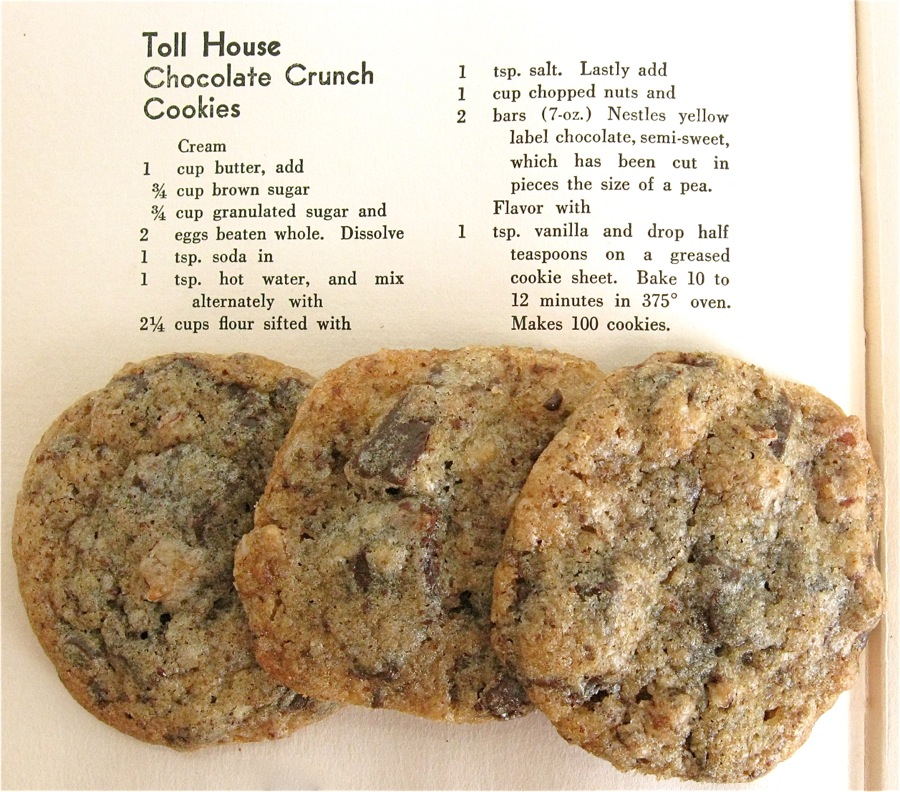
Ruth calls for “2 bars (7-ounce) Nestlé’s yellow label chocolate, semi-sweet, which has been cut in pieces the size of a pea.”
Easier said than done! I used two of a competitor’s bars (6.8 ounces each – close enough), and thought I’d just use my handy bench knife to chop them up.
Way too difficult.
Next, I whacked each bar vigorously with a rolling pin, hoping it would break into tiny (pea-sized) pieces.
No dice.
The rolling pin did, however, crack the bars into irregular shards – which I then chopped into smaller pieces with the bench knife. Some were smaller than peas, but most were larger.
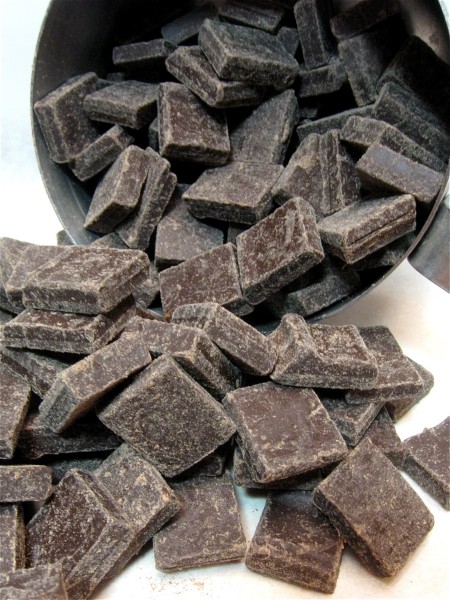
Next time, I think I’ll just stick with my favorite semisweet chocolate: Peter’s Burgundy Chunks, which comes in handy little squares. Perfect!
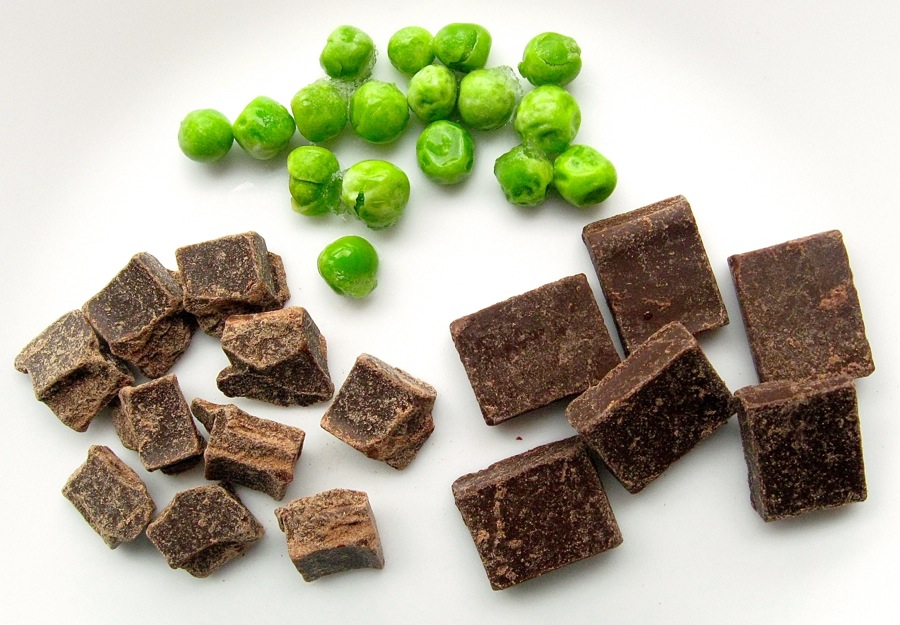
Or, if you want to get closer to “pea-sized” – our Callebaut semisweet chocolate chunks (left; Burgundy chunks are on the right) are even closer to Ruth’s suggested size.
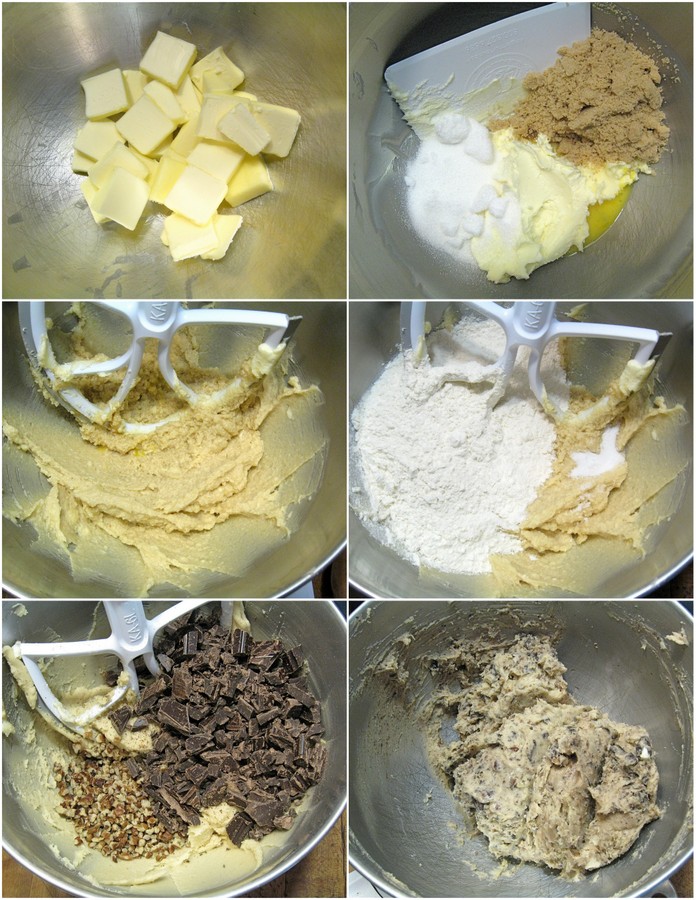
Next, cream 1 cup butter, then add 3/4 cup each brown sugar and granulated sugar, along with “2 eggs beaten whole”.
Once those are thoroughly mixed, dissolve 1 teaspoon baking soda in 1 teaspoon hot water, and “mix alternately with 2 1/4 cups flour mixed with 1 teaspoon salt.”
I confess to diverging from the recipe directions here. Mix a teaspoon of water/baking soda into the dough alternately with a couple of cups of flour?
Phooey on that; I just added the baking soda in water right along with the flour, and mixed it all up into a soft dough.
By the way, rumor has it (and we believe) that Ruth used King Arthur Flour at the Toll House Inn. After all, it makes sense; King Arthur was New England’s local flour back then. So, make sure to use your King Arthur Unbleached All-Purpose Flour when you bake these cookies!
Next, add 1 cup chopped nuts and the chopped chocolate, along with 1 teaspoon vanilla.
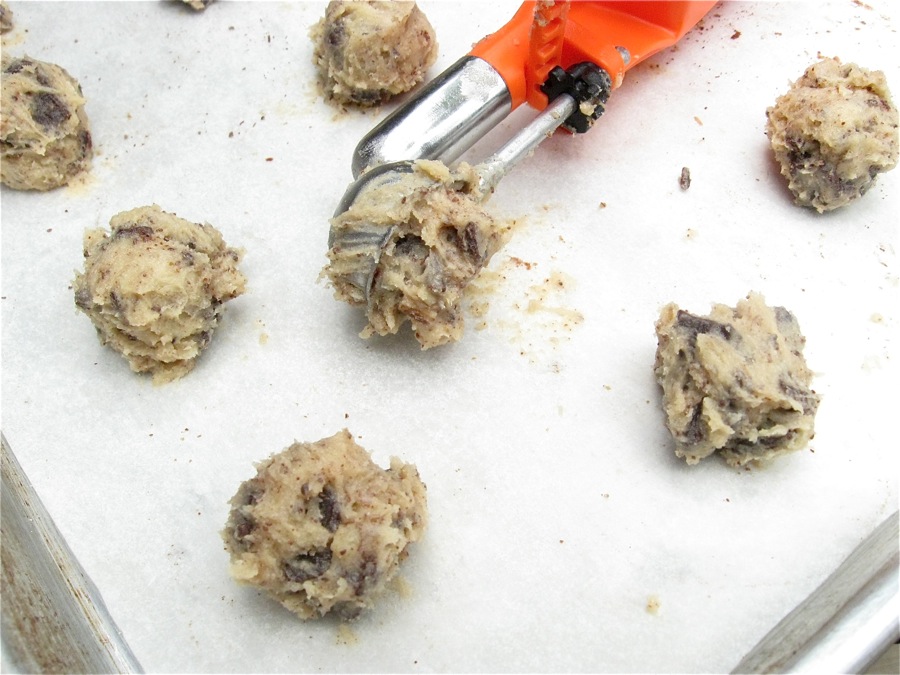
OK, the dough’s finished. Ready to “drop half teaspoons on a greased cookie sheet.”
Rather than greasing the sheets, I lined them with parchment – the cookie baker’s BFF.
BFF #2? My teaspoon cookie scoop, a very helpful tool for this sticky dough.
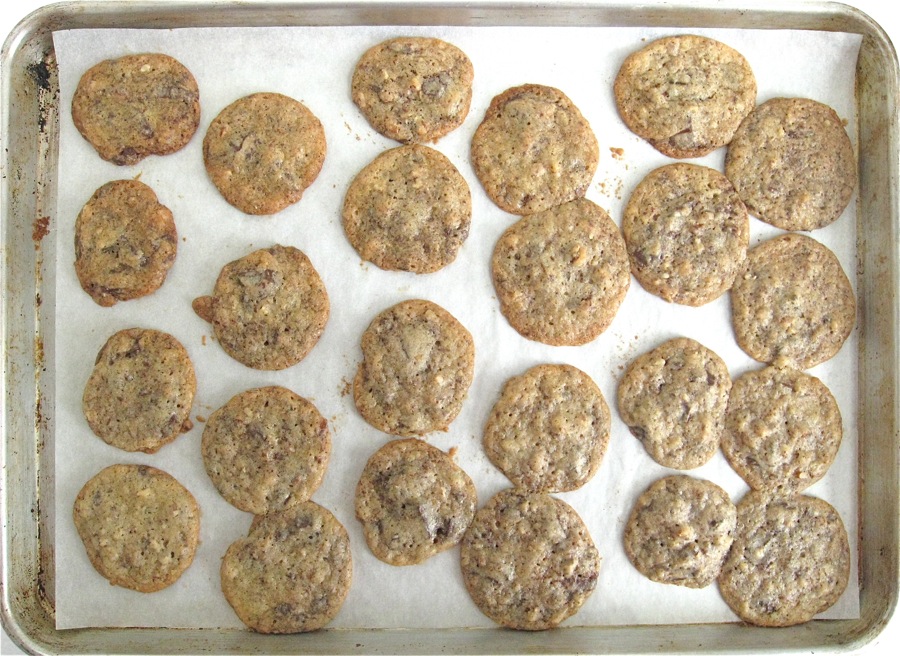
“Bake 10 to 12 minutes in 375°F oven. Makes 100 cookies.”
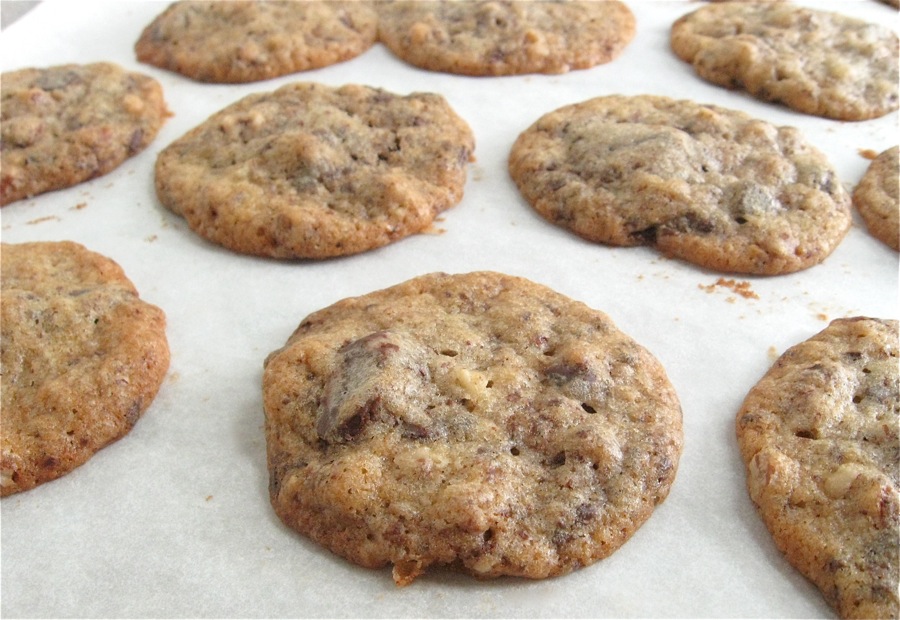
The cookies did indeed bake nicely at that time/temperature, though I only got 92 – but who’s counting, right?
Speckled from the finely chopped bits of chocolate, lumpy from the bigger chocolate chunks and the nuts, these cookies don’t win the Miss Chocolate Chip Cookie USA beauty pageant.
But tasty? Suffice it to say, I can see why this recipe spread around the country like wildfire back in the day.
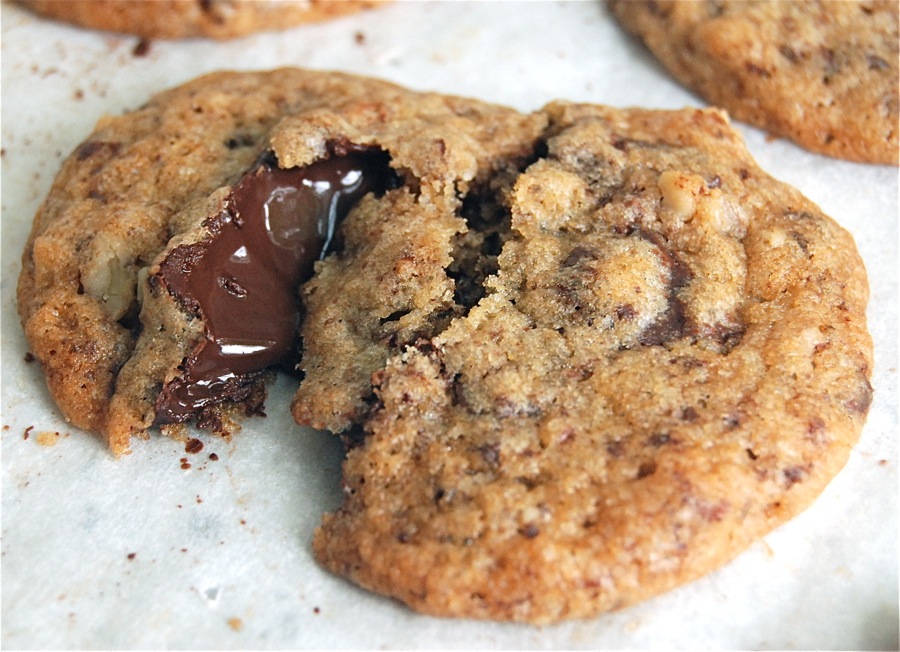
Buttery and vanilla-y, with the occasional big chunk of melting chocolate, these chocolate chip cookies are exactly what they’re supposed to be:
Toll House Chocolate Crunch Cookies – the Original Chocolate Chip Cookie.
Whatever the real story – we’re SO glad that a Nestlé semisweet chocolate bar found its way into Ruth Wakefield’s sugar cookie recipe!
Here’s a warm-from-the-oven cookie made with chopped-up chocolate bar. BIG melting chunks.
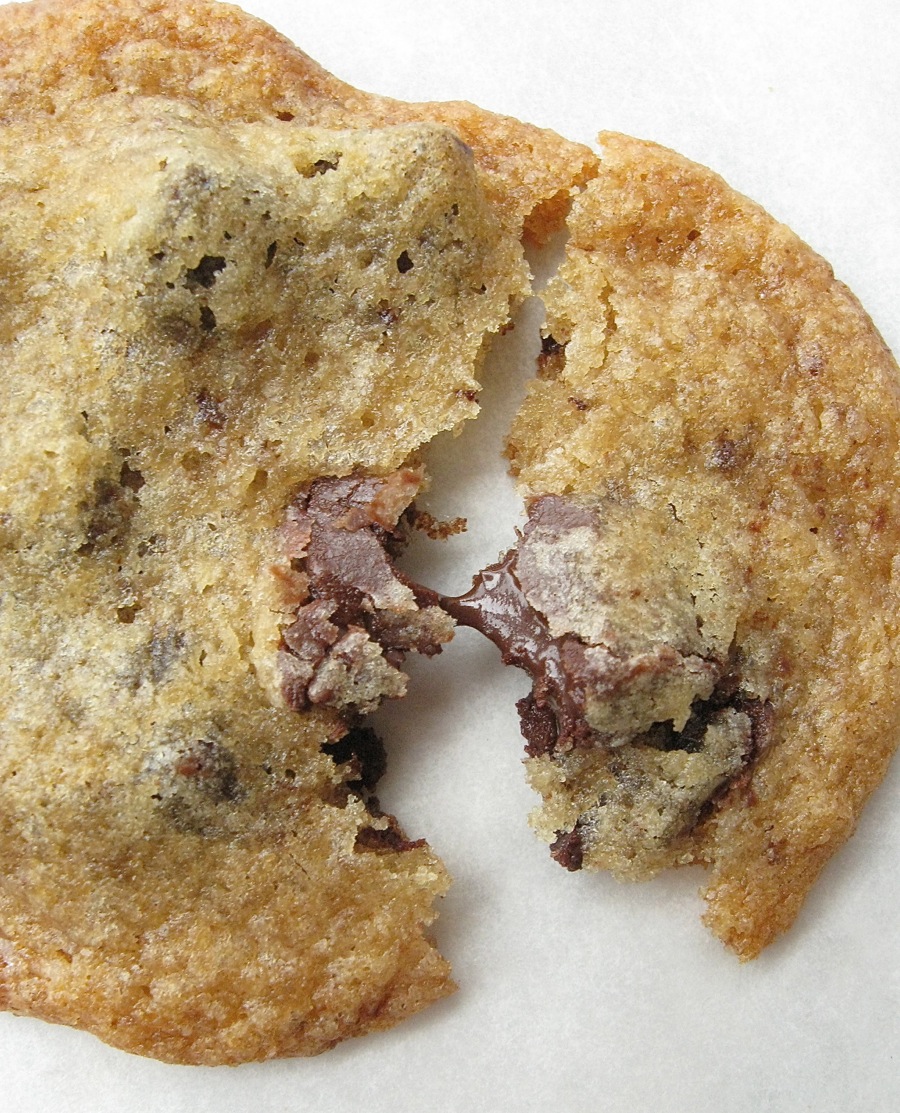
And here’s the same cookie using the smaller (Callebaut), more uniform chunks.
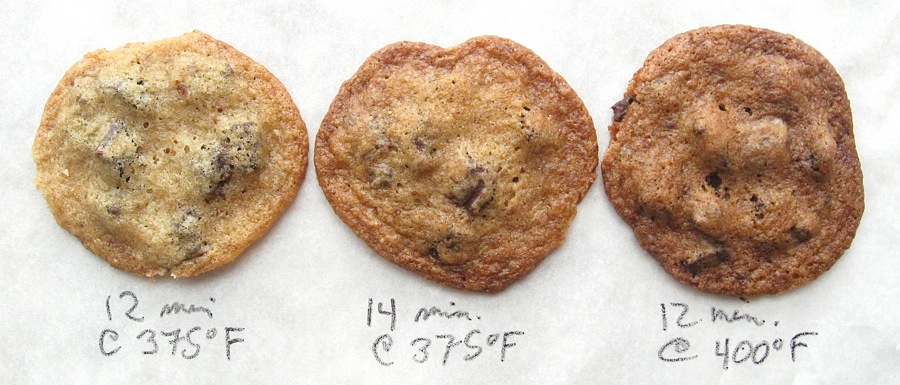
Finally, here’s the same batch of cookies baked three slightly different ways, for three different textures/flavors. Note: all three were baked on a light-colored cookie sheet lined with parchment. If you bake on a darker sheet without parchment, reduce the time by about 2 minutes.
Want a soft/chewy cookie? Bake for 12 minutes at 375°F.
For a crisp/crunchy cookie, increase the time to 14 minutes.
For a dark, crisp cookie with caramelized flavor, bake for 12 minutes in a hotter, 400°F oven.
Note: That’s right, there’s no recipe link here; please follow the recipe in the photo above.



February 5th, 2013 at 1:52 am
So glad we have ready-made chocolate chips in this modern time–chopping all that chocolate (especially for restaurant-size batches) is WAY too much work!! I wonder if freezing the chocolate and THEN whacking it might shatter the chocolate more easily….
Julia, I tried freezing; it actually was a bit harder, as I had to whack harder, and the result wasn’t any better. I think cooks back then were just used to dong a lot more work; plus, that’s why they had “kitchen maids…”
PJH
The trick I learned when tasked with chopping large slabs of chocolate: use a large serrated knife! It cuts into the chocolate without slipping like regular straight-edges knives. The drawback? You create more shards and flakes of chocolate than nice, square pieces. For candy-making, you can’t beat it. For cookies, best to go with either ready-made chunks or whack a thin bar of chocolate as PJ did! Best, Kim@KAF
February 5th, 2013 at 11:34 am
My Nana used to make these all the time. Now my Mom makes them. It’s that tsp of water and the baking soda! I have so many wonderful childhood memories of waiting for my Nana to come up the long driveway in MA when she and my Gramps would drive for NYC to come visit us with her tins of chocolate chip cookies, oatmeal raisin and tin foil wrapped bricks of lemon squares and brownies. I still have the tin she used to put her chocolate chip cookies in. I think it might be time to teach my boys the “secret family recipe.”
I remember too that episode of Friends when Monica begs for Phoebe’s secret family recipe and it’s the Toll House Recipe!
I know that episode, too! Yes, this is also one of the first cookie recipes I knew when I was little. Thank you for sharing! Kim@KAF
February 5th, 2013 at 11:53 am
A comment and a question:
Comment: I’ve had excellent luck chopping chocolate bars with my heavy Chinese cleaver. If I’m going for chunks of a specific size, I can carefully chop across the bar (as you attempted with the bench knife, but I think the cleaver gives some extra weight and sharpness) and I’ll get chunks of approximately equal size without too, too much of the shredding problem.
Question: This is the first cookie recipe I’ve seen that calls for dissolving the baking soda in water. Is it an anachronism from the days when baking soda was, perhaps, unreliable and needed to be “proofed” or lumpy and needed to be broken up? If I understand aright, dissolving the baking soda in water will reduce it’s raising power up-front (but maybe give it a small increase in the oven if it’s double-acting?) Does this step make the cookies flatter? Or is the baking soda just there to improve browning and not doing much for leavening at all?
Yes, it seems to be a hold over from the ‘olden days”. These days you would not need to take this step, PJ was just staying true to the original recipe. ~ MaryJane
February 5th, 2013 at 11:54 am
I have a 6-tine chocolate chipper that I use for breaking up big slabs of chocolate. (I think it was originally intended for use as an ice chipper.) I think I bought it from KAF but I’m not sure you still sell it. It’s a sturdy beast but way overkill for chipping small bars.
The folks in Ruth Wakefield’s days didn’t have TV or video games or computers so I guess chipping chocolate was a form of entertainment for them.
It’s strongly possible, Julia! As for the chipper, we do still carry one: Item 6066. Kim@KAF
February 5th, 2013 at 12:02 pm
You talk about cooking with light and darker colored pans with parchment. I use a stone. What would be the difference in temperature and texture? I love my stones. And now that it is seasoned well, they do not stick! Thanks for your help!
Not knowing which stone you have, you may want to check the manual or instructions that came with them to see what they recommend for temps and times. Susan in the test kitchen is also a big proponent of baking one or two cookies at different temps and for different times to get your “perfect” cookie. ~ MaryJane
February 5th, 2013 at 12:06 pm
Thanks so much for posting this! I grew up in the town of the original Toll House. I was saying not too long ago that its a shame that the town doesn’t get more recognition for the birthday of an American favorite. Even a Toll House branded shop. Now all that remains of the restaurant that burnt down in the ’80′s is a condo complex bearing it’s name.
Come on Nestle, jump on this bandwagon!
Hmm, I just can’t picture the Toll House Apartments, not nearly as romantic and wonderful as the original Toll House. ~ MaryJane
February 5th, 2013 at 12:21 pm
Big old chef’s knife or bread knife and not cold chocolate! I loved this recipe for the longest time and have it written down somewhere – the one with the water was the only true original for me. I heard that Ruth used to refrigerate her dough overnight before baking. Maybe where that 36 hour recipe got its start?
Could be…I’m guessing it might have been for scheduling purposes too. Prep on Monday, bake on Tuesday, rest on Wednesday? ~ MaryJane
February 5th, 2013 at 12:25 pm
I put the chocolate bar in a ziplock bag and whacked it with a rolling pin to get my chunks. They are not uniform, but small enough for what I wanted!
February 5th, 2013 at 12:41 pm
I noticed the cup of butter you creamed was cut into pieces (tablespoons?) Do you always do this instead of just putting the whole stick of butter in the bowl? Also, how long do you leave butter at room temperature when a recipe calls for ” [so much] butter, softened”? I would lthink it would soften faster if cut into pieces rather than left as a whole stick. I find that if it’s too soft initially, the cookies spread way too much when they’re baked. Love your blogs–the pictures and explanations are SO helpful! Thank you for all you do!
HI Carol,
To soften the butter, it is helpful to cut it up first. More surface area, don’tcha know. I’d say soft butter should take between 15-25 minutes depending on the temperature of your kitchen at the time. It should just leave the impression of your finger when you press down. If your finger can’t press down at all, it is too cold. If it sinks in past your fingertip, it is too warm. Hope this helps! ~ MaryJane
February 5th, 2013 at 12:47 pm
I wonder if you have a high altitiude version of this recipe? I’m at 8000ft.
HI there,
You’ll find our handy-dandy high altitude baking chart online. It will help you know what to change, how much and why. ~ MaryJane
February 5th, 2013 at 12:49 pm
Thanks for putting the original recipe, I remembered we always put the soda in water first and now you never see it. What was the reason? To make sure it was active?
Hi Sue,
Most likely bakers would have been testing the soda, and also dissolving it at the same time. I’m pretty sure I remember reading that soda and powder were much coarser in texture early on. ~ MaryJane
February 5th, 2013 at 12:53 pm
So, carefully following the original recipe, the first thing you did was to NOT use the original chocolate (which I am certain is not the same as it was 80 years ago anyway),
~ MaryJane
Then proceed to change the mixing directions, and finish by choosing a
different baking surface and cookie size. And likely, a different type of oven entirely.
THAT’S MY KIND OF BAKING.
You did not however, deviate from the most important elements.
King Arthur Flour, and any good chocolate.
And for those of us that regularly bake this way, THANK YOU FOR THE BAKERS” HOT LINE!!!
If it ain’t broke, don’t fix it right? But do feel free to tweak it all over to make it YOURS.
February 5th, 2013 at 1:33 pm
I make these all the time however the recipe I have (that was written down years ago) calls for 2 1/2 cups flour instead of 2 1/4 cups. I find they do not spread as much and make a chewier cookie.
That is how my BFF makes her cookies and I tend to like hers better than mine most days. ~ MaryJane
February 5th, 2013 at 3:40 pm
My family prefers their CCCs to stand up and not spread out all over the place like a lace cookie. I use Crisco instead of butter.
Sandy Patterson
Thanks for sharing Sandy. Lots of folks go the Crisco route, or even 50/50. One notable recipe I saw used bacon fat. Not sure how I feel about that, but it sure is interesting. ~ MaryJane
February 5th, 2013 at 3:40 pm
What is the purpose for mixing the soda with hot water before adding to the mix?
General consensus here is that bakers would have done this to test their soda, and to dissolve it at the same time. Today’s sodas and powders are so much finer, there is no need for this any longer. ~ MaryJane
February 5th, 2013 at 4:07 pm
One of my friends who grew up in PA many years ago told of her mother sharing with her how the cookies were always served socially. When the hostess (or someone who brought the cookies to share) would set the table for guests, the cookies were placed on the radiator to keep warm. She said they were always served warm, not cold. At least that is the tradition she passed on.
Interesting – and totally sensible. I think next time I bring cookies to someone in the winter, I’ll suggest we set them on the radiator while we chat. Who doesn’t love warm cookies? Thanks for sharing – PJH
February 5th, 2013 at 4:16 pm
Loved the article..have you noticed on the back of the Toll House packages there is no water in the recipes. I don’t know the year that they took that out, however, I do know this: my step father made our chocolate chip cookies for years, claiming to have the original back of the package recipe. Mom always said that the water was the one thing that “made” them the original! I see after reading, as to why you would add the water to the baking soda, but always did wonder why they took it out. I still make mine by the original recipe!! Thank you for a great article!
You know what, the original oatmeal cookie recipe on the Quaker Oats box had (does it still have?) a teaspoon of water. I always figured it was there so Quaker could tell if someone was using their recipe without attribution; but now that I see Ruth used a teaspoon of water to dissolve the soda, maybe that’s why Quaker’s recipe had it, too. So interesting how recipes evolve over the decades, isn’t it? PJH
February 5th, 2013 at 4:40 pm
It just so happens that my mother and Ruth Wakefield were class mates at Framingham Normal School (now Framingham State College) and like her, she also became an innkeeper and restaurateur. My mother always talked about the first origin of the cookie which you listed.
I would be quite certain King Arthur Flour would have been used as it, too, was the only flour my mother used in her professional career, which started in about 1924!! I know, the good King has been around far longer than that!
Lucille
Lucille, that’s fascinating; thanks so much for sharing. And thanks to your mother for her loyalty to “the King”! When my husband and I got married, our parents met for the first time at the Toll House – and my sister-in-law later had her wedding reception there. It used to be quite the nice place. Could you share where your mom’s restaurant was? I’m familiar with the South Shore, as I grew up there… PJH
February 5th, 2013 at 5:44 pm
Adding the water to the bi-carb also helps to produce a thinner, crisper biscuit. In our famous Anzac biscuits here in Oz, you can add one or two Tbs of water, more water for thinner and crispier biscuits. I also find that the raising agents also spreads more evenly through the dough when mixed with water, just like using water with salt of hartshorn.
Thanks, Nay – I didn’t know that about crisper. I always figured water made certain cookies harder, but now that you make me think, hard could be translated as crisp if the cookies are thin enough. Thanks for connecting from Oz! PJH
February 5th, 2013 at 10:13 pm
I have been buying 100-gram (3.5 ounce) bars recently because they have been on sale. A bar at 65F chops with little effort into the perfect sized pieces for cookies. Use a chefs knife on a wooden cutting board. Chop into 1/4″ strips and then chop crosswise into 1/4″ chunks. Hold the blade down onto the face of the bar with one hand, and press down the back of the knife with the other hand to prevent slipping, so there will not be too many smaller bits. Takes just a minute per bar and you get the real essence of these cookies.
I don’t know why you didn’t try the knife the first time, i
This is great information, Irene. I know that I prefer to use a serrated knife to chop chocolate. I start at one corner of the bar and work my way in. Elisabeth
Irene, you make it sound so easy that even I should be able to handle it. Thanks for your good feedback. PJH
February 5th, 2013 at 10:21 pm
(continued)
Since the original recipe says to “cut” the chocolate, I wonder why anybody in a test kitchen would think that a scraper or rolling pin would be the way to go. I mean, the moment that the scraper failed, why not re-read the original and just reach for the chefs knife? Isn’t that what naturally comes to mind when a recipe says “cut”?
And have you PJ never taken a chefs knife to a chunk of chocolate? In all your years at KAF? You seem to have missed out on some real basic cooking experience.
You’re right, Irene – I’m not much of a cook. Never been to culinary school, don’t have good knife skills – which is why I chose other methods to “cut” the chocolate. That, and pure laziness! Thought maybe a couple of good whacks would be fast and work well – nope. Oh well… PJH
February 6th, 2013 at 9:00 am
Thank you, thank you, thank you!! My grandmother would host Thanksgiving at her Appleton, WI house for about 50 of us. We came from the East coast, Chicago area, Florida, Colorado and Montana to be with our cousins for a couple of days a year. Grandma would make dozens of chocolate chip cookies for us and I have never been able to replicate the cookies with the current “toll house” recipe. I always wondered what I was doing wrong!!! Now I know…. just a little water to dissolve the baking soda. I used a #50 scoop – probably 1 T. Baked for 7 min. top and bottom rack and voila – Grandma Rose’s Thanksgiving Chocolate Chip cookies. Sweet memories, for sure!! I already emailed the recipe to the cousins……. Thank you again for publishing this recipe!
Ah, so happy to hear you’ve been reunited with your grandma’s recipe, Megan. I love it when we’re able to help make this happen. Enjoy! PJH
February 6th, 2013 at 10:53 am
I just love the KAF site and all the blogs. This one is especially great – show and tell and everything. Never met a cookie I didn’t like! Thanks for sharing the ORIGINAL “Original Toll House Cookies” recipe.
You’re very welcome – always a pleasure to showcase everyone’s favorite cookie! PJH
February 6th, 2013 at 11:00 am
Thank you for the tips on the water and longer baking times for a crispy cookie which is the way I love them. Now whenever I made CCCs they would always turn out chewy. My Grandmother was the superintendent of the merchant marine retirement home Sailors Snug Harbor, Powder Point, Duxbury MA. The cooks at the home (Dorothy and Benny) made the best CCCs and they were crispy. I used to hoard the batch made for me, making them last right up until school started in the fall.
Loved spending the month of July there and visiting with cousins from Cohasset. My Uncle Peter’s family owned Cohasset Motors and he would bring down a jeep from the lot and we would go out riding the dunes at Saquish before setting off fireworks on the sprawling front lawn of the home.
Food and family memories are so strong and enduring – we can honor our forebears by duplicating the foods (and the feelings) with the next generation. Happy Baking – Irene @ KAF
What nice stories, Miss Percy – I grew up next door in Hingham, so of course know Cohasset well, and remember Cohasset Motors. And Powder Point, Duxbury, too – gorgeous! Thanks for the trip down Memory Lane – PJH
February 6th, 2013 at 11:01 am
Lighten up, Irene in T.O.
February 6th, 2013 at 12:15 pm
I have always used a variation that was published in a Good Housekeeping cookbook in the 1940′s. It calls for 2-1/2 cups of cake flour rather than AP flour, replaces half the butter with vegetable shortening, and adds 2 Tbs. water. But the main difference is the baking time and temperature: 19 minutes at 300F. This produces a cookie that is puffy, very light, and crisp rather than chewy. They are delectable when warm, but – even better – they keep perfectly for at least a week (if you can protect them from snackers for that long!).
Thanks for sharing the Good Housekeeping version! Like you, we love to see the results of different ingredients and baking times – Irene @ KAF
February 6th, 2013 at 12:40 pm
KAF – you sure make a lot of people happy and inspire us to be creative in ou kitchen. Much love from your audience. Ruthie.
Thanks, Ruthie – we owe it all to our wonderful customer/bakers who inspire us! Happy Baking – Irene @ KAF
February 6th, 2013 at 4:03 pm
Hmmm….All the difficulty in cutting up the chocolate seems to cast a great deal of doubt on the second “history” of the cookies that says the chocolate fell into the bowl and broke up!
Maybe the chocolate 80 years ago was softer, eh, Sandy? We’ll never know… Or maybe their mixer was super-powerful!
PJH
February 6th, 2013 at 4:26 pm
Another tip for baking any cookie is to bake it in a convection oven if you have it. Turns out crispy on the outside and chewy on the inside, and they don’t get as flat. A perfect cookie!
Wow, I never knew that – thanks for the insight. If I ever get a convection oven, I’ll surely know what to do with it first!
PJH
February 8th, 2013 at 12:16 pm
Microwave the chocolate bar slightly (time depends on the strength of your microwave and the thickness of your chocolate bar- start with 20 seconds) and it will chop much easier.
February 9th, 2013 at 12:38 am
I too grew up in Hingham. My mother and Ruth Graves Wakefield were contemporaries and good friends. She was “Aunt Ruth” to me. There are a couple of vague references in the usual Toll House recipe which need correcting. First, it isn’t just brown sugar that’s used, but dark brown sugar. Aunt Ruth occasionally fortified this by adding a bit of molasses. Second, it isn’t just chopped nuts, as if any species would do. Aunt Ruth always used chopped walnuts. She held that their dry flavor reduced the cloying effect of the chocolate. Finally, she didn’t set out to make cookies, but a sort of brownie. The butter (Crisco is heresy!) made the outcome crisp and the whole baked into one piece, so the cookie was born. by dropping spoonfuls the next time. It was a lucky accident.
What a great accident it was, though! Thank you for providing some excellent clarifications and insight into this recipe. We appreciate the historical accounts we’ve received since posting about these cookies. Happy Baking! Kim@KAF
February 9th, 2013 at 12:02 pm
Interesting comments about CCCs. I find that using butter results in a crisp cookie and Crisco makes a chewy cookie. I often refrigerate the dough overnight. The resulting cookies don’t spread as much. Also, for a taste variation, I use dark chocolate chips and black walnuts.
February 9th, 2013 at 5:21 pm
PJ, it is your being “not much of a cook” and lack of culinary school training that gives many of us permission to have a go at baking. You write so beautifully about the joys (and trials) of baking, and give us all great recipes and tips. I’ll never be able to make an artistic cookie, cake or pie and wouldn’t attempt it, but I love your practical and forgiving approach. My family has learned that if PJ says it will be good, it will. Thank you.
Mary
February 12th, 2013 at 11:22 pm
Thanks for sharing a great old recipe. I have used the recipe on the bag but substituted almond for the vanilla with good results,included the walnuts & think I actually like it better. Seems to give a richer taste if that could be possible! Now I have to make cookies…geez!
So sorry we’ve forced you to make these cookies… I know, life is tough! I’ve added almond, too – just a touch, and people don’t know what the flavor is, but they always like it. I’d absolutely add nuts, too, if any of my family liked them. Thanks for sharing – PJH
March 1st, 2013 at 12:46 am
Thanks for sharing the original recipe ins and outs. I love history and CCC history is the best!! Some have called me the cookie lady and it’s for my CCC! We like a chocolate chip cookie that isn’t crisp but not really chewy either. I follow the recipe as it’s written on the Nestle’s package except I use 2 3/4 cup AP and no they don’t taste floury. Nuts are must. Being a southern girl, I started out using pecans but found walnuts do work out better. I also freeze the dough after scooping them out with a 2 tbsp. scoop. I don’t get 100 cookies!! Cooking time usually runs about 14-15 minutes. I’ve found a stone makes the bottoms too dark for my husband’s taste so I use either an air bake pan with a silicone type liner or a good heavy sheet pan with a liner of some sort. I don’t like to do too many dishes, it gets in the way of cookie eating! Thanks for the blog. I Love reading it and planning my next baking expedition! PS I Love the idea of putting your cookies on the radiator to warm them ever so gently. Makes me hungry thinking about it!
Thanks for sharing your “ccc wisdom” with all of us here – much appreciated!
PJH
April 17th, 2013 at 11:36 am
I have not had success with the Tollhouse ccc recipe in the past and I suspect it is due to how the flour is measured. Do you “scoop” the flour, or “spoon” it into the measuring cup?
We have a full page dedicated to measuring flour. All our recipes are based on the fluff/sprinkle/level method: http://www.kingarthurflour.com/recipe/measuring-flour.html Kim@KAF